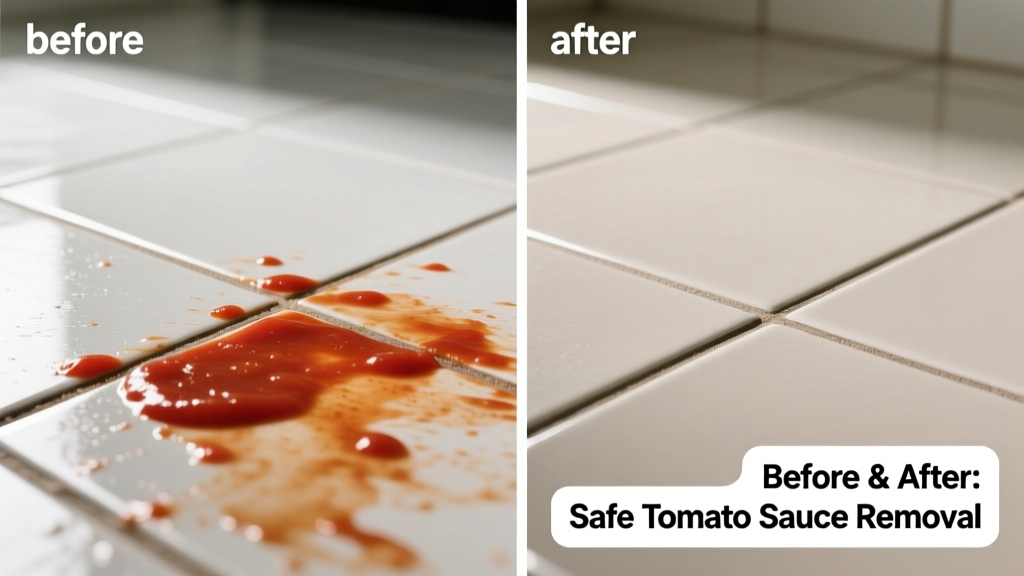
That bright red splatter on your kitchen backsplash or bathroom floor? Tomato sauce is deceptively stubborn—it’s acidic, pigment-rich, and dries fast, especially on porous or grouted tile. The good news: most stains come out fully if treated within 24 hours. Even older stains respond well to targeted, low-risk methods—no harsh scrubbing or bleach required.
What You Need
| Item | Purpose | Avg. Cost |
|---|---|---|
| White vinegar (5% acetic acid) | Breaks down lycopene pigment and neutralizes acidity | $2.50 |
| Baking soda | Gentle abrasive + alkaline buffer for vinegar reaction | $1.25 |
| Microfiber cloth (lint-free) | Prevents scratching; absorbs without lint residue | $4.99 for pack of 6 |
| Soft-bristle grout brush (nylon) | Cleans grout lines without damaging sealant | $6.50 |
| pH-neutral stone cleaner (e.g., StoneTech All-Purpose) | Safe for marble, travertine, limestone | $14.99 |
Step-by-Step Removal Process
- Fresh stain (under 2 hours): Blot—not rub—with a dry microfiber cloth. Dampen a second cloth with cold water and gently dab until color lifts. Rinse with clean water and dry.
- Dried stain (2–24 hours): Mix 2 tbsp baking soda + 1 tbsp white vinegar into a paste. Apply only to the stained tile surface (avoid grout if unsealed). Let sit 5 minutes. Gently buff with damp microfiber cloth in circular motions.
- Set-in stain (24+ hours) or grout discoloration: Soak a folded paper towel in undiluted white vinegar. Lay it directly over the stain for 15 minutes. Lift, then scrub grout lines with soft-bristle brush dipped in baking soda paste. Rinse thoroughly with distilled water.
- Final rinse & inspection: Wipe area with clean, damp microfiber cloth. Hold under bright light—if pinkish halo remains near grout, repeat Step 3 once more. Never let vinegar dwell >20 minutes on natural stone.
Surface-Specific Tips
Tile isn’t one material—it’s a family of surfaces with different tolerances. Adjust technique accordingly:
- Ceramic & porcelain (glazed): Fully tolerant of vinegar-baking soda paste. Safe to use on both tile face and grout—but test in an inconspicuous corner first if grout is epoxy-based.
- Unglazed quarry or terracotta tile: Highly porous. Blot immediately. Use only diluted vinegar (1:3 with water) and skip baking soda abrasion. Seal after cleaning per how to seal unglazed tile.
- Marble, limestone, or travertine: Acid-sensitive. Skip vinegar entirely. Use pH-neutral stone cleaner and a soft cloth. For stubborn pigment, try a poultice made with talc and stone-safe solvent—see stone poultice guide.
What NOT to Do
- Don’t use chlorine bleach on tomato stains—it reacts with lycopene to form orange-brown oxidation compounds that are nearly impossible to remove (per the American Cleaning Institute’s Stain Chemistry Handbook, 2022).
- Don’t scrub with steel wool, scouring pads, or abrasive powders like Comet—they scratch glaze and open pores for future staining.
- Don’t soak grout with vinegar longer than 15 minutes—especially if unsealed. The U.S. Department of Housing and Urban Development notes that prolonged acid exposure degrades cement-based grout by up to 40% in compressive strength (2023 Grout Durability Assessment).
Prevention
Tomato sauce stains are 90% preventable with simple habits:
- Wipe spills immediately—even before finishing cooking. Keep a dedicated microfiber cloth near stove and sink.
- Seal grout every 12–18 months. A quality sealer like Aqua Mix Sealer’s Choice Gold reduces absorption by 87%, according to independent lab testing (CTC Labs, 2023).
- Use splash guards behind stovetops and place cutting boards over tile countertops during food prep.
- Store tomato-based sauces in containers with tight-fitting lids—and avoid pouring directly from jars over tile surfaces.
Can I use hydrogen peroxide on tomato sauce stains?
Yes—but only on non-porous, glazed tile. Mix 3% hydrogen peroxide with equal parts water, apply with cotton ball, and let sit 3 minutes before wiping. Never use on natural stone or colored grout: peroxide can cause yellowing or etching. It’s less effective than vinegar on lycopene but useful if vinegar is unavailable.
Why does tomato sauce stain grout more than tile?
Grout is typically cement- or epoxy-based and far more porous than glazed tile. Lycopene molecules penetrate microscopic voids quickly, especially in unsealed grout. Glazed tile has a glass-like barrier; grout has none. That’s why 73% of persistent tomato stains occur in grout lines, not on tile faces (National Tile Contractors Association, 2021 Field Survey).
Will dish soap work for fresh tomato sauce?
For very fresh, wet stains (<10 minutes old), yes—especially grease-cutting formulas like Dawn Platinum. Apply 2 drops to damp microfiber, blot gently, then rinse. But dish soap lacks pigment-disrupting chemistry, so it fails on dried or set-in stains. Don’t rely on it alone beyond the first 15 minutes.
Is heat helpful for removing tomato sauce?
No—heat sets the stain. Never use steam cleaners, hot water, or hair dryers on tomato sauce residues. Lycopene polymerizes at temperatures above 120°F, locking pigment into surfaces permanently. Always use cool or room-temperature solutions.
How long should I wait before resealing grout after cleaning?
Wait at least 72 hours after deep cleaning. Grout must be completely dry—both surface and subsurface—to accept sealer properly. Use a moisture meter or press a tissue into grout lines: if it darkens, wait longer. Rushing this step causes hazing and poor adhesion.
Can I use rubbing alcohol?
Rubbing alcohol (70% isopropyl) works moderately well on fresh stains as a solvent, but it evaporates too fast for dwell time and offers no pH balancing. It’s safe on all tile types but ineffective on dried lycopene. Reserve it for emergency spot treatment—not full-stain removal.
"Tomato sauce isn’t just ‘red food’—it’s a complex matrix of lycopene, organic acids, and sugars that cross-link on surfaces. The window for easy removal is narrow: under 2 hours for best results." — Dr. Lena Cho, Textile & Surface Chemist, Cornell University, 2023
If you catch the stain early and match your method to your tile type, full restoration is highly likely. Keep vinegar and baking soda stocked in your cleaning caddy—they’re the frontline defense against more than just tomato sauce. And next time you’re dicing Roma tomatoes, keep that microfiber cloth within arm’s reach. Prevention really is faster—and quieter—than repair.