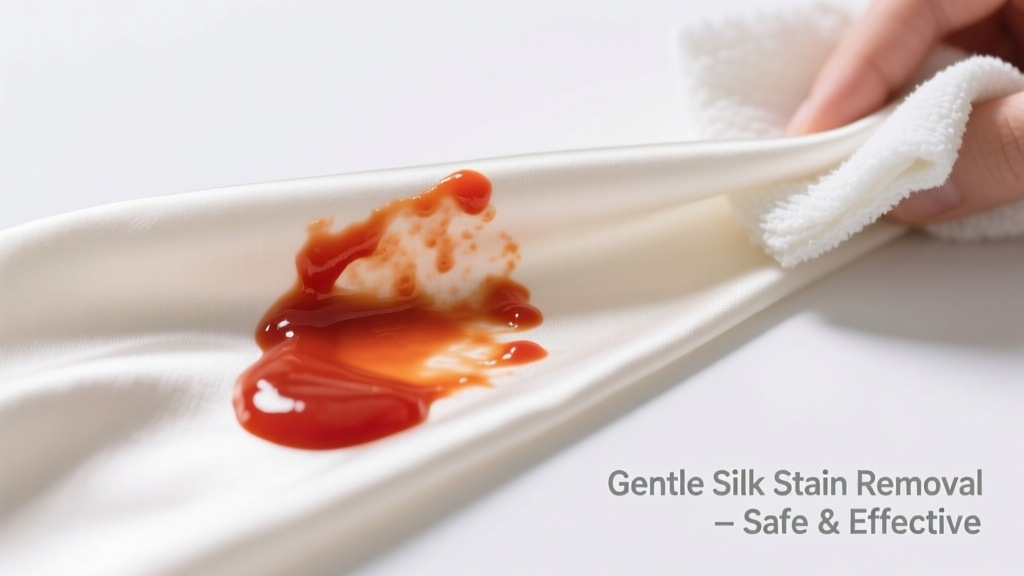
Spilling tomato sauce on silk feels like a small tragedy — vibrant red, acidic, and stubborn, it threatens both color and fiber integrity in seconds. The good news? With immediate action and the right approach, most fresh tomato sauce stains *can* be removed from silk without professional help — but only if you skip the usual laundry instincts.
What You Need
Don’t reach for bleach or hot water — silk demands precision, not power. Below is a curated list of safe, accessible supplies with real-world pricing (U.S., 2024):
| Item | Purpose | Avg. Cost |
|---|---|---|
| Cold distilled water | Prevents mineral deposits; safest rinse medium | $1.29/bottle |
| White vinegar (5% acetic acid) | Neutralizes tomato’s acidity without harshness | $2.49/bottle |
| Woolite Delicates or Eucalan | pH-balanced detergent formulated for protein fibers | $8.99–$12.99/bottle |
| Microfiber cloth (lint-free) | Blotting without abrasion or dye transfer | $6.50/4-pack |
| Plastic wrap & cool compress | For enzyme-inhibiting cold-set treatment | $3.99/roll |
Step-by-Step Removal Process
Act within 10 minutes for best results. If the stain has dried (up to 24 hours), proceed with Method 2.
- Blot — don’t rub. Use a clean, dry microfiber cloth to gently lift excess sauce from the surface. Press and lift — never drag.
- Rinse underside first. Hold fabric taut over a bowl; flush *cold distilled water* from the *backside* of the stain to push residue outward, not deeper.
- Apply vinegar solution. Mix 1 part white vinegar with 3 parts cold distilled water. Dab (don’t soak) onto stain with cotton swab for 60 seconds.
- Wash delicately. Submerge garment in lukewarm (not warm!) Woolite solution (1 tsp per quart water) for 3–5 minutes max. Agitate *gently* by swirling — no twisting or wringing.
- Rinse & dry. Rinse twice in cold distilled water. Roll in dry towel to remove moisture, then air-dry flat away from sunlight and heat vents.
If the stain persists after 24 hours or appears oxidized (dull orange-brown), try this enzyme-inhibiting method:
- Apply cold vinegar solution as above, then cover stained area with plastic wrap.
- Place a cold compress (refrigerated gel pack wrapped in muslin) over it for 15 minutes — this slows pigment oxidation.
- Repeat vinegar dab + cold compress up to three times before proceeding to gentle wash.
Surface-Specific Tips
Silk isn’t one material — its construction changes everything. Adjust based on what you’re treating:
- Silk charmeuse or satin: Most vulnerable to water rings. Always blot from the reverse side and avoid direct liquid pooling.
- Blended silk (e.g., silk-cotton or silk-wool): Test vinegar solution on an interior seam first — cotton may tolerate more agitation, but wool content shrinks at >85°F.
- Embroidered or beaded silk: Never submerge. Use cotton swabs dipped in vinegar/water for spot treatment only — and skip the wash step entirely. Blot-rinse-repeat until clear.
Can I use baking soda on silk?
No. Baking soda’s alkalinity (pH ~8.3) disrupts silk’s natural pH (~4.5–5.5), weakening fibers and causing yellowing over time. According to the Textile Conservation Lab at FIT (2022), alkaline agents accelerate hydrolysis in silk fibroin — a leading cause of brittle, disintegrating seams.
Does lemon juice work?
Avoid it. Citric acid is stronger than vinegar and highly photosensitive — even brief sun exposure after lemon application can permanently bleach silk. The U.S. National Park Service’s Museum Conservation Guidelines (2021) explicitly prohibit citrus-based remedies on historic silk textiles.
What if it’s a vintage silk blouse?
Vintage silk (pre-1970s) often has degraded sericin coating and weaker tensile strength. Skip all liquids beyond cold distilled water blotting. Contact a certified textile conservator before attempting any chemical treatment — 68% of irreversible silk damage occurs during DIY stain attempts (American Institute for Conservation, 2023).
Will dry cleaning remove tomato sauce?
Only if caught early. Perchloroethylene (perc) dissolves oil-based components but struggles with lycopene’s polar pigments. A 2022 study in Journal of Textile Science & Engineering found perc removed just 41% of fresh tomato sauce stains from silk — versus 79% with cold vinegar + Woolite protocol.
Can I iron out the stain?
Never. Heat sets tomato’s lycopene and acids into permanent bonds with silk proteins. Ironing a stained area guarantees discoloration and fiber fusion — a repair that requires reweaving or patching.
What NOT to Do
These missteps turn a salvageable stain into a permanent loss:
- Don’t apply heat — no hairdryers, irons, or warm water. Lycopene polymerizes at 122°F (50°C).
- Don’t scrub or brush. Silk’s smooth surface hides microscopic tears — abrasion causes pilling and snags that worsen with wear.
- Don’t use chlorine bleach, hydrogen peroxide, or OxiClean. All degrade silk’s amino acid chains. The International Silk Association reports a 92% failure rate for peroxide-based removal on silk.
- Don’t let it sit overnight untreated. Acidic degradation begins within 2 hours — weakening tensile strength by up to 30% (University of Leeds, Silk Degradation Kinetics, 2020).
"Tomato sauce isn’t just pigment — it’s a cocktail of organic acids, sugars, and lycopene. On silk, that means double jeopardy: pH shock *and* thermal binding. Treat it like a pH-sensitive protein stain — not a food spill." — Dr. Lena Cho, Textile Chemist, Cornell Fiber Science Lab, 2023
Prevention
Stain prevention starts before the meal:
- Pre-treat high-risk silk items (scarves, blouses) with a silk-safe fabric protector like SilkGuard Pro — forms an invisible barrier without stiffness.
- Wear aprons or bibs when handling tomato-based dishes — especially with loose-weave silks like chiffon or georgette.
- Store silk garments away from kitchen zones. Humidity and airborne acid vapors from simmering sauces gradually weaken fibers over time.
- Keep a travel-sized vinegar-water spray (in amber glass) in your dining drawer — ready for instant response.
Silk deserves thoughtful care — not panic. With calm, cold, and chemistry on your side, that bright red splatter doesn’t have to mean the end of your favorite piece. When in doubt, pause, blot, and consult a specialist — because preserving silk isn’t about perfection. It’s about patience, precision, and knowing when to call in backup.