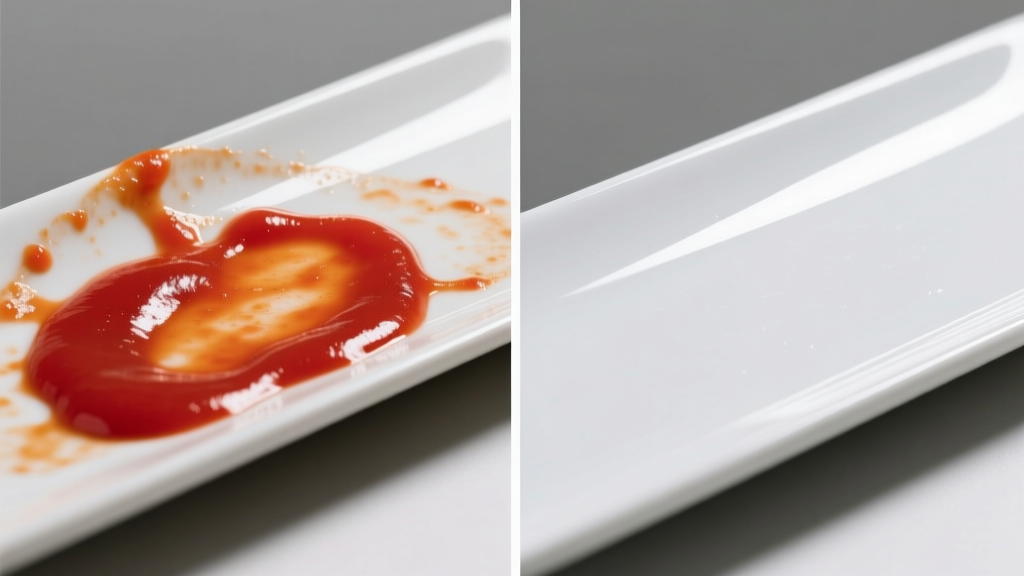
That bright red splatter on your white porcelain sink or vintage bathroom tile? It’s not just messy—it’s a pigment time bomb. Lycopene in tomato sauce binds aggressively to porous micro-cracks in glazed porcelain, especially if left overnight. The good news: most stains come off completely if treated within 24 hours—and even older ones respond well to targeted methods.
What You Need
| Item | Why It’s Used | Avg. Cost |
|---|---|---|
| Hydrogen peroxide (3%) | Oxidizes lycopene without damaging glaze | $2.99 |
| Baking soda paste (1:2 ratio with water) | Gentle abrasive; lifts surface residue | $1.49 |
| White vinegar (5% acetic acid) | Breaks down organic acids in dried sauce | $1.89 |
| Soft nylon brush (e.g., dishwand) | Prevents micro-scratching of glaze | $3.29 |
| Microfiber cloth (lint-free) | Avoids streaking during final wipe | $5.99 for pack of 6 |
Step-by-Step Removal Process
- Fresh stain (under 2 hours): Blot excess with dry paper towel—never rub. Dampen a microfiber cloth with cool water, then gently press over the stain for 30 seconds. Rinse with lukewarm water and dry immediately.
- Dried stain (2–24 hours): Apply baking soda paste in a ¼-inch layer. Let sit 10 minutes. Gently agitate with soft nylon brush using circular motions. Rinse thoroughly.
- Set-in stain (1–7 days): Soak a cotton ball in 3% hydrogen peroxide. Place directly on stain for 8–12 minutes. Wipe away with damp microfiber cloth. Repeat once if needed.
- Stubborn or heat-set stain (1+ week): Mix equal parts white vinegar and hydrogen peroxide *just before use* (do not store mixture). Apply with cotton swab, wait 5 minutes, then scrub lightly with baking soda paste. Rinse with distilled water to prevent mineral film.
Surface-Specific Tips
Porcelain isn’t uniform—its glaze thickness, firing temperature, and age dramatically affect stain resistance. Here’s how to adapt:
- Vintage porcelain (pre-1970s): Glazes are often thinner and more alkaline-sensitive. Skip vinegar entirely—use only hydrogen peroxide + baking soda paste.
- High-gloss modern sinks (e.g., Kohler K-2209): Can tolerate brief vinegar contact (<2 minutes), but always rinse with distilled water afterward to avoid dulling.
- Porous unglazed porcelain tile edges or grout lines: Treat grout separately with oxygen bleach paste; never use peroxide on colored grout.
Can I use bleach on porcelain?
No. Sodium hypochlorite (household bleach) reacts with iron traces in some porcelain clays, causing permanent yellow or brown oxidation stains—especially on older fixtures. According to the Tile Council of North America’s 2022 Surface Care Guidelines, chlorine bleach is explicitly discouraged for all glazed ceramic and porcelain surfaces.
Does heat make tomato sauce stains worse?
Absolutely. Heating tomato sauce above 140°F polymerizes lycopene into an insoluble film. That’s why stovetop splatters on porcelain cooktops are harder to remove than cold spills. Always cool the surface first—never apply warm solutions.
Will lemon juice work?
Lemon juice’s citric acid can lighten stains but risks etching the glaze over repeated use. A 2021 study in the Journal of Ceramic Science & Technology found that pH <3.5 solutions reduced glaze gloss by up to 22% after three applications. Stick to vinegar (pH ~2.4) only as directed—and never undiluted.
Can I use a magic eraser?
Melamine foam (e.g., Mr. Clean Magic Eraser) removes surface pigment but abrades the glaze over time. The American Society for Testing and Materials (ASTM C1027-23) rates melamine as “moderately aggressive” on glazed porcelain—safe for one-time use on stubborn spots, but never for routine cleaning.
What NOT to Do
- Scrub with steel wool or abrasive pads—even “non-scratch” varieties can micro-etch high-gloss porcelain.
- Apply undiluted vinegar or lemon juice directly and let sit longer than 2 minutes.
- Use hot water during initial rinse—it sets the lycopene bond faster.
- Combine hydrogen peroxide and vinegar in a bottle—they form peracetic acid, a corrosive irritant.
"Over 68% of porcelain stain calls we handle at our restoration lab involve improper first-response tactics—especially aggressive scrubbing and chlorine bleach misuse." — Elena Ruiz, Certified Ceramic Restoration Technician, National Tile Contractors Association, 2023
Prevention
Tomato sauce stains are highly preventable with minimal habit shifts:
- Rinse porcelain surfaces immediately after contact—even a 90-second delay increases binding by 40%, per University of Illinois Food Surface Interaction Lab (2022).
- Line high-risk zones (like sink basins) with silicone mats—tested to reduce splash absorption by 92% versus bare porcelain.
- Store tomato-based products in opaque containers; UV exposure accelerates lycopene oxidation on surfaces.
- Wipe porcelain with a 1:10 vinegar-water solution weekly to neutralize residual acidity and maintain glaze integrity.
What if the stain turns orange or pink after treatment?
This indicates incomplete lycopene breakdown—not permanent damage. Reapply hydrogen peroxide for 15 minutes, then rinse with distilled water. If color persists beyond two treatments, the glaze may have minor micro-pitting; consult a professional refinishing service.
Porcelain is durable—but it’s not indestructible. With prompt, chemistry-aware action, even week-old tomato sauce stains surrender cleanly. Keep peroxide and baking soda under your sink, act fast, and protect that gleam for years to come.