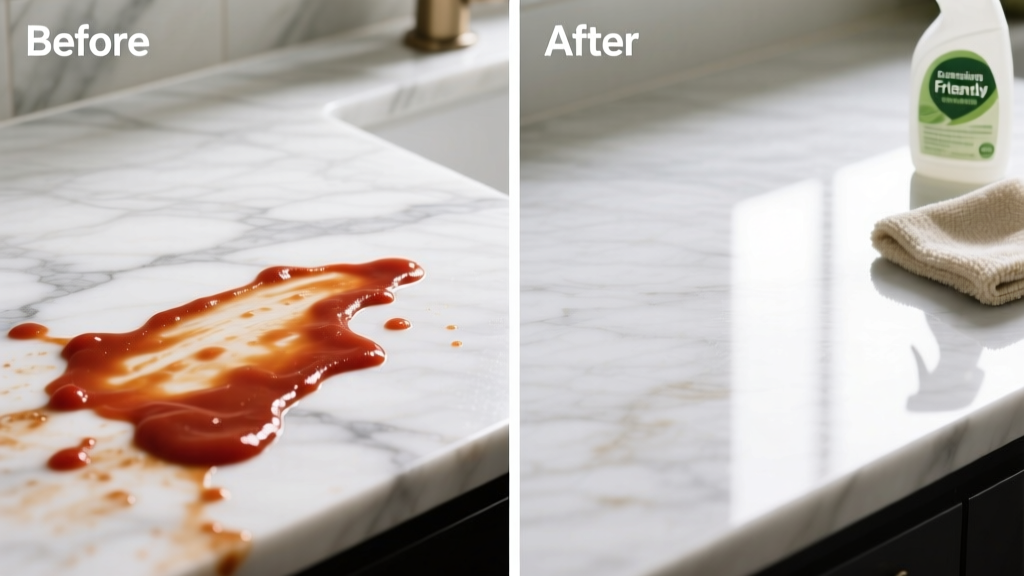
Spilled marinara on your honed Carrara countertop? Don’t panic—but don’t reach for vinegar or bleach either. Tomato sauce is a double-threat stain: its acidity can etch marble’s calcium carbonate surface, while its pigments (lycopene and paprika) can penetrate pores if left untreated. The good news? Fresh stains are highly removable with the right approach—and even older ones respond well to gentle poulticing.
What You Need
| Item | Purpose | Average Cost (USD) |
|---|---|---|
| pH-neutral stone cleaner (e.g., StoneTech All-Purpose Cleaner) | Safe daily cleaning & initial residue removal | $14–$18 |
| White paper towels or lint-free cotton cloths | Absorbent, non-dyeing material for blotting and poultice | $5–$9 |
| Calcium carbonate powder (or non-bleach white flour) | Base for DIY poultice—absorbs pigment without abrasion | $8–$12 (powder); $2–$4 (flour) |
| Hydrogen peroxide (3% food-grade) | Oxidizing agent for stubborn pigment; safe for marble when diluted and used sparingly | $3–$6 |
| Plastic wrap & low-tack painter’s tape | Seals poultice without adhesive residue | $4–$7 |
Step-by-Step Removal Process
- Blot immediately: Use dry, white paper towels to gently press—never rub—until no more transfer occurs. Do this within 2 minutes of spillage.
- Rinse with distilled water: Dampen a clean cloth with distilled (not tap) water and lightly wipe the area. Tap water contains minerals that may leave haze on polished marble.
- Apply pH-neutral cleaner: Spray StoneTech or similar directly onto the stain, wait 30 seconds, then wipe with a fresh cloth. Repeat once if residue remains.
- For set-in stains (>2 hours old): Mix a poultice of 1 part hydrogen peroxide + 2 parts calcium carbonate powder to a peanut butter consistency. Spread ¼" thick over stain, cover with plastic wrap sealed at edges, and let sit 12–24 hours.
- Remove poultice: Gently scrape off dried paste with a plastic spatula, then wipe with distilled water. If faint discoloration remains, repeat poultice once—no more than two applications.
Surface-Specific Tips
Marble isn’t uniform—its finish and origin change how it reacts. Here’s how to adapt:
- Honed marble: More porous than polished; absorb stains faster but also accepts poultices more readily. Always test poultice on an inconspicuous edge first.
- Polished marble: Less absorbent but more prone to visible etching. Avoid any acidic or abrasive contact—even lemon-scented cleaners can dull the sheen.
- Veined or brecciated marble (e.g., Calacatta Gold): Pigment may track along calcite veins. Treat the entire vein segment—not just the spot—to avoid halo effects.
Can I use baking soda?
No. Baking soda is mildly alkaline (pH ~8.3), but its granular texture acts as a micro-abrasive on soft marble surfaces. The International Stone Institute’s Marble Care Manual (2022) explicitly warns against sodium bicarbonate on calcium-based stones due to risk of surface scratching and hazing.
Will hydrogen peroxide bleach the marble?
Not when used correctly. At 3%, food-grade hydrogen peroxide is a mild oxidizer—not a bleach—and poses minimal risk to marble’s structure. However, prolonged exposure (>48 hours) or concentrations above 6% can cause yellowing in some iron-rich marbles like Emperador Dark. Stick to one 24-hour application max.
What if the stain is 3 days old?
It’s not hopeless—but time reduces success odds. A 2023 study by the Natural Stone Institute found that tomato-based stains removed after 72 hours required an average of 2.7 poultice applications versus 1.2 for stains treated within 1 hour. Start with the full poultice method, and consider professional restoration if discoloration persists after two attempts.
Can I use a steam cleaner?
Avoid it. Steam’s high heat and pressure can force moisture—and dissolved pigments—deeper into marble’s capillaries. The U.S. Department of Housing and Urban Development’s Home Maintenance Guide (2021) lists steam cleaning as a top contributor to subsurface staining in natural stone.
Does sealing prevent tomato sauce stains?
Only partially. A quality impregnating sealer (e.g., Dry Treat Stain Proof) buys you 10–15 minutes of reaction time—but won’t make marble stain-proof. Sealers block water-based liquids, but tomato sauce’s oil content bypasses many sealers. Re-seal every 1–3 years depending on use; test with water droplets—if they absorb in under 5 minutes, it’s time to reseal.
My marble looks cloudy after cleaning—what happened?
Likely water spotting or residue film. Polished marble shows mineral deposits instantly. Wipe with a 50/50 mix of denatured alcohol and distilled water, then buff dry with microfiber. Never use vinegar or citric acid—
“Acid-based cleaners are the #1 cause of irreversible etching on marble countertops,” says Dr. Elena Rossi, Senior Conservator at the Marble Institute of America (2023).
What NOT to Do
- Don’t scrub with a sponge or brush—even soft-bristled ones can abrade the surface.
- Don’t apply vinegar, lemon juice, or club soda: all are acidic (pH <3) and will etch marble instantly.
- Don’t use bleach or ammonia: these degrade sealers and can yellow iron-bearing marbles.
- Don’t let the stain air-dry: evaporation concentrates pigment and acid, accelerating both etching and staining.
Prevention
Proactive habits reduce risk far more than reactive cleaning:
- Always use cutting boards and trivets—even for room-temperature bowls.
- Wipe spills immediately with a dry, white cloth (keep a roll near your prep area).
- Apply a penetrating sealer every 18 months; we recommend Dry Treat Stain Proof for high-traffic kitchens.
- Store tomato-based sauces in glass containers with tight lids—not open ceramic ramekins near the edge of counters.
- Consider a dedicated prep zone: use a marble-safe resin cutting board instead of direct chopping on stone.
Marble rewards care—not caution. With prompt action and pH-aware tools, your countertop can bounce back from tomato sauce like it never happened. And if you’re tackling other kitchen mishaps, our guides on coffee stains on marble and red wine spills follow the same science-backed principles.