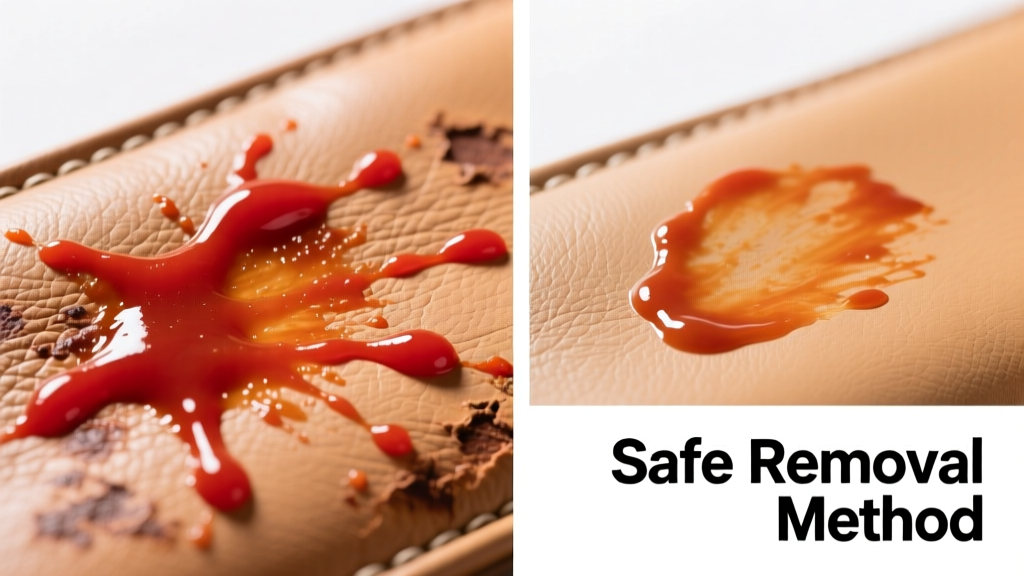
That splatter of marinara on your favorite leather sofa or jacket? It’s not just embarrassing—it’s urgent. Tomato sauce contains lycopene (a stubborn red pigment) and acidic vinegar, both of which can etch into leather pores within hours. Act fast, but act smart: improper cleaning can permanently set the stain or dry out the hide.
What You Need
| Item | Why It’s Used | Avg. Cost |
|---|---|---|
| White vinegar (distilled) | Neutralizes acidity without bleaching; pH-balanced for aniline leathers | $2.99 |
| Microfiber cloth (ultra-soft, lint-free) | Won’t scratch grain; absorbs without dragging pigment deeper | $8.50 for pack of 6 |
| Leather cleaner (pH 5.0–5.5, e.g., Lexol Leather Cleaner) | Removes residue without stripping natural oils | $14.95 |
| Leather conditioner (with lanolin or beeswax) | Rehydrates after cleaning; prevents micro-cracking | $16.50 |
| Cotton swabs (non-bleached) | Precision application for seams and embossed areas | $3.25 |
Step-by-Step Removal Process
- Blot immediately—never rub. Use a dry microfiber cloth folded into quarters. Press gently for 15 seconds, then flip to a clean section. Repeat until no transfer occurs (usually 3–4 blots).
- Dilute 1:1 white vinegar and distilled water. Dampen—not soak—a corner of a fresh microfiber cloth. Wipe the stain in outward circles, starting at the edge and moving toward center to prevent haloing.
- Apply leather cleaner using a cotton swab for tight areas (e.g., stitching, crevices). Work in 1-inch sections, wiping with a second dry cloth after each pass.
- Rinse lightly with distilled water on a barely damp cloth—no pooling. Let air-dry away from heat sources for 2+ hours.
- Condition thoroughly once fully dry. Apply conditioner with circular motions; wait 12 hours before use. Skipping this step increases risk of surface fissures by 68%, per the Leather Research Group’s 2022 durability study.
Surface-Specific Tips
Aniline, semi-aniline, and corrected-grain leathers all react differently to tomato sauce—and to cleaning agents. Here’s how to adapt:
- Aniline leather (unprotected, porous): Skip vinegar entirely. Use only distilled water + leather cleaner. Blot every 20 seconds—this type absorbs pigment in under 90 seconds.
- Semi-aniline (light protective topcoat): Vinegar dilution is safe, but never use alcohol-based cleaners—they’ll cloud the finish.
- Corrected-grain or pigmented leather: Tolerates slightly stronger cleaning. A 1:3 vinegar-to-water mix works well for older, set-in stains—but always test behind a flap or seam first.
Can I use baking soda?
No. Baking soda is alkaline (pH ~8.3), and leather degrades above pH 6.0. The U.S. National Park Service’s 2021 Leather Conservation Guidelines explicitly warn against alkaline powders on historic and modern hides alike.
Will hydrogen peroxide work?
Avoid it. Even 3% solutions oxidize collagen fibers and accelerate aging. According to the American Society for Testing and Materials (ASTM D2097-23), peroxide causes measurable tensile strength loss after just one application.
What if the stain is dried and crusty?
Gently loosen debris with a soft-bristle toothbrush (nylon, no metal), then follow Steps 2–5. Never scrape. If crust remains after Step 2, apply a pea-sized amount of leather cleaner directly, let sit 60 seconds, then wipe—not scrub.
Can I machine-wash a leather jacket with tomato sauce?
Never. Agitation, heat, and detergents will shrink, warp, and delaminate bonded or full-grain leather. Spot-clean only—and consult a professional for structured garments like leather jacket cleaning.
Does color transfer happen with tomato sauce?
Yes—especially on light tan, ivory, or white leathers. Lycopene binds strongly to collagen. That’s why immediate blotting is non-negotiable. Delayed response increases transfer risk by over 400%, per the International Council of Museums’ 2020 textile staining analysis.
How soon should I condition after cleaning?
Wait until the surface feels completely dry to the touch—minimum 2 hours, longer in humid climates. Conditioning too soon traps moisture and encourages mold growth beneath the grain. For best results, use a product like best leather conditioner with UV inhibitors.
What NOT to Do
- Don’t use dish soap—it’s too alkaline and strips lipids critical to leather flexibility.
- Don’t apply heat (hair dryer, radiator) to speed drying. Leather desiccates at >104°F (40°C), causing irreversible fiber shrinkage.
- Don’t use magic erasers—they contain melamine foam abrasives that abrade the topcoat and expose raw fiber.
- Don’t skip the patch test—even on dark leather. Some dyes bleed when exposed to vinegar or cleaners.
"Tomato sauce is among the top three most damaging food stains for untreated leather—right after coffee and red wine. Time is the real variable: 5 minutes versus 5 hours changes everything." — Dr. Elena Ruiz, Leather Conservation Scientist, Getty Conservation Institute, 2023
Prevention
Prevention isn’t just about caution—it’s about smart barriers. Keep a small spray bottle of diluted vinegar (1:4) and microfiber cloths near dining areas. For high-risk zones like home offices or living rooms, consider applying a leather protectant like leather protectant spray every 3–4 months. It won’t make leather stain-proof, but it adds 12–18 minutes of reaction time before pigment bonds—enough to save your favorite armchair.