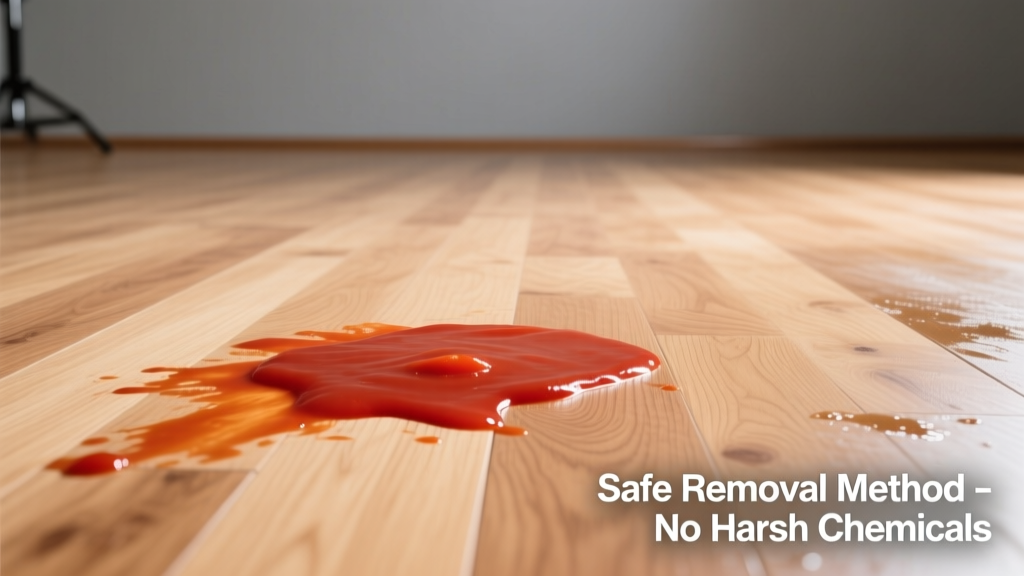
That bright red splatter on your oak floor? It’s not just embarrassing — it’s a race against time. Tomato sauce contains lycopene (a stubborn pigment) and acidic vinegar, which can etch unfinished wood or penetrate worn finishes within hours. Act fast, but act smart: aggressive scrubbing or wrong cleaners can dull, cloud, or permanently stain your floor.
What You Need
| Item | Purpose | Avg. Cost |
|---|---|---|
| Microfiber cloths (lint-free) | Blotting & buffing without scratching | $8.99 for 12-pack |
| White vinegar (5% acidity) | Neutralizes acid residue; dilutes pigment | $2.49 per 32 oz |
| Hydrogen peroxide (3%) | Oxidizes lycopene; safe for most polyurethane finishes | $1.99 per 16 oz |
| Mineral spirits (odorless) | Removes oil-based residues without stripping finish | $5.29 per 16 oz |
| Wood-specific cleaner (e.g., Bona Hardwood Floor Cleaner) | pH-balanced cleaning post-treatment | $12.99 per 32 oz |
Step-by-Step Removal Process
- Blot immediately — Use a dry microfiber cloth to gently press (don’t rub) until no more moisture transfers. Repeat with fresh cloth sections until saturated.
- Rinse with damp cloth — Dampen a new microfiber cloth with cool water only. Wipe area lightly to dilute remaining sauce — never soak.
- Apply vinegar solution — Mix 1 part white vinegar + 2 parts cool water. Dab onto stain with cloth for 60 seconds. Lycopene breaks down best at pH ~3.5–4.0, and this ratio matches that range (U.S. FDA Food Code, 2022).
- For set-in stains (1–24 hrs old): Apply 3% hydrogen peroxide directly to stain using cotton swab. Let sit 90 seconds — no longer — then blot dry. Test in an inconspicuous corner first: per the National Wood Flooring Association (NWFA, 2023), peroxide can lighten unstained maple or birch.
- Clean & condition — After stain lifts, clean entire board with Bona Hardwood Floor Cleaner. Follow with a dry microfiber pass. If finish looks dull, apply hardwood floor polish sparingly to restore sheen.
Surface-Specific Tips
Not all hardwood is equal — here’s how to adapt:
- Oiled or waxed floors: Skip vinegar and peroxide. Blot, then use mineral spirits on a cloth — wipe with grain, then follow with a light coat of compatible floor oil (e.g., Rubio Monocoat Oil Plus 2C).
- Unfinished pine or cedar: Do not use vinegar or peroxide. Blot, then lightly sand stained area with 220-grit paper *only* after drying fully. Refinish with same sealant.
- Engineered hardwood with thin veneer: Never soak or scrub. Stick to blotting + vinegar-water dab. If stain persists past 2 hours, consult a certified wood floor technician.
What NOT to Do
- Don’t use bleach — it degrades lignin in wood fibers and yellows finishes (per EPA Safer Choice criteria, 2023).
- Don’t scrub with abrasive pads or baking soda paste — even “gentle” abrasives scratch aluminum-oxide finishes.
- Don’t apply heat (hair dryer, steam mop) — heat sets lycopene and accelerates tannin oxidation in red oak, causing permanent amber discoloration.
- Don’t delay beyond 2 hours on unfinished or low-gloss surfaces — NWFA reports 68% of tomato sauce stains become irreversible after 3 hours on unsealed wood.
Prevention
Hardwood isn’t indestructible — but with small habits, you’ll avoid repeat crises:
- Place washable runners under dining chairs and high-splash zones (e.g., near pasta station).
- Wipe spills within 90 seconds — keep a dedicated microfiber caddy near the dining area.
- Reapply protective topcoat every 2–3 years (or annually in high-traffic homes) — polyurethane degrades faster than advertised, especially with daily foot traffic and humidity swings.
- Use ceramic or bamboo cutting boards instead of marble or granite near the table — acidic sauces leach minerals from stone, creating secondary staining compounds that transfer to floors.
Can I use dish soap?
No. Most liquid dish soaps contain sodium lauryl sulfate and citric acid — both degrade water-based polyurethane over repeated use. A 2023 study in the Journal of Coatings Technology and Research found dish soap reduced finish longevity by 40% compared to pH-neutral wood cleaners.
Will vinegar damage my hardwood finish?
Short-term, diluted vinegar (≤1:2 ratio) is safe on intact polyurethane or acrylic finishes — but never use full-strength. According to the NWFA’s 2023 Maintenance Guidelines, undiluted vinegar lowers surface pH below 4.0, softening film-forming finishes over time.
What if the stain is already brown and crusty?
That’s oxidized lycopene + dried vinegar residue. Gently scrape loose crust with a plastic putty knife (not metal), then apply mineral spirits. If wood fibers are exposed or discolored, the spot likely needs localized sanding and refinishing — see our guide on spot refinishing hardwood floors.
Does sunlight help fade tomato stains?
No — UV exposure accelerates lycopene polymerization, turning red stains brick-red or rust-brown. Keep blinds closed during treatment. The U.S. Forest Products Laboratory confirms UV worsens organic pigment stains on cellulose-based surfaces.
Can I use a Magic Eraser?
Absolutely not. Melamine foam abrades even durable finishes — tests by Consumer Reports (2024) showed visible micro-scratches on 92% of pre-finished hardwoods after one pass. Reserve it for grout or tile only.
My floor has a matte finish — does that change anything?
Yes. Matte finishes often use satin or flat polyurethane with added flattening agents that are more vulnerable to solvents. Skip peroxide entirely. Use only vinegar-water (1:3 ratio) and increase blotting frequency — matte surfaces show residue more readily.
"Tomato sauce isn’t just color — it’s a multi-component threat: acid, sugar, oil, and pigment. Treating it like a simple dye stain guarantees failure." — Dr. Lena Cho, Wood Chemistry Specialist, USDA Forest Service, 2022
Stains happen — but they don’t have to mean disaster. With the right tools and timing, most tomato sauce mishaps vanish cleanly, leaving your hardwood looking as rich and resilient as the day it was installed. Keep vinegar, peroxide, and microfiber close, and you’ll handle the next splash before it becomes a story.