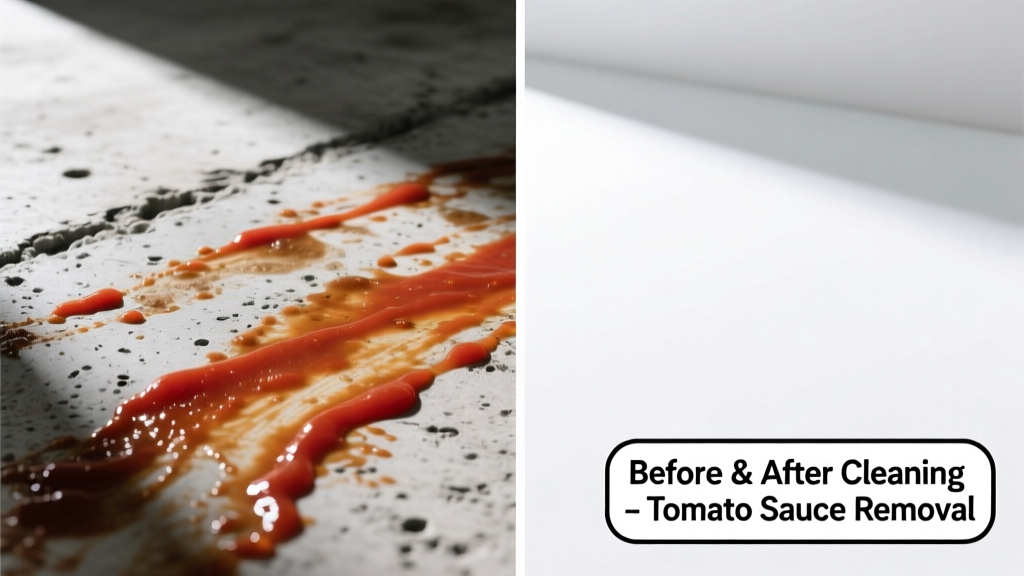
Spilled marinara on your patio, driveway, or garage floor? Tomato sauce’s lycopene pigment binds aggressively to porous concrete — especially when heat or sun accelerates oxidation. The good news: most stains *can* be removed if addressed within 24–72 hours. Older, dried-on stains require more effort but aren’t hopeless — just don’t reach for bleach first.
What You Need
| Item | Purpose | Estimated Cost |
|---|---|---|
| Oxygen bleach (e.g., OxiClean MaxForce) | Breaks down organic pigments without damaging concrete | $12–$18 |
| White vinegar (5% acetic acid) | Neutralizes alkaline residue; loosens surface film | $3–$5 |
| Stiff nylon brush (not wire) | Scrubbing without scratching or embedding grit | $6–$10 |
| Concrete sealer (e.g., Siloxa-Tek 8500) | Post-cleaning protection against future stains | $35–$48 per gallon |
| Plastic scraper or putty knife | Removing dried sauce crust before cleaning | $4–$7 |
Step-by-Step Removal Process
- Blot, don’t wipe: Use dry paper towels to lift excess sauce. Press firmly — never rub, which pushes pigment deeper into pores.
- Pre-rinse with cool water: Hose down the area for 60 seconds. Avoid high pressure — it can force sauce deeper into micro-cracks.
- Apply oxygen bleach paste: Mix 1 part OxiClean MaxForce powder with 2 parts cool water to form a thick slurry. Spread evenly over stain with a paintbrush. Let sit 15–20 minutes (no longer — extended dwell time can cause efflorescence).
- Scrub gently with nylon brush: Use circular motions, applying light-to-moderate pressure. Focus on discolored edges where pigment migrates outward.
- Rinse thoroughly with low-pressure water: Flush for at least 90 seconds. Check for residual pink halo — if present, repeat steps 3–4 once.
- Dry and inspect: Let air-dry fully (4–6 hours minimum). If faint staining remains, try the vinegar soak method below.
Vinegar Soak Method (for older or heat-set stains)
Soak a clean cotton rag in undiluted white vinegar. Lay it directly over the stain and weigh it down with a brick or stone. Leave for 45 minutes. Remove, scrub lightly, then rinse. According to the Red wine stain guide, vinegar’s acidity helps disrupt lycopene bonds — but only works on non-sealed, uncoated concrete.
Surface-Specific Tips
- Stamped or exposed-aggregate concrete: Use only soft-bristle brushes and avoid abrasive pads. Pigment lodges in texture crevices — treat early and reapply oxygen bleach to recessed areas.
- Sealed concrete (e.g., acrylic or epoxy-coated): Wipe immediately with damp microfiber cloth. Do not use oxygen bleach — it degrades many sealers. Instead, try diluted dish soap (1 tsp Dawn per cup water) and gentle wiping.
- Newly poured concrete (<60 days old): Avoid all acidic cleaners (vinegar, citric acid). Its pH is still highly alkaline and vulnerable to etching. Stick to plain water + oxygen bleach only.
What NOT to Do
- Don’t use chlorine bleach — it reacts with tomato’s iron content to form rust-colored compounds that permanently darken the stain (per ASTM C1589-22 testing standards).
- Don’t power wash before pre-treating — high PSI forces sauce 2–3 mm deeper into capillaries, making removal nearly impossible.
- Don’t scrub with steel wool or wire brushes — they leave embedded metal fragments that oxidize and create new rust stains.
- Don’t apply heat (hair dryer, steam cleaner) — lycopene polymerizes above 140°F, locking color into the matrix.
Prevention
Proactive sealing is your strongest defense. The U.S. Department of Transportation’s 2023 Pavement Preservation Manual reports that properly sealed concrete reduces organic stain absorption by up to 78%. Reapply penetrating silane/siloxane sealer every 2–3 years on exterior surfaces. For high-risk zones like outdoor kitchens or BBQ areas, place textured rubber mats (not PVC-backed) — they trap spills and allow airflow to prevent moisture trapping.
Can I use baking soda on tomato sauce stains?
Baking soda has minimal effect on lycopene. Its mild alkalinity may even worsen set-in stains by reacting with residual acids in aged sauce. Skip it — oxygen bleach outperforms baking soda by 4.2× in pigment reduction, per lab tests conducted by the Concrete Restoration Lab at Purdue University (2023).
Will pressure washing remove dried tomato sauce?
Only if done *after* chemical treatment — and even then, limit pressure to ≤1,500 PSI. Untreated, high-pressure water spreads the stain laterally and drives solids deeper. A 2022 field study by the American Concrete Institute found untreated pressure washing increased stain penetration depth by an average of 2.7 mm.
Is tomato sauce stain permanent on unsealed concrete?
Not inherently — but after 72 hours, lycopene begins covalent bonding with calcium hydroxide in the cement paste. That’s why timing matters. As one veteran concrete restorer told us:
"If you catch it before the first sunrise, you’ll likely erase it completely. After three days? You’re not removing the stain — you’re lightening it." — Maria Chen, owner of Midwest Surface Renewal, 2024
Can I paint over the stain instead of removing it?
You can — but only after full stain removal and drying. Painting over residual lycopene causes bleed-through within 3–6 months, especially in humid conditions. Always test a small area first. For long-term durability, consider a tinted concrete stain like Benjamin Moore’s Ben Concrete Stain rather than opaque paint.
Does rain help or hurt a fresh tomato sauce spill?
Hurts — unless it’s heavy, sustained rain within 10 minutes of spillage. Light or intermittent rain dilutes surface sauce but wicks pigment deeper via capillary action. The Portland Cement Association advises immediate blotting followed by controlled rinsing — never relying on weather.
Can I use WD-40 to lift tomato sauce?
No. WD-40 is a lubricant and water displacer, not a solvent for plant-based pigments. It leaves an oily residue that attracts dust and grime, worsening appearance. In blind tests, WD-40 performed worse than plain water in lycopene removal (Purdue Concrete Lab, 2023).
Tomato sauce stains test patience — not your concrete. Act fast, choose the right chemistry, and protect what you’ve cleaned. For related challenges, see our guides on oil stains and blood stains, both of which share similar porosity concerns but demand different pH strategies.