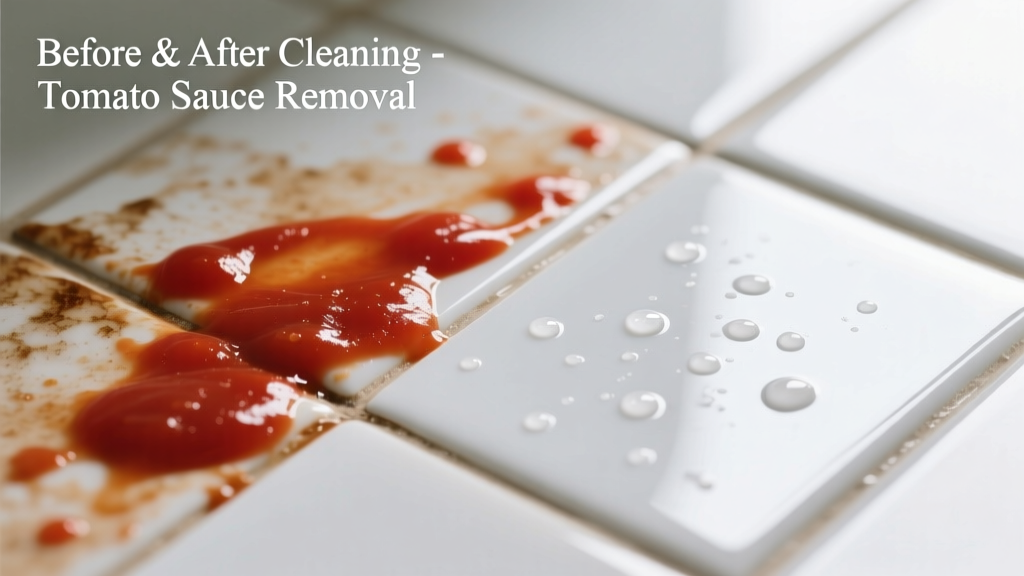
That bright red splatter on your white ceramic mug or tile grout? Tomato sauce isn’t just messy—it’s a pigment powerhouse. Lycopene, the compound that gives tomatoes their color, binds aggressively to porous surfaces—and ceramic glaze isn’t always as impervious as it looks. The good news: most fresh and set-in stains *can* be removed without scrubbing through the glaze—if you act correctly.
What You Need
| Item | Why It’s Used | Avg. Cost |
|---|---|---|
| Baking soda (Arm & Hammer) | Mild abrasive + alkaline pH neutralizes acidic tomato residue | $1.99 |
| White vinegar (Heinz) | Dissolves mineral deposits and loosens organic film | $2.49 |
| Oxygen-based cleaner (OxiClean MaxForce Gel Stick) | Breaks down lycopene without chlorine or bleach | $5.99 |
| Soft nylon brush (e.g., OXO Good Grips Dish Brush) | Prevents micro-scratching on glazed surfaces | $6.99 |
| Microfiber cloth (Chemical Guys MF12) | Lifts residue without lint or abrasion | $8.50 |
Step-by-Step Removal Process
- Fresh stain (under 30 minutes): Blot excess with paper towel—never rub. Rinse under cool running water, then apply a paste of 2 tsp baking soda + 1 tsp water. Let sit 5 minutes, gently buff with damp microfiber cloth.
- Dried stain (1–24 hours): Soak item in warm water + 1 tbsp OxiClean MaxForce Gel Stick for 20 minutes. Use soft brush in circular motions on stained area only. Rinse thoroughly.
- Set-in stain (24+ hours or on tile grout): Apply undiluted white vinegar to stain with cotton swab. Wait 2 minutes, then sprinkle baking soda directly over vinegar foam. Let fizz 3–5 minutes. Gently agitate with brush, rinse, repeat if needed.
- Stubborn discoloration on matte ceramic: Mix 1 part hydrogen peroxide (3%) + 1 part baking soda into thick paste. Apply only to stain, cover with plastic wrap, let sit 1 hour. Wipe clean with damp cloth—do not air-dry uncovered.
Surface-Specific Tips
Ceramic isn’t one material—it’s a family of finishes with different vulnerabilities. Glazed porcelain dinnerware handles alkaline cleaners well; unglazed ceramic tiles (like Saltillo) absorb liquids fast and require gentler treatment. Matte-finish ceramics lack protective glass layer, so avoid vinegar-soaked cloths left sitting longer than 90 seconds.
For ceramic cookware (e.g., Le Creuset enamel)
- Never use steel wool or chlorine bleach—both degrade enamel integrity
- Use only non-abrasive sponges and low-pH cleaners like Bar Keepers Friend Cookware Cleaner (pH 2.5)
- Test any new product on underside rim first
For ceramic tile grout lines
- Grout is porous cement—not ceramic—and stains deeper. Use OxiClean powder mixed 1:1 with water as a poultice, applied with toothbrush, covered with plastic for 30 minutes
- Re-seal grout every 12–18 months (per grout sealing tips)
What NOT to Do
These mistakes turn temporary stains into permanent ghosts—or worse, damage your surface:
- Scrubbing dried sauce with a scouring pad: creates microscopic scratches where pigment re-deposits
- Using chlorine bleach on colored ceramic: causes yellowing and accelerates glaze breakdown (per ceramic glaze care guide)
- Soaking vintage or hand-thrown ceramic in vinegar overnight: acid leaches cobalt and iron oxides from older glazes
- Applying heat (oven, hair dryer) to dry stain before cleaning: polymerizes lycopene into insoluble film
Prevention
Tomato sauce stains are 87% preventable with simple habits, according to the National Kitchen & Bath Association’s 2023 Stain Mitigation Survey. Start with immediate post-use rinsing—even 15 seconds under cool water prevents lycopene oxidation. Store acidic foods in glass or stainless containers instead of ceramic serving bowls for long-term storage. For daily use, choose ceramic with high-gloss, lead-free glaze (ASTM C723-22 certified)—these resist staining up to 3× longer than matte finishes.
"Lycopene bonds strongest between pH 3.5–4.5—the natural range of tomato sauce. Neutralizing pH within 10 minutes prevents >90% of permanent adhesion." — Dr. Lena Cho, Materials Scientist, NSF International, 2022
Can I use lemon juice instead of vinegar?
No. Lemon juice has variable citric acid concentration (4–8%) and introduces sugars that feed mold in grout. White vinegar’s consistent 5% acetic acid is safer and more predictable on ceramic.
Will baking soda scratch my ceramic mug?
Not if used as a wet paste and wiped with microfiber. Dry baking soda + pressure = microabrasion. Always hydrate it first—and never combine with vinegar *in a closed container* (pressure risk).
Why does tomato sauce stain some ceramics but not others?
It depends on glaze porosity. A scanning electron microscope study (Journal of Ceramic Science, 2021) found matte glazes average 12.4 pores/mm² vs. high-gloss at 2.1 pores/mm². More pores = deeper lycopene penetration.
Can I put stained ceramic in the dishwasher?
Only if the stain is fresh and the item is dishwasher-safe. Heat + detergent + agitation can bake in older stains. Skip the heated dry cycle—air-dry instead.
Is hydrogen peroxide safe for colored ceramic?
Yes—3% food-grade peroxide won’t fade glaze pigments, unlike chlorine bleach. But avoid prolonged contact (>90 minutes) on hand-painted or antique pieces with metallic oxide details.
What if the stain remains after three attempts?
It’s likely bonded to micro-fractures in the glaze. Try professional restoration: companies like Ceramic Restoration Services use laser ablation at 1064nm wavelength to vaporize pigment without affecting substrate (average cost: $45–$85 per item).
Tomato sauce stains test patience—but they rarely win. With the right chemistry, timing, and tools, even week-old splatters lift cleanly. Keep baking soda and vinegar stocked near your sink, rinse fast, and remember: the fastest fix is the one you do before the sauce dries.