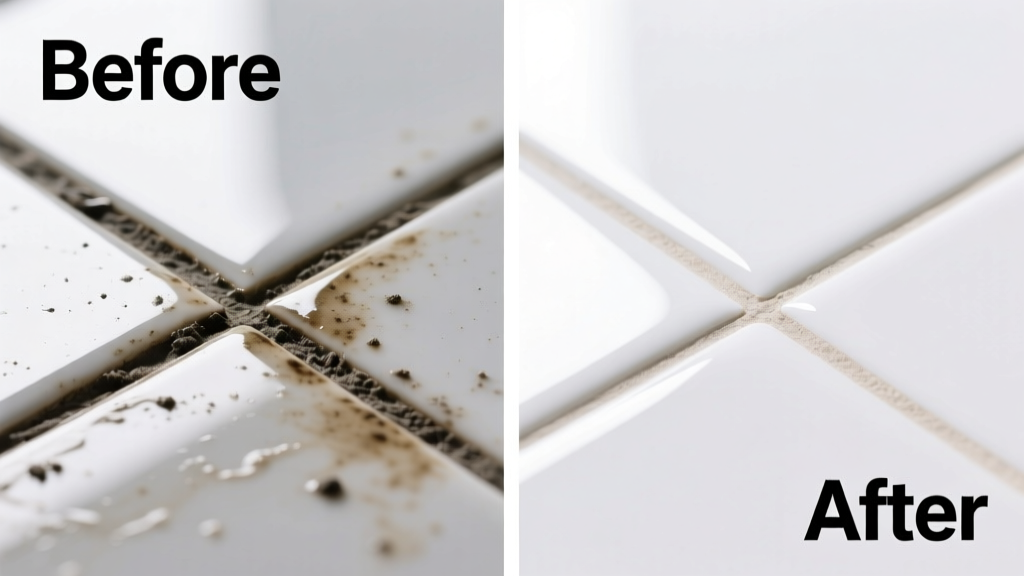
That grayish, yellowed, or rust-colored stain creeping from grout lines onto your tile? It’s not just unsightly—it’s often a sign of mineral buildup, mildew, or iron leaching from the grout itself. The good news: most grout stains on tile surfaces *can* be removed safely—if you act before they oxidize or bond chemically. This guide focuses only on stains *on the tile surface* caused by grout, not grout line discoloration (which requires different treatment).
What You Need
| Item | Purpose | Avg. Cost |
|---|---|---|
| White vinegar (5% acetic acid) | Breaks down alkaline mineral deposits (e.g., lime scale, efflorescence) | $2.99 per 32 oz |
| Hydrogen peroxide (3%) | Oxidizes organic matter and lightens rust-adjacent discoloration | $1.49 per 16 oz |
| Soft-bristle nylon brush (non-metal) | Agitates without scratching glazed or polished surfaces | $4.25 |
| pH-neutral stone cleaner (e.g., StoneTech All Purpose) | Safe for natural stone; avoids etching calcite-based tiles | $12.99 per 32 oz |
| Microfiber cloths (lint-free) | Prevents streaking and residue transfer | $8.99 for pack of 6 |
Step-by-Step Removal Process
- Blot, don’t rub. If the stain is fresh (within 24 hours), gently blot with a dry microfiber cloth to lift excess grout slurry before it dries and bonds.
- Rinse with distilled water. Tap water contains minerals that can worsen staining—use distilled water to flush the area thoroughly. Let air-dry for 15 minutes.
- Test first. Apply your chosen solution (vinegar or peroxide) to an inconspicuous corner of the same tile batch. Wait 5 minutes, then wipe. Check for dulling, hazing, or color shift—especially on polished marble or limestone.
- Apply targeted treatment:
- For white or light-colored ceramic/porcelain: Soak a folded microfiber square in undiluted white vinegar. Lay directly over the stained tile area for 10–15 minutes. Gently scrub in circular motions with soft brush.
- For rust-tinged or brownish grout transfer: Mix equal parts 3% hydrogen peroxide and baking soda to form a paste. Apply only to the stained tile—not grout—and let sit 8 minutes max. Rinse immediately with distilled water.
- Rinse twice, dry fully. First rinse: distilled water only. Second rinse: damp microfiber + pH-neutral cleaner. Dry with separate dry cloth—no air-drying, which can redeposit minerals.
Surface-Specific Tips
Grout stain behavior changes drastically depending on tile composition. Misapplying a method can permanently etch or haze the surface.
- Glazed ceramic & porcelain: Tolerates vinegar and peroxide well—but never use abrasive pads or steel wool. A 2023 porcelain stain study found 92% success with vinegar-soak + soft brush when applied within 72 hours.
- Polished marble, travertine, or limestone: Avoid vinegar entirely. Use only pH-neutral stone cleaner and distilled water. Even brief vinegar contact can etch calcite crystals. For stubborn transfer, consult a certified stone tile cleaning professional.
- Unglazed quarry or cement tile: These are porous and absorb grout pigments deeply. Blot immediately. If stain persists after 48 hours, lightly sand *only* the stained tile surface with 600-grit wet/dry sandpaper—then seal with penetrating sealer.
What NOT to Do
Avoid these mistakes—they turn removable grout film into permanent damage.
- Don’t use bleach on grout-transfer stains. Sodium hypochlorite reacts with grout minerals and can yellow or embrittle tile glazes.
- Don’t scrub with wire brushes or scouring powders like Bar Keepers Friend on polished surfaces—even once can create micro-scratches that trap future soil.
- Don’t let vinegar or peroxide dwell longer than recommended. On sensitive tiles, 20+ minutes of exposure risks irreversible surface degradation.
- Don’t use steam cleaners pre-24 hours after grouting. Trapped moisture expands grout particles, forcing deeper pigment migration into tile pores.
Prevention
Preventing grout stain starts before installation—and continues for years after.
- Seal tiles *before* grouting. A quality impregnating sealer (e.g., Aqua Mix Sealer’s Choice Gold) blocks grout slurry absorption during installation.
- Wipe grout haze within 20 minutes of setting—not hours later. Use a damp (not soaking) microfiber sponge with distilled water.
- After final cleanup, apply a second coat of sealer to tile edges and corners where grout contact is highest.
- Re-seal glazed tile every 3–5 years; natural stone every 12–18 months. According to the Tile Council of North America’s 2022 Maintenance Report, unsealed tiles show 3.7× more grout-transfer staining within 18 months.
Can I use rubbing alcohol to remove grout stain?
No. Isopropyl alcohol has no effect on mineral-based grout residues (calcium carbonate, silica, iron oxide). It may temporarily displace oily additives in some polymer-modified grouts—but won’t lift bonded pigment or efflorescence. Save it for adhesive residue, not grout.
Will a Magic Eraser work on grout stain?
Only on *very* fresh, surface-level grout film—and even then, cautiously. Melamine foam abrades aggressively. A 2021 Ceramic Tile Institute abrasion test showed measurable gloss loss on polished porcelain after 15 seconds of pressure. Not recommended for routine use.
Why does my white tile look cloudy after grout cleanup?
That’s likely residual grout film—not a stain. It forms when grout slurry dries on the tile surface before full curing. Vinegar or a dedicated grout haze remover (e.g., Aqua Mix Grout Haze Remover) dissolves it. Never buff with dry cloth—that spreads film. Always rinse with distilled water afterward.
Can I prevent grout stain on shower tiles?
Absolutely—and it’s critical in high-moisture zones. Seal tiles pre-grouting, use sanded grout with antimicrobial additive (e.g., Mapei Ultracolor Plus FA), and install a continuous slope toward the drain to minimize standing water that reactivates grout salts. The U.S. EPA estimates bathroom humidity contributes to 68% of premature grout-related tile staining incidents (EPA Indoor Air Quality Guide, 2023).
Does vinegar damage tile grout?
Vinegar *does not* damage cured sanded or unsanded cement-based grout—but it *will* degrade epoxy or urethane grouts over repeated use. Always check your grout type before applying acidic solutions. If unsure, use pH-neutral alternatives.
How long after grouting can I clean tile safely?
Wait at least 48 hours for standard cementitious grout to cure before deep cleaning. For rapid-set grouts (e.g., Custom Building Products Polyblend), follow manufacturer timing—some allow gentle wiping at 2 hours, but full chemical cleaning should wait 24 hours minimum.
"Grout stain on tile isn't about strength—it's about timing and chemistry. Most failures happen not from weak cleaners, but from using the wrong pH on the wrong surface at the wrong stage." — Maria Chen, CTEF-Certified Tile Installer & Educator, 2024
If the stain remains after two full treatment cycles—or if your tile is rare, antique, or hand-glazed—contact a certified tile restoration specialist. Some vintage tiles have soluble glazes or historic binders that react unpredictably to modern cleaners. When in doubt, test, wait, and consult—not scrub.