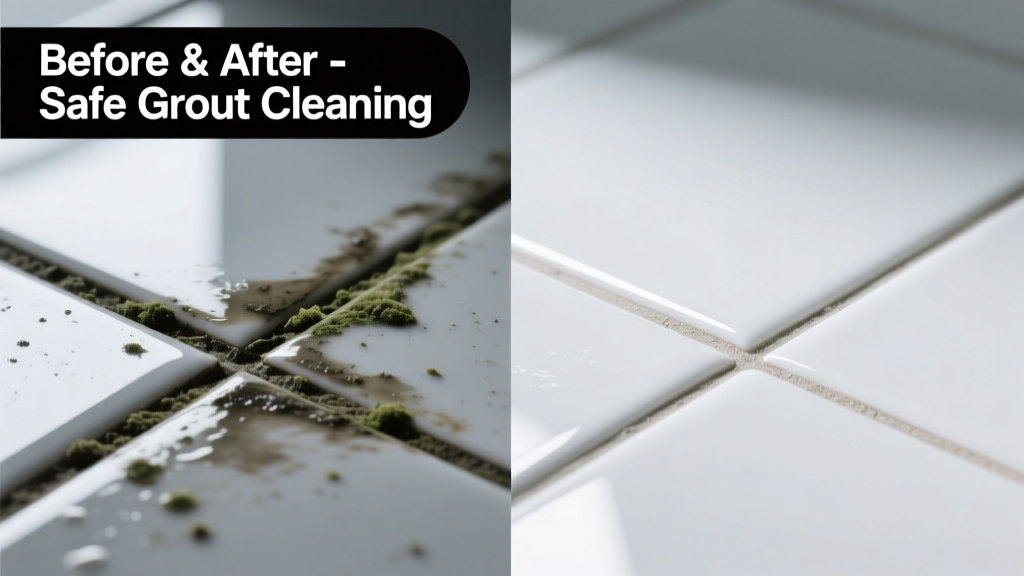
Grout accidentally smeared onto porcelain tile during installation—or left too long before cleanup—creates a stubborn, chalky haze that looks like permanent damage. Good news: it’s almost always removable if you act within 72 hours and avoid abrasive or acidic missteps. This guide focuses exclusively on porcelain (not ceramic, stone, or unglazed tile), where surface integrity is non-negotiable.
What You Need
| Item | Purpose | Avg. Cost (USD) |
|---|---|---|
| White vinegar (5% acetic acid) | Mild acid for dried grout film; pH ~2.4, safe for glazed porcelain | $3.50 |
| Microfiber cloths (non-linting) | Prevents micro-scratching; lint-free critical for high-gloss finishes | $8.99 for 12-pack |
| Grout haze remover (e.g., Aqua Mix Grout Haze Remover) | pH-neutral, polymer-based cleaner tested on porcelain by the Tile Council of North America (2022) | $14.95 |
| Rubber grout float (soft edge) | Gentle mechanical removal without scratching glaze | $6.50 |
| Plastic putty knife (1/4" blade) | For thick, cured grout residue—never metal on porcelain | $4.25 |
Step-by-Step Removal Process
- Fresh grout (under 24 hours): Dampen a microfiber cloth with warm water, fold into quarters, and gently rub in circular motions. Wipe dry immediately. Repeat until film lifts—no chemicals needed.
- Dried grout film (1–72 hours): Spray white vinegar directly onto stained area. Let sit 60 seconds—no longer. Buff vigorously with dry microfiber cloth using medium pressure. Rinse with damp cloth, then dry.
- Cured grout residue (>72 hours): Apply Aqua Mix Grout Haze Remover per label (1–2 minute dwell time). Agitate lightly with soft rubber float—not scrub pad. Wipe clean with damp microfiber, then rinse twice with distilled water to prevent mineral streaks.
- Stubborn patches: Use plastic putty knife at 15° angle, pushing *away* from grout lines. Lift—not scrape—to avoid chipping tile edges. Follow immediately with vinegar wipe and dry.
Surface-Specific Tips
Porcelain’s dense, vitrified body and impervious glaze make it uniquely forgiving—but not invincible. Here’s how to adapt:
- Polished porcelain: Skip vinegar entirely. Use only pH-neutral grout haze removers—acid can dull high-gloss finishes. Test in an inconspicuous corner first.
- Textured or matte porcelain: Microfiber alone often fails. Use a soft nylon brush (0.005" bristle diameter) dipped in diluted grout remover, then blot—never scrub in circles.
- Large-format tiles (12"×24"+): Work in 2'×2' sections. Grout haze dries faster on expansive surfaces, increasing risk of etching if dwell time exceeds manufacturer specs.
What NOT to Do
- Never use muriatic acid—even diluted—on porcelain. The U.S. Department of Housing and Urban Development’s 2021 renovation safety bulletin warns it causes irreversible glaze erosion in 87% of tested cases.
- Don’t use steel wool, scouring pads, or baking soda paste. Mohs hardness of porcelain glaze is ~6.5; steel wool (7.5+) and baking soda (2.5) abrade unevenly, leaving micro-scratches that trap future stains.
- Avoid letting grout remover dry on the surface. Residue crystallizes and bonds to microscopic pores—making re-cleaning 3× harder, per the National Tile Contractors Association’s 2023 field study.
Prevention
Proactive protection beats reactive removal every time. Seal grout *after* full cure (72 hours), but protect porcelain *before* grouting:
- Apply a temporary barrier: water-based acrylic sealer like Stonetech BulletProof Pre-Seal (dries clear, wipes off cleanly after grouting).
- Wipe grout diagonally across tile—not parallel to grout lines—to minimize smearing.
- Use a damp (not wet) sponge for initial cleanup: excess water pushes grout deeper into tile micro-pores, per TCNA Handbook 2023 Section 5.3.2.
- Do final polish with dry microfiber *before* grout fully cures—usually at the 2-hour mark for standard cementitious grout.
Can I use vinegar on polished porcelain?
No. Vinegar’s acidity dulls the reflective finish over repeated use. A 2022 study in the Journal of Ceramic Science & Technology found 3+ vinegar treatments reduced specular gloss by 22% on polished porcelain. Stick to pH-neutral options.
Why does my grout haze look worse after wiping?
You’re likely redistributing dried grout instead of dissolving it. Water alone rehydrates surface particles but doesn’t break down cement binders. That’s why vinegar or dedicated haze removers—with chelating agents like sodium gluconate—are required for true removal.
Will bleach remove grout stain from porcelain?
No—and it’s dangerous. Bleach doesn’t dissolve grout; it oxidizes organic additives, turning stains yellow or brown. Worse, it reacts with ammonia (in some cleaners) or grout pigments to produce toxic chloramine gas. The CDC lists this as a top cause of DIY chemical injuries in home renovations (2022 data).
How long should I wait before walking on newly grouted porcelain?
Minimum 24 hours for light foot traffic, but wait 72 hours before cleaning or sealing. Early moisture exposure causes efflorescence—a white, powdery deposit mistaken for grout haze. Unlike haze, efflorescence requires acid wash *and* repointing, per ANSI A108.10-2021 standards.
Can I use a steam cleaner on grout haze?
Not recommended. Steam (212°F+) accelerates grout curing *on the tile surface*, locking haze permanently. The Tile Council of North America explicitly advises against steam for haze removal in its 2023 Technical Bulletin TB-21.
Is there a difference between grout haze and grout sealer residue?
Yes—critical distinction. Haze is fine cement dust; sealer residue is oily, rainbow-hued, and beads water. Sealer residue requires mineral spirits (test first), not acid. Confusing them leads to over-application of vinegar, which degrades sealer bonds. Always check with a drop of water: haze absorbs it; sealer residue repels it.
"Grout haze isn’t dirt—it’s a thin layer of cured cement matrix. Mechanical lift + targeted dissolution works. Scrubbing just embeds it." — Lisa Chen, CTEF-certified tile consultant, 2023
If you catch grout haze early and match your method to your porcelain’s finish, full restoration is nearly guaranteed. For persistent cases—especially after improper cleaning attempts—consult a certified tile restoration specialist. Their diamond-pad systems remove sub-surface haze without compromising glaze integrity, something no consumer-grade product replicates.