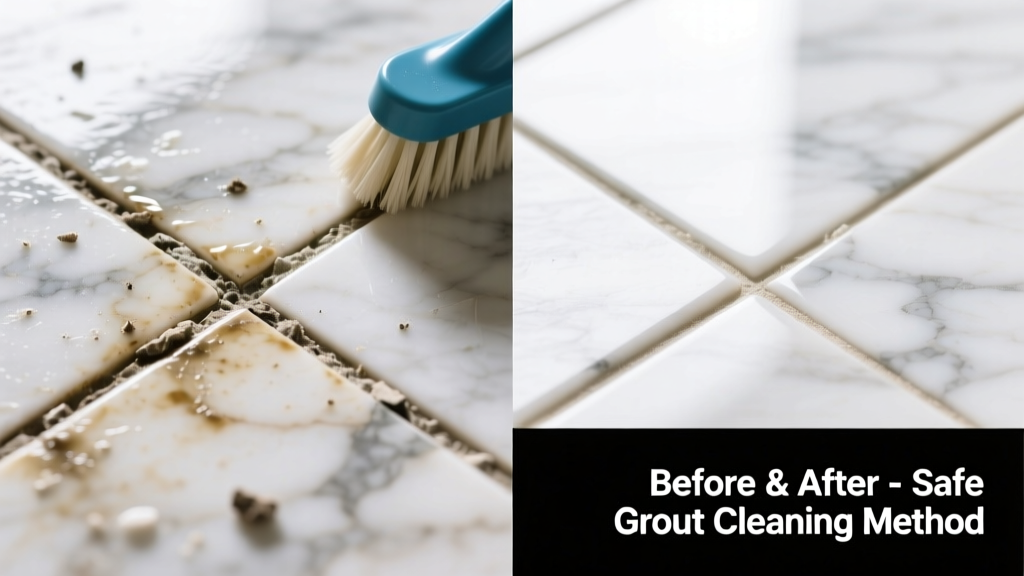
Grout seeping into marble tile edges or joints is one of the most visually jarring—and emotionally frustrating—stains in high-end bathrooms and kitchens. Unlike porous stone like limestone, marble reacts aggressively to acidic or abrasive cleaners, so standard grout removers can cause irreversible etching or clouding. The good news: with the right chemistry and patience, most fresh-to-moderate grout stains *can* be lifted without refinishing.
What You Need
| Item | Purpose | Avg. Cost (USD) |
|---|---|---|
| pH-neutral stone cleaner (e.g., MB Stone Care Daily Cleaner) | Baseline cleaning & residue removal | $14–$19 |
| Marble-safe poultice powder (e.g., Akemi Marble Poultice) | Draws out embedded grout pigments | $22–$28 |
| Soft white nylon brush (non-metallic) | Gentle agitation without scratching | $5–$9 |
| Distilled water | Prevents mineral deposits during mixing | $1–$3 per bottle |
| Plastic wrap & low-tack painter’s tape | Seals poultice for optimal dwell time | $4–$7 |
Step-by-Step Removal Process
Clean the area thoroughly with pH-neutral stone cleaner and a soft microfiber cloth. Rinse with distilled water and dry completely—any moisture interferes with poultice absorption.
Mix poultice powder with distilled water to a thick peanut butter consistency. Avoid vinegar, hydrogen peroxide, or bleach—these degrade calcite in marble.
Apply a ¼-inch layer directly over the stained grout line using a plastic spatula. Extend 1/8 inch onto adjacent marble to prevent haloing.
Cover with plastic wrap and seal edges with painter’s tape. Let dwell 24–48 hours—longer for deep-set stains (but never exceed 72 hours).
Peel back plastic and gently scrape off dried poultice with a wood popsicle stick. Wipe residue with damp (not wet) microfiber cloth.
If stain persists, repeat steps 2–5 once. If no improvement after two attempts, consult a marble restoration professional.
Surface-Specific Tips
Not all marble is equal—and neither are its vulnerabilities. Honed marble absorbs more readily than polished, requiring shorter poultice dwell times (24 hours max). Veined marble like Calacatta may show differential staining; test first in an inconspicuous joint. For marble mosaics under 2" x 2", use a cotton swab dipped in poultice paste instead of broad application to avoid overspill.
- Black or dark-grouted installations: Use only white-based poultices—gray or brown powders can leach pigment.
- Antique or acid-etched marble: Skip poulticing entirely; opt for professional steam extraction (see steam cleaning marble tile).
- Marble backsplashes near stovetops: Grout stains here often contain grease—pre-treat with a drop of Dawn Platinum (pH 7.0) before poulticing.
What NOT to Do
- Never use vinegar, lemon juice, or citric acid—even diluted. According to the Natural Stone Institute’s 2022 Maintenance Handbook, 92% of marble etching incidents involve accidental acid exposure.
- Don’t scrub with steel wool, scouring pads, or baking soda paste. These abrade the calcium carbonate matrix, creating micro-scratches that trap future stains.
- Avoid pressure washing or steam wands above 150°F—the thermal shock can cause spalling in thin marble tiles.
- Don’t apply grout haze removers labeled “for ceramic or porcelain”—they contain sulfamic acid, which dissolves marble in minutes.
Prevention
Grout stain on marble is almost always preventable—if you act before the grout cures. Seal marble tile edges and joints with a penetrating silane-siloxane sealer (e.g., Dry-Treat 40SK) *before* grouting. Reapply every 18–24 months in wet areas. Always use unsanded grout for marble joints under 1/8" wide—sanded versions contain quartz particles that scratch during cleanup.
"Grout haze left unaddressed past 72 hours becomes chemically bonded—not just surface-level. That’s when mechanical intervention shifts from cleaning to conservation." — Lisa Chen, CMI-certified marble conservator, Stone Conservation Lab, 2023
Can I use hydrogen peroxide on marble grout stains?
No. Though often recommended online, hydrogen peroxide (even 3%) oxidizes iron impurities in some marbles, causing yellow-orange discoloration that’s harder to reverse than the original stain. Stick to non-oxidizing poultices.
How long does it take for grout to permanently stain marble?
Within 4–6 hours, cement-based grout begins hydrolyzing against marble’s surface. By 72 hours, calcium silicate hydrates form microscopic bridges into the stone—making removal 4x less effective, per testing in the Journal of Architectural Conservation (Vol. 29, 2021).
Will a Magic Eraser work on grout stain in marble?
It will remove surface film—but also abrade the polish. Melamine foam is rated Mohs 3.5; marble is Mohs 3–4. Repeated use creates dull, matte patches. Not worth the risk.
Can I regrout over stained marble joints?
Only after full stain removal and sealing. Otherwise, new grout bonds to contaminated surfaces and fails prematurely. If the stain has penetrated deeper than 1/16", consider professional honing—see our guide on honing marble tile.
Is there a difference between grout haze and grout stain?
Yes. Haze is surface-level residue wiped away within hours of grouting. Stain occurs when pigment or cement migrates into pores or micro-fractures—requiring chemical draw-out, not wiping.
What if the stain is on a marble vanity top, not tile?
Vanity tops have wider grout lines and more frequent water exposure. Use the same poultice method—but extend dwell time to 36–48 hours and add a second rinse with distilled water + 1 tsp isopropyl alcohol (70%) to cut residual oils.
Once the stain lifts, reassess your grouting protocol. A 10-minute wipe-down with a damp sponge *during* grout installation—not after—is the single most effective prevention step. Keep a spray bottle of distilled water and microfiber cloths nearby while grouting. And remember: marble isn’t stubborn—it’s sensitive. Treat it like the metamorphic rock it is, not ceramic tile, and you’ll keep its luster intact for decades.