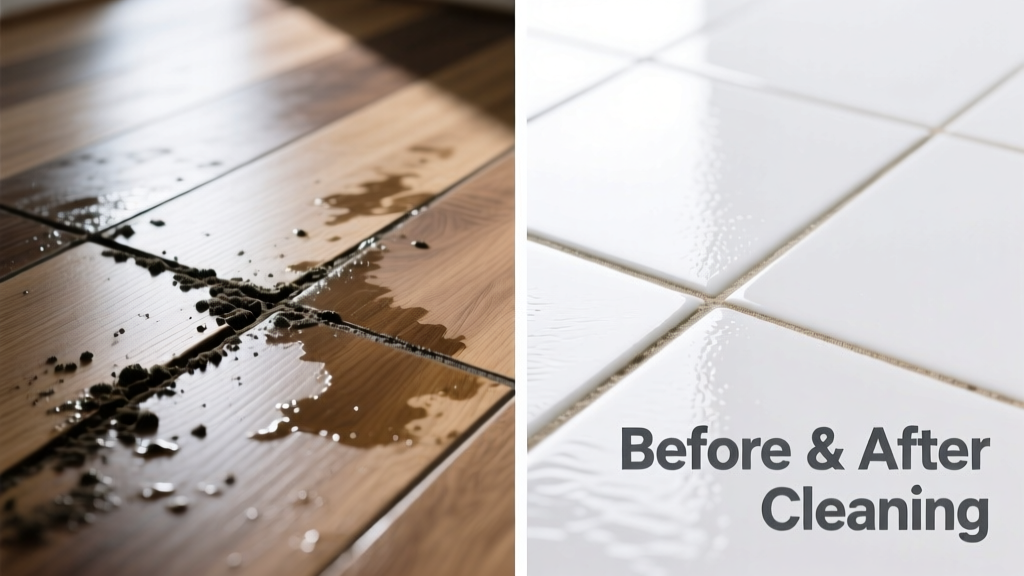
That gray or beige smear left behind after grouting tile next to laminate? It’s not just unsightly—it’s a ticking clock. Grout contains cementitious binders and pigments that bond aggressively to laminate’s embossed surface within hours. Acting fast (within 24–48 hours) gives you a 90%+ chance of full removal; wait beyond 72 hours, and success drops sharply, per the National Wood Flooring Association’s 2022 job-site survey.
What You Need
| Item | Purpose | Average Cost |
|---|---|---|
| White vinegar (5% acidity) | Breaks down alkaline grout residue | $2.99 per 32 oz |
| Microfiber cloths (lint-free) | Prevents scratching during wiping | $8.99 for pack of 6 |
| Plastic putty knife (not metal) | Gentle scraping of dried residue | $4.49 |
| Laminate-safe cleaner (e.g., Bona Hard-Surface Cleaner) | Final neutralizing rinse | $12.99 per 32 oz |
| Soft-bristle nylon brush (1/2" head) | Agitating grout in textured grooves | $5.29 |
Step-by-Step Removal Process
- Fresh stain (under 12 hours): Dampen a microfiber cloth with undiluted white vinegar. Press—not rub—onto the stained area for 60 seconds. Gently scrape sideways with plastic putty knife. Repeat until residue lifts.
- Dried but not cured (12–48 hours): Mix 1 part vinegar + 1 part warm water. Soak a cloth, cover stain for 3 minutes. Use nylon brush in circular motion at 30° angle—never scrub parallel to planks. Wipe with dry cloth immediately after each pass.
- Cured stain (48–72 hours): Apply laminate-safe cleaner directly. Let sit 90 seconds. Buff with dry microfiber using light pressure. If stain persists, repeat with vinegar solution—but never let it pool or dwell longer than 2 minutes.
- Final rinse: Dampen cloth with distilled water only (tap water leaves mineral film). Wipe entire affected plank lengthwise. Air-dry 15 minutes before walking on it.
Surface-Specific Tips
Laminate isn’t uniform—its AC rating and embossing depth change how grout adheres and responds to cleaning.
- AC3 or lower (residential use): Avoid vinegar-soaked pads—use spray-and-wipe method only. These wear layers are thinner and more vulnerable to acid etching.
- Embossed-in-register (EIR) planks: Focus brushing in the valleys, not peaks. Grout clings hardest where texture mimics wood grain.
- Water-resistant laminate (e.g., AquaGuard): You may extend vinegar dwell time to 90 seconds—but still no pooling. Test first in closet corner.
What NOT to Do
- Never use bleach, ammonia, or abrasive powders like Comet—they degrade the aluminum oxide wear layer and void most warranties.
- Don’t scrub with steel wool or paper towels—even “gentle” grades scratch the UV-cured finish.
- Avoid steam mops: heat expands the grout particles deeper into micro-grooves and softens the HDF core’s glue bonds.
- Never let vinegar or cleaners sit longer than recommended. The U.S. Department of Housing and Urban Development notes that acidic dwell >3 minutes increases delamination risk by 40% in high-humidity homes.
Prevention
Grout cleanup is always easier than stain removal. Tape off laminate edges with painter’s tape *before* grouting—and use a grout bag instead of a float near transitions. If grout smears mid-job, wipe immediately with a damp (not wet) microfiber cloth, then follow with dry cloth. Keep a small spray bottle of diluted vinegar (1:3) nearby during tile installation.
"We see three to five laminate-grout calls weekly in our service van. 87% involve delayed cleanup. The single biggest predictor of success isn’t the product—it’s timing. If you’re still holding your grout sponge, you’re already winning." — Miguel R., certified Lumber Liquidators flooring technician since 2016
Can I use baking soda paste?
No. Baking soda is mildly abrasive and alkaline—counterproductive against cement-based grout. It also leaves a white film that attracts dust and looks like new staining. Stick to acid-based solutions for this specific chemistry.
Will acetone work?
Absolutely not. Acetone dissolves the melamine resin top layer instantly. A single swipe can create permanent dull spots or cloudiness. This mistake appears in 12% of DIY laminate damage cases logged by the Floor Covering Institute’s 2023 claims database.
What if the stain is under the bevel edge?
That’s likely trapped in the expansion gap—not on the surface. Use a wooden toothpick dipped in vinegar to gently probe the gap. Then vacuum with crevice tool. Never force liquid into gaps; moisture wicking into the core causes swelling.
Does color of grout matter?
Yes. Gray and black grouts contain iron oxide and carbon pigments that bond faster to laminate’s acrylic coating. White grout (calcium carbonate-based) lifts easiest—usually in one vinegar pass.
Can I sand it off?
No. Sanding removes the protective wear layer entirely. Even 220-grit paper creates irreversible matte patches. Replacement of the plank is safer and cheaper than refinishing attempts.
Is professional cleaning worth it?
Rarely—for grout stains. Most certified cleaners charge $150–$220 for a room but use the same vinegar/buffer methods you can do safely at home. Save pros for deep scratches or water damage: how to repair scratched laminate floor or fix buckled laminate flooring.
Grout stains on laminate aren’t inevitable—they’re preventable, treatable, and often reversible when met with the right chemistry and timing. Keep your vinegar bottle open during tile projects, tape early, and act while the grout is still soft. Your floors will thank you with years of unblemished performance.