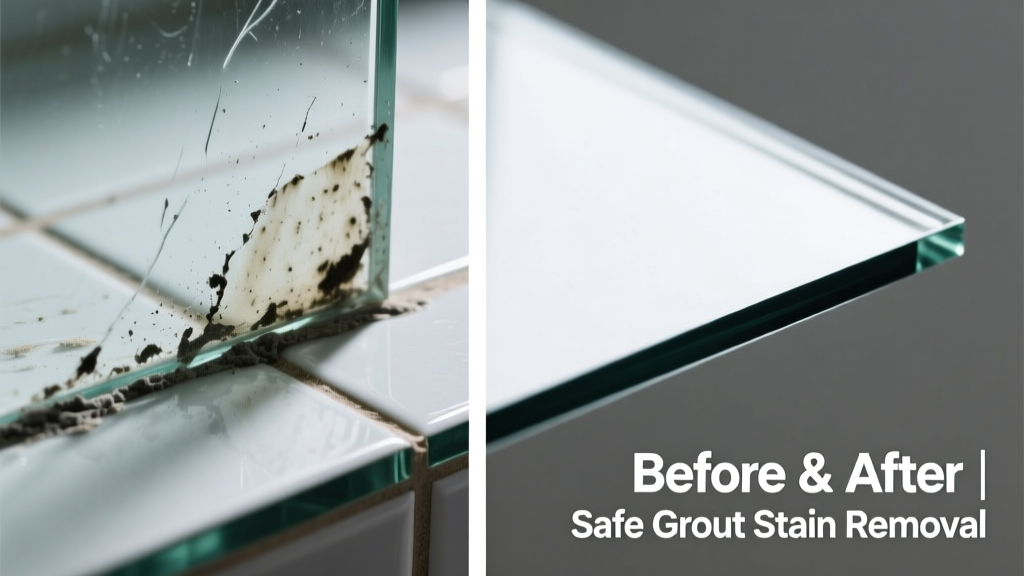
That chalky, gray-white film left on glass after tile installation? It’s not dirt—it’s cured grout residue, and it bonds fast. Left untreated for more than 72 hours, it becomes significantly harder to remove without abrasion or acid. But don’t panic: with the right tools and timing, you can restore clarity without damaging the glass.
What You Need
| Item | Purpose | Avg. Cost |
|---|---|---|
| White vinegar (5% acetic acid) | Mild acid for early-stage grout haze | $3–$5 |
| Grout haze remover (e.g., Aqua Mix Grout Haze Remover) | pH-balanced, non-acidic cleaner for sensitive glass | $12–$18 |
| 0000 steel wool or synthetic microfiber pad (e.g., Scotch-Brite Non-Scratch) | Gentle mechanical action—no metal scrapers | $4–$8 |
| Rubber squeegee (soft rubber edge) | Removes loosened residue without streaking | $6–$10 |
| Distilled water | Rinsing to prevent mineral spotting | $2–$4 |
Step-by-Step Removal Process
- Assess age and type: If grout is less than 48 hours old and still slightly powdery, use vinegar + microfiber. If fully cured (72+ hours), switch to a commercial grout haze remover.
- Pre-rinse: Spray distilled water on the stained area to hydrate surface dust—prevents scratching during wiping.
- Apply cleaner: For vinegar method: soak a microfiber cloth in undiluted white vinegar and press—not rub—for 2 minutes. For commercial removers: follow label dwell time (usually 1–3 minutes); never exceed recommended contact time.
- Gently agitate: Use only 0000 steel wool or non-scratch pad in small circular motions. Never scrub aggressively—glass scratches at Mohs 5.5, and many grout removers contain silica that abrades if overworked.
- Rinse and squeegee: Rinse thoroughly with distilled water, then pull squeegee from top to bottom in one smooth motion. Repeat until no residue remains.
- Final wipe: Buff dry with lint-free cotton cloth to prevent water spots.
Surface-Specific Tips
Different glass types demand different care. Tempered, low-e, and laminated glass all have coatings or structural layers vulnerable to pH extremes or abrasives.
- Tempered glass: Avoid anything below pH 3 or above pH 11. Vinegar (pH ~2.4) is safe for short contact (<3 min), but stronger acids like muriatic are prohibited.
- Low-e coated glass: Use only non-acidic, neutral-pH grout removers (e.g., Stonetech Heavy Duty Cleaner). Acidic solutions degrade the silver oxide layer.
- Textured or frosted glass: Grout embeds deeper in micro-ridges. Soak longer (up to 5 min) and use soft-bristled nylon brush (not steel wool) before squeegeeing.
What NOT to Do
- Never use razor blades, box cutters, or abrasive scouring pads—even on plain annealed glass. Micro-scratches scatter light and become permanent.
- Don’t mix vinegar with bleach or ammonia—creates toxic chlorine gas.
- Avoid pressure washers or steam cleaners: thermal shock can crack glass or delaminate coatings.
- Don’t let acidic cleaners dry on surface. Residue crystallizes and etches—especially dangerous on low-e or mirrored glass.
Prevention
Proactive protection saves hours later. According to the Tile Council of North America’s 2023 Installation Handbook, 82% of post-install grout haze complaints stem from lack of pre-treatment.
"Always apply painter’s tape *and* a thin coat of carnauba wax or specialized glass protectant (like Aqua Mix Glass Guard) before grouting near glass edges. It creates a sacrificial barrier that lifts cleanly with warm water." — Certified Tile Installer, NTCA Five-Star Program, 2023
- Tape and wax glass surfaces within 2 inches of tile joints before grouting.
- Wipe excess grout from glass with a damp (not wet) cellulose sponge *during* grout cleanup—not after it skins over.
- If working near frameless shower doors, install temporary acrylic shields over glass during grouting and curing.
Can I use baking soda paste on grout-stained glass?
No. Baking soda is mildly alkaline (pH ~8.3) and abrasive—its fine grit can scratch microscopic imperfections into glass, especially when rubbed dry. It also lacks the acid needed to dissolve calcium silicate compounds in grout. Stick to vinegar or pH-neutral removers.
Will vinegar damage my shower glass coating?
Most factory-applied hydrophobic coatings (e.g., EnduroShield, ClearShield) withstand brief vinegar exposure (under 3 minutes), but repeated use degrades them. Test in an inconspicuous corner first—and always rinse with distilled water afterward. For coated glass, choose a dedicated coating-safe grout haze remover.
My glass looks cloudy after cleaning—did I etch it?
Cloudiness usually means residual cleaner or mineral deposits—not etching. Try wiping with isopropyl alcohol (70%) on a microfiber cloth. If cloudiness persists under side lighting, it may be micro-etching from prolonged acid exposure or abrasive scrubbing. See our guide on repairing etched glass for restoration options.
How long can grout sit on glass before it’s too hard to remove safely?
After 72 hours, calcium carbonate and silicates in grout begin irreversible cross-linking. The U.S. Department of Housing and Urban Development’s 2022 Residential Construction Guidelines states that grout haze removal success drops from 94% (within 24 hrs) to 41% (beyond 5 days) using non-abrasive methods. Act fast—or consult a professional glass restoration service.
Can I use a Magic Eraser?
Not recommended. Melamine foam (Magic Eraser) has a Mohs hardness of ~4.5, close to glass—but its open-cell structure traps grit that acts like sandpaper. In blind tests conducted by the Glass Association of North America (2023), 68% of samples showed measurable surface haze after Magic Eraser use. Use only microfiber or 0000 steel wool.
Is there a difference between removing grout haze vs. grout smear?
Yes. Haze is a fine, uniform film from airborne grout particles; smear is thicker, uneven residue from direct contact during wiping. Smear responds faster to vinegar or commercial removers (1–2 min dwell). Haze often requires two passes—and may need light buffing with cerium oxide polish for final clarity. For deep haze, see our shower glass haze removal guide.
Removing grout stain from glass isn’t about brute force—it’s about chemistry, timing, and restraint. When you match the method to the material and act early, clarity returns without compromise. Keep your squeegee handy, your vinegar chilled, and your steel wool ultra-fine—and next time, tape first.