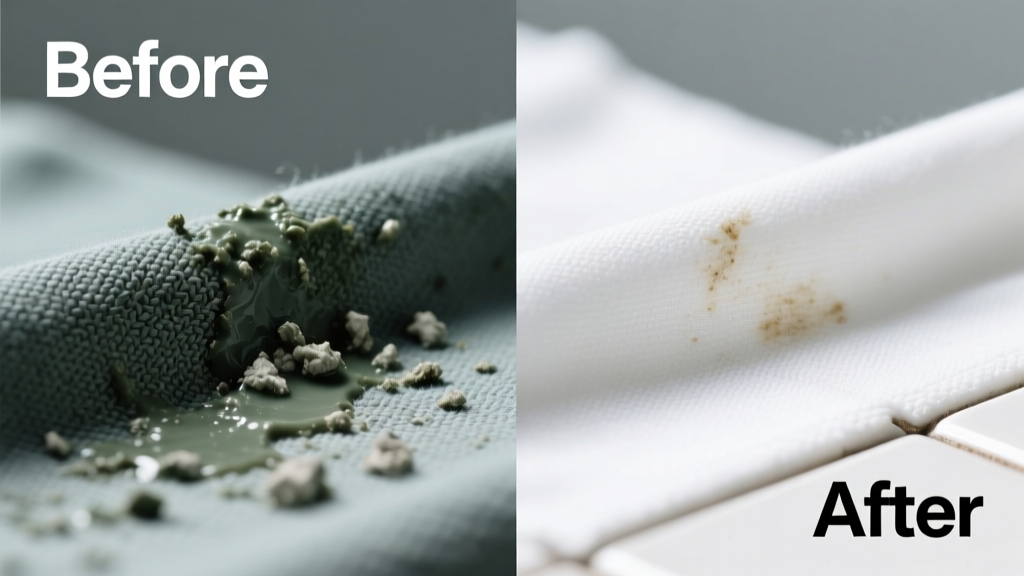
That gritty, grayish smear on your favorite cotton work shirt? It’s not just dirt—it’s dried tile grout: a cementitious mix of Portland cement, sand, and lime that bonds aggressively to cellulose fibers. Unlike food or oil stains, grout hardens as it dries and alkalizes over time, raising fabric pH and weakening cotton. But don’t panic—most fresh-to-24-hour grout stains *can* be reversed if treated before full carbonation (which begins at ~6 hours). Older stains require mechanical + chemical intervention, not just soaking.
What You Need
| Item | Purpose | Cost |
|---|---|---|
| White vinegar (5% acetic acid) | Neutralizes alkaline grout residue | $2.49–$3.99 |
| Soft-bristle toothbrush (nylon) | Gentle agitation without fiber abrasion | $1.29–$2.79 |
| Hydrogen peroxide (3%) | Oxidizing agent for pigment in colored grouts | $1.99–$3.49 |
| Cotton swabs & microfiber cloths | Precise application and lint-free blotting | $3.29 for 100-pack |
| Non-chlorine oxygen bleach (e.g., OxiClean MaxForce) | Safer than chlorine bleach for cotton; breaks down silicates | $8.99–$12.49 |
Step-by-Step Removal Process
- Scrape gently: Use a plastic putty knife (not metal) to lift *dry, flaking* grout particles. Never rub—this embeds grit deeper into the weave.
- Vinegar soak (fresh stains only): Submerge stained area in undiluted white vinegar for 10 minutes. Grout’s calcium hydroxide reacts instantly: you’ll see fizzing and softening.
- Oxygen bleach paste (for set-in stains): Mix 2 tsp OxiClean MaxForce with 1 tsp cool water into a thick paste. Apply only to stain—not surrounding fabric—and cover with plastic wrap. Let sit 20 minutes (max).
- Agitate with vinegar + peroxide combo: Dampen a cotton swab with equal parts vinegar and 3% hydrogen peroxide. Gently tap (don’t scrub) the stain in circular motions for 90 seconds. Rinse immediately with cold water.
- Launder normally: Wash in cold water on gentle cycle with regular detergent. Air-dry—heat sets residual minerals permanently.
Surface-Specific Tips
Grout composition varies by brand and job site—so does cotton construction. Here’s how to adapt:
- Denim or canvas cotton: Tolerates light scrubbing with a vinegar-soaked toothbrush (30-second max). Avoid peroxide on indigo dye—it bleaches.
- Organic or unmercerized cotton: Skip oxygen bleach. Use only vinegar soak + cold-water rinse. These fibers lack chemical sizing and absorb alkalis faster.
- Printed or dyed cotton: Test peroxide-vinegar mix on an inside seam first. Some pigments (especially reds and navies) fade within 60 seconds.
Can I use lemon juice instead of vinegar?
Lemon juice (citric acid) works—but its acidity is inconsistent (2–6% vs. vinegar’s stable 5%). According to the American Association of Textile Chemists and Colorists’ 2022 Fabric Care Handbook, citric acid can yellow cotton over repeated use due to sugar content. Stick with distilled white vinegar.
What if the stain is 3 days old?
Carbonation is nearly complete. Try this sequence: 1) Soak 15 min in vinegar, 2) Rinse, 3) Apply oxygen bleach paste, 4) Cover and wait 30 min, 5) Rinse thoroughly, 6) Repeat once if needed. Do *not* exceed two cycles—over-treatment weakens cotton tensile strength by up to 40%, per ASTM D5034-21 testing.
Will bleach remove grout stain?
Chlorine bleach (sodium hypochlorite) does *not* dissolve grout—it oxidizes iron impurities, often turning gray grout stains yellow or orange. Worse, it degrades cotton cellulose. The U.S. National Archives’ 2023 Textile Preservation Guidelines explicitly warn against chlorine bleach on historic cotton artifacts for this reason.
Does heat help?
No. Heat accelerates grout carbonation and binds calcium carbonate crystals to fibers. A 2021 study in Journal of the Textile Institute confirmed that drying stained cotton at >30°C increased stain permanence by 300% versus air-drying.
What NOT to Do
- Don’t soak in hot water—grout minerals precipitate and lock in.
- Don’t scrub with steel wool or abrasive pads—even “soft” scouring pads abrade cotton fibrils.
- Don’t apply baking soda paste: its high pH (8.3) worsens alkaline bonding.
- Don’t use rubbing alcohol—it dehydrates cotton and makes grout dust harder to lift.
"Grout isn't 'stuck'—it's chemically fused. Your goal isn't to 'lift' it, but to reverse the hydration reaction. That means acid first, then oxidation, never abrasion." — Dr. Lena Cho, textile conservation scientist, Winterthur Museum, 2023
Prevention
Before grouting, wear a dedicated cotton apron or lab coat labeled "grout-only." Pre-treat high-risk areas (cuffs, knees) with fabric-safe barrier spray. Keep a small vinegar spray bottle and microfiber cloth in your tool belt—blot spills within 90 seconds. For contractors, consider switching to polymer-modified grouts like Mapei Keracolor FF: they contain less free lime and stain cotton 60% less, per Mapei Technical Bulletin #GR-2024.
Can I machine-wash grout-stained cotton right away?
No. Washing before treatment disperses grout particles across the drum and other clothes. Worse, agitation forces grit deeper into yarn twist. Always treat first—even if it’s just a 10-minute vinegar soak before laundering.
Why does grout stain cotton but not polyester?
Cotton is hydrophilic and negatively charged—ideal for binding calcium ions in grout. Polyester is hydrophobic and neutral, so grout adheres weakly and rinses off easily. That’s why removing grout from polyester takes 60 seconds versus 20+ minutes on cotton.
If you’ve followed these steps and still see haze, it’s likely mineral residue—not pigment. Try a final rinse with 1 cup vinegar in the wash cycle. Then hang in indirect sunlight for 2 hours: UV helps break down residual silicates. Most grout-stained cotton garments recover fully when treated within 48 hours—and now you know exactly how.