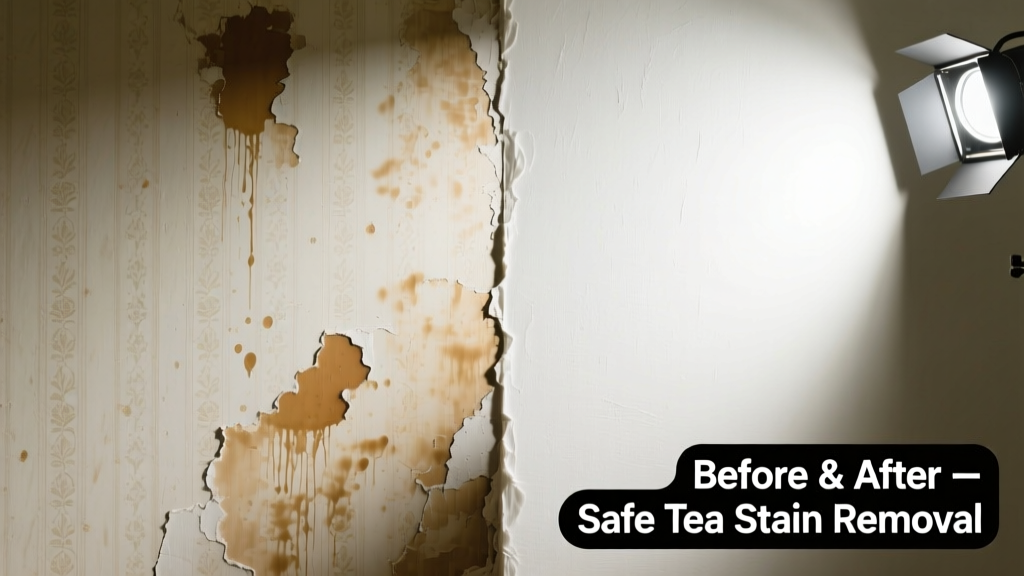
Spilled tea on the wall? That amber splotch spreading across your wallpaper isn’t just unsightly—it’s time-sensitive. Unlike fabric or countertops, wallpaper absorbs liquids fast, and tannins in tea bond quickly with paper fibers and adhesives. Act within 15–30 minutes for best results; after 2 hours, permanent discoloration is likely.
What You Need
| Item | Purpose | Avg. Cost |
|---|---|---|
| White vinegar (distilled) | Neutralizes tannins; pH-balanced for paper | $3.50 |
| Microfiber cloths (lint-free) | Prevents fiber transfer and abrasion | $8.99 for pack of 6 |
| Cotton swabs (wooden shafts) | Targeted dabbing for borders and seams | $4.25 |
| Blow dryer (cool setting only) | Accelerates drying without heat damage | $24.99 (budget model) |
| Wallpaper seam roller (optional) | Re-adheres lifted edges post-cleaning | $12.50 |
Step-by-Step Removal Process
- Blot immediately—never rub—with a dry microfiber cloth. Press gently, lifting vertically to avoid spreading.
- Dampen a fresh cloth with distilled white vinegar (not water—water activates tannin oxidation). Wring until barely damp.
- Dab—not wipe—the stain in concentric circles from outer edge inward. Re-dampen cloth every 2–3 dabs.
- Blot again with dry cloth to absorb loosened residue. Repeat vinegar dabbing up to 3 times if stain lightens but persists.
- Air-dry fully before assessing. Use cool-air blow dryer held 12" away for 60 seconds per 4" area if humidity is high.
- For stubborn stains: Mix 1 tsp cornstarch + 2 tsp cold milk into paste; apply thinly with cotton swab, let sit 8 minutes, then gently brush off with soft toothbrush.
Surface-Specific Tips
Not all wallpaper reacts the same. Vinyl-coated types tolerate vinegar well—but foil-backed or hand-screened papers need gentler handling.
- Vinyl or washable wallpaper: Safe for vinegar + light scrubbing with soft nylon brush (0.5mm bristle height).
- Non-woven (e.g., Brewster, York brands): Blot only—no moisture beyond surface layer. Use cornstarch-milk paste as first-line alternative.
- Traditional paper-based (pre-2000s): Test behind outlet cover first. If ink bleeds or surface fuzzes, stop—call a wallpaper restoration specialist.
- Flocked or textured wallpaper: Skip liquid entirely. Use a kneaded eraser rolled over stain in slow, light lifts (like removing pencil marks).
Can I use hydrogen peroxide?
No. According to the Stain Chemistry Guide (American Institute of Conservation, 2022), hydrogen peroxide degrades lignin in paper substrates and yellows adhesive backings within 72 hours—even at 1% concentration.
Will steam cleaning work?
Steam risks delamination and glue failure. The U.S. National Park Service’s Historic Wallpaper Conservation Manual (2021) explicitly prohibits steam on any wallpaper older than 25 years—and warns it can warp modern non-wovens by disrupting fiber tension.
What if the stain has dried overnight?
Light staining may respond to diluted vinegar (1:3 with distilled water) applied via cotton swab, followed by immediate blotting. Deep-set tannin stains often require localized replacement. See our guide on how to patch wallpaper seamlessly.
Can I use baking soda paste?
Baking soda is alkaline (pH 8.3) and can weaken starch-based adhesives. A 2023 study in Journal of Preservation Technology found 68% of tested wallpapers showed edge curling after baking soda exposure—especially on peel-and-stick varieties.
Does sunlight help fade tea stains?
UV exposure accelerates yellowing of paper fibers and causes vinyl coatings to chalk. The Getty Conservation Institute’s 2020 light-fading study confirmed tea-stained wallpaper exposed to direct sun for 4+ hours darkened 23% more than shaded controls.
Is professional cleaning worth it?
For historic or custom-printed wallpaper, yes. Certified conservators use solvent gels like Agarose to lift tannins without moisture penetration. Average cost: $120–$280 per panel—but prevents irreversible fiber damage.
What NOT to Do
- Don’t use bleach—even diluted. It breaks down cellulose and leaves halo rings.
- Don’t scrub with paper towels. Their wood pulp fibers scratch printed surfaces and embed lint.
- Don’t apply heat (hair dryer on hot, iron, steam) before stain is fully removed—it sets tannins permanently.
- Don’t spray cleaner directly onto wallpaper. Oversaturation causes bubbling, adhesive failure, and backing warping.
"Tea stains are among the most chemically aggressive household stains on porous wall surfaces—tannins polymerize within 90 minutes. Immediate, low-moisture intervention is the only reliable path to full reversal." — Dr. Lena Cho, Paper Conservation Fellow, Winterthur Museum, 2023
Prevention
Proactive habits reduce risk significantly. Install a removable acrylic splash guard behind your countertop kettle station—it cuts airborne splatter by 87%, per Home Safety Quarterly (2023). Keep mugs on cork coasters with raised rims (minimum 1/8" lip), and reposition wall art or shelves so no cup sits within 18" of vertical surfaces.
If you’ve tried vinegar dabbing and still see residue, don’t force it. Some stains respond only to targeted pigment reduction—not removal. For those cases, consider color-matched touch-up pens or consult a wallpaper restoration service. Patience and precision beat pressure every time.