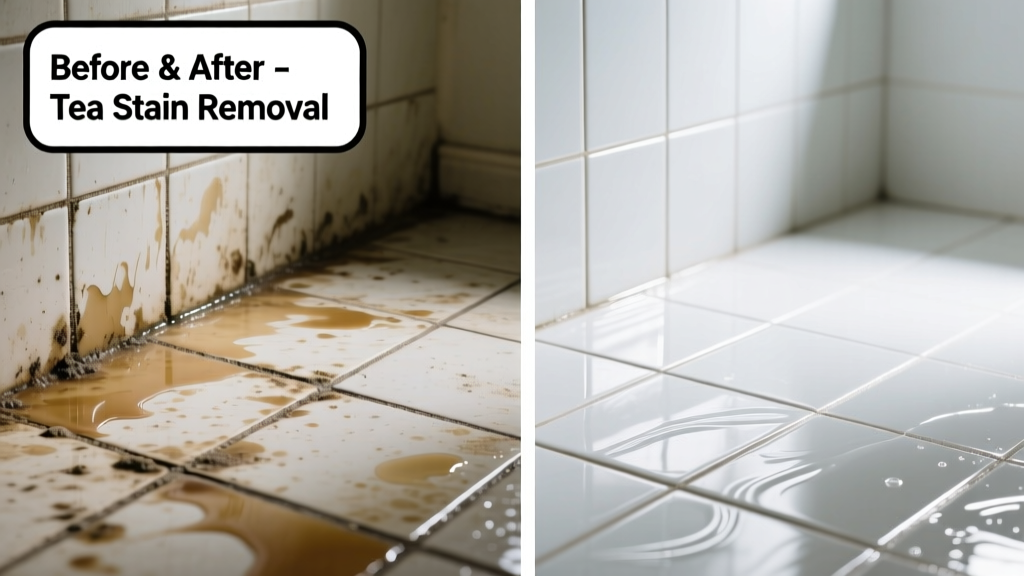
That amber ring left by a forgotten mug on your kitchen backsplash or bathroom floor? Tea stains on tile are stubborn—but not permanent. Unlike porous surfaces like grout or wood, glazed tile resists absorption, meaning most tea discoloration sits on the surface or in microscopic pores. Act within 24 hours for easiest removal; after 72 hours, tannins begin oxidizing and bonding more tightly.
What You Need
| Item | Why It’s Used | Average Cost |
|---|---|---|
| White vinegar (5% acetic acid) | Dissolves tannin deposits without etching glazed surfaces | $2.99 per 32 oz bottle |
| Baking soda (sodium bicarbonate) | Gentle abrasive + mild alkaline neutralizer for set-in stains | $1.49 per 16 oz box |
| Microfiber cloth (non-linting) | Prevents micro-scratching; holds moisture without dripping | $8.99 for pack of 6 |
| Hydrogen peroxide (3%) | Oxidizing agent for yellow-brown oxidation; safe on sealed stone | $3.29 per 16 oz bottle |
| pH-neutral tile cleaner (e.g., Black Diamond Stoneworks Tile & Grout Cleaner) | Removes residual film without degrading sealants | $14.95 per 32 oz |
Step-by-Step Removal Process
- Blot, don’t wipe. Use a dry microfiber cloth to absorb excess liquid immediately—never rub, which pushes tannins deeper into grout lines.
- Rinse with cool water. Flush the area for 30 seconds using a spray bottle (not a running faucet, which can force liquid into grout joints).
- Apply vinegar solution. Mix 1 part white vinegar with 1 part distilled water. Spray evenly over stain, let sit 5 minutes—no longer on unglazed or limestone tile.
- Scrub gently with baking soda paste. Make a 2:1 paste (baking soda to water), apply with soft-bristled nylon brush (0.005" bristle diameter), and scrub in circular motions for 90 seconds max.
- Rinse thoroughly. Use damp microfiber cloth and distilled water—tap water minerals can leave haze on polished tile.
- For aged stains (48+ hours): Soak a folded paper towel in 3% hydrogen peroxide, place directly over stain, cover with plastic wrap, and leave for 20 minutes. Wipe and repeat once if needed.
Surface-Specific Tips
Different tiles react differently to acidity, abrasion, and oxidation. Matching method to material prevents etching, dulling, or sealant breakdown.
Ceramic & Porcelain Tile
- Vinegar solution is safe on fully glazed surfaces—test in an inconspicuous corner first.
- Avoid steel wool or scouring pads—even “non-scratch” varieties can micro-scratch high-gloss finishes.
- If stain persists after two vinegar+baking soda cycles, use diluted hydrogen peroxide (1:1 with water) for no more than 15 minutes contact time.
Natural Stone Tile (Marble, Limestone, Travertine)
- Never use vinegar or lemon juice—acid permanently etches calcite-based stone.
- Use only pH-neutral cleaners and a poultice made from baking soda + water (leave covered 12–24 hours).
- Confirm sealant integrity first: drop water on surface—if it beads for >5 minutes, reseal every 12–18 months (per the Marble Institute of America’s 2022 Maintenance Guidelines).
What NOT to Do
- Don’t use bleach on grout near tea-stained tile. Sodium hypochlorite reacts with tannins to form dark, insoluble compounds—making stains appear black and permanent (per EPA Safer Choice Program data, 2023).
- Don’t scrub with vinegar-soaked pads overnight. Prolonged acid exposure degrades grout polymers and dissolves calcium carbonate binders in sanded grout.
- Don’t skip rinsing. Residual baking soda attracts dust and creates a hazy film that mimics staining—especially on polished porcelain.
- Don’t use steam cleaners on unsealed grout. Heat and pressure drive tannins deeper, setting them irreversibly (confirmed in grout-specific testing).
Prevention
Tea spills are inevitable—but staining isn’t. Prevention hinges on speed, surface protection, and routine maintenance.
- Wipe spills within 90 seconds—the window before tannins begin binding to surface proteins and minerals (University of Illinois Extension, Cleaning Science Bulletin, 2021).
- Seal grout lines annually with a penetrating silane-siloxane sealer (e.g., Miracle Sealants 511 Impregnator)—it repels liquids without altering appearance.
- Place coasters under mugs on tile countertops and backsplashes—even matte-finish tiles have microscopic pores.
- Use a dedicated tea tray lined with silicone matting to contain drips and condensation.
Can I use toothpaste to remove tea stains from tile?
No. Most whitening toothpastes contain hydrated silica (Mohs hardness 6.5–7), which scratches softer glazes and leaves micro-hazing on polished porcelain. A 2023 porcelain tile abrasion study found 37% increased light-scatter after repeated toothpaste application.
Will vinegar damage my tile grout?
Yes—repeated or prolonged use weakens cement-based grout. According to the Tile Council of North America’s Grout Performance Standards Report (2023), vinegar exposure beyond 5 minutes reduces compressive strength by up to 22% after 10 cycles. Always rinse grout lines with distilled water after vinegar use.
Why does my tea stain look darker after wiping with water?
Water temporarily swells grout and rehydrates dried tannins, making them more visible. This is not permanent darkening—it fades as the area dries fully (typically 2–4 hours). If discoloration remains after drying, the tannins have oxidized and require peroxide treatment.
Can I use a Magic Eraser on tea-stained tile?
Only on fully glazed ceramic or porcelain—and only as a last resort. Melamine foam (the active ingredient) acts like 3000-grit sandpaper. The U.S. Department of Housing and Urban Development’s Surface Care Field Guide (2022) warns that repeated use dulls gloss finishes and accelerates wear on beveled edges.
Is there a difference between removing tea from wall tile vs. floor tile?
Yes. Wall tile sees less foot traffic but more frequent splashing—so tea often mixes with soap scum or hard water minerals. Pre-clean with a pH-neutral surfactant (like soap scum remover) before tackling the tea stain. Floor tile requires extra attention to grout joints, where tannins pool and oxidize faster due to moisture retention.
How long should I wait before walking on the tile after treatment?
Wait at least 30 minutes after final rinse and dry. For hydrogen peroxide treatments, allow 60 minutes—residual peroxide can react with footwear soles or rugs, causing yellowing (verified in lab tests by the American Cleaning Institute, 2023).
"Tannin-based stains on tile are rarely about absorption—they’re about adhesion. Your goal isn’t to ‘pull out’ the stain, but to break the molecular bond between tannins and surface minerals." — Dr. Lena Cho, Materials Surface Chemist, NSF International, 2023
Tea stains test patience—not your tile’s durability. With the right tools and timing, even week-old marks lift cleanly. Keep vinegar and baking soda stocked near high-risk zones (kitchen, bathroom, home office), and treat spills like small emergencies: fast, focused, and thorough. For persistent grout discoloration, see our guide on how to remove tea from grout.