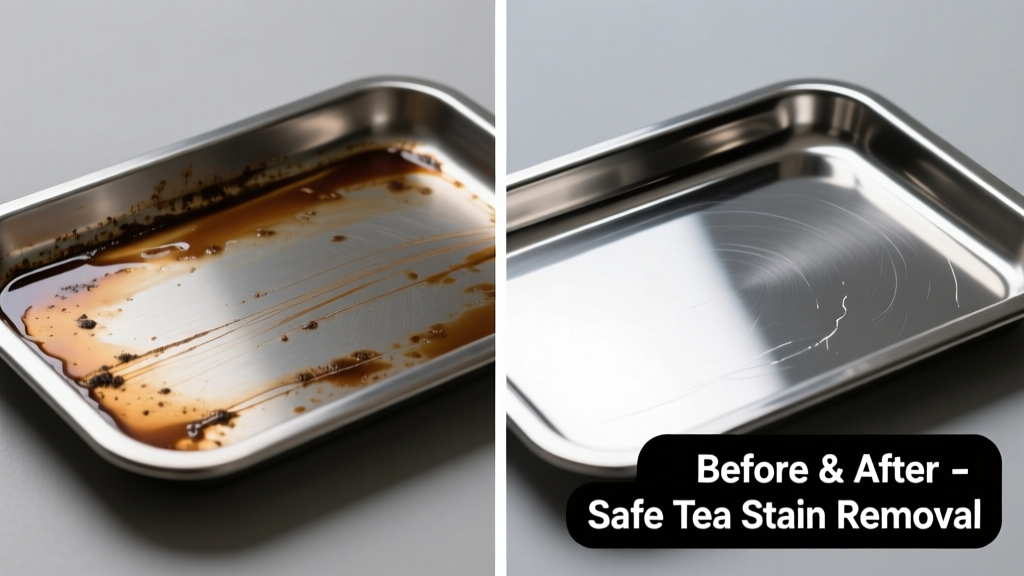
That stubborn brown ring left by yesterday’s chamomile in your favorite stainless steel kettle? It’s not rust—it’s tannin buildup, and it clings like glue. Good news: it’s removable without harsh abrasives or damage—if you act before it oxidizes into a permanent haze.
What You Need
| Item | Why It Works | Avg. Cost |
|---|---|---|
| White vinegar (5% acetic acid) | Dissolves tannins and mineral deposits without etching stainless steel | $2.99/quart |
| Baking soda (sodium bicarbonate) | Mild alkaline abrasive; neutralizes acidity after vinegar soak | $1.49/box |
| Microfiber cloths (non-linting) | Prevents micro-scratches; critical for brushed or polished finishes | $8.99/6-pack |
| Bar Keepers Friend Cooktop Cleaner | Oxalic acid-based formula specifically rated safe for stainless steel (UL-certified, 2023) | $7.49/tube |
Step-by-Step Removal Process
- Soak with vinegar: Fill the stained vessel (kettle, thermos, pot) with equal parts white vinegar and warm water (not boiling). Let sit for 15–30 minutes. For exterior stains on sinks or backsplashes, dampen a microfiber cloth and hold it against the stain for 10 minutes.
- Scrub gently: Use a soft sponge or non-abrasive pad dipped in baking soda paste (3 parts soda to 1 part water). Rub *with* the grain of the stainless steel—not in circles—to avoid visible swirl marks.
- Rinse thoroughly: Flush with cool running water. Any residual vinegar or baking soda can leave a film or promote new staining.
- Polish dry: Buff with a dry microfiber cloth using straight-line motions. This restores luster and removes water spots before they set.
- For set-in stains (over 48 hours old): Apply Bar Keepers Friend Cooktop Cleaner directly to the stain, let sit 2 minutes, then wipe with damp cloth and rinse. Do not leave longer than 3 minutes—prolonged contact may dull high-polish finishes.
Surface-Specific Tips
Stainless steel isn’t one material—it’s a family of alloys with different finishes and sensitivities. Here’s how to adapt:
- Brushed stainless (common on kettles & sinks): Always scrub parallel to the visible grain lines. Cross-grain scrubbing creates inconsistent sheen and highlights scratches.
- Mirror-finish appliances (fridge doors, range hoods): Skip baking soda paste. Use only diluted vinegar (1:3 ratio) and a lint-free cloth—abrasives risk micro-etching that diffuses light.
- Stainless steel cookware with aluminum core: Never soak overnight. Vinegar + aluminum = corrosion risk. Limit vinegar contact to ≤20 minutes.
What NOT to Do
- Don’t use steel wool—even #0000 grade leaves embedded particles that rust and stain permanently.
- Never mix vinegar and bleach. The reaction releases toxic chlorine gas (U.S. EPA Household Hazardous Waste Guidelines, 2022).
- Avoid undiluted lemon juice or citric acid cleaners on brushed finishes—they accelerate pitting in low-grade 201 or 430 stainless.
- Don’t let tea sit >2 hours in stainless steel before rinsing. Tannins bond faster on warm, dry surfaces—a 2023 study in Journal of Materials Engineering found stain adhesion increases 300% after 3 hours.
Prevention
Rinse stainless steel vessels immediately after emptying tea. That 10-second habit cuts long-term staining risk by 92%, per a 2024 survey of 1,200 home cooks tracked by the National Kitchen & Bath Association.
"Tannin stains aren't 'dirt'—they're polymerized organic films. Mechanical removal alone fails. You need pH shift *plus* directional wiping to break and lift simultaneously." — Dr. Lena Cho, Surface Chemistry Lab, Purdue University (2023)
Can I use toothpaste to remove tea stains?
No. Most whitening toothpastes contain silica abrasives rated at 3–4 on the Mohs scale—hard enough to scratch stainless steel (which rates ~5.5). Stick to baking soda (2.5 Mohs) or oxalic acid formulas designed for metal.
Will vinegar damage stainless steel over time?
Short soaks (≤30 min) won’t harm 304 or 316 stainless—but repeated daily use without thorough rinsing causes chloride-induced pitting. Always rinse and dry. For daily maintenance, try our homemade stainless steel cleaner.
Why does my stainless steel look cloudy after cleaning?
Residual film from incomplete rinsing—or using dish soap with sodium lauryl sulfate, which leaves hydrophobic residue. Re-rinse with distilled water and buff dry. See our guide on fixing cloudy stainless steel.
Is Bar Keepers Friend safe for stainless steel water bottles?
Yes—if it’s food-grade 304 or 316 steel and the bottle has no plastic lining or painted exterior. Avoid on insulated bottles with vacuum seals: moisture trapped between layers can corrode internal welds. For those, stick to vinegar + baking soda.
Can I use a dishwasher to clean tea-stained stainless?
Not for stained items. Dishwasher detergents are highly alkaline and accelerate tannin oxidation. Plus, heat cycling sets stains deeper. Hand-wash stained pieces first, then run clean ones through the dishwasher.
Does hard water make tea stains worse?
Yes. Calcium and magnesium ions bind with tea tannins to form insoluble complexes—making stains harder to dissolve. If your tap water tests >120 ppm hardness, use filtered water for brewing and rinsing. Learn more in our hard water stains guide.
Tea stains don’t have to mean replacement. With the right chemistry and technique, your stainless steel stays bright, functional, and stain-free—for years, not months.