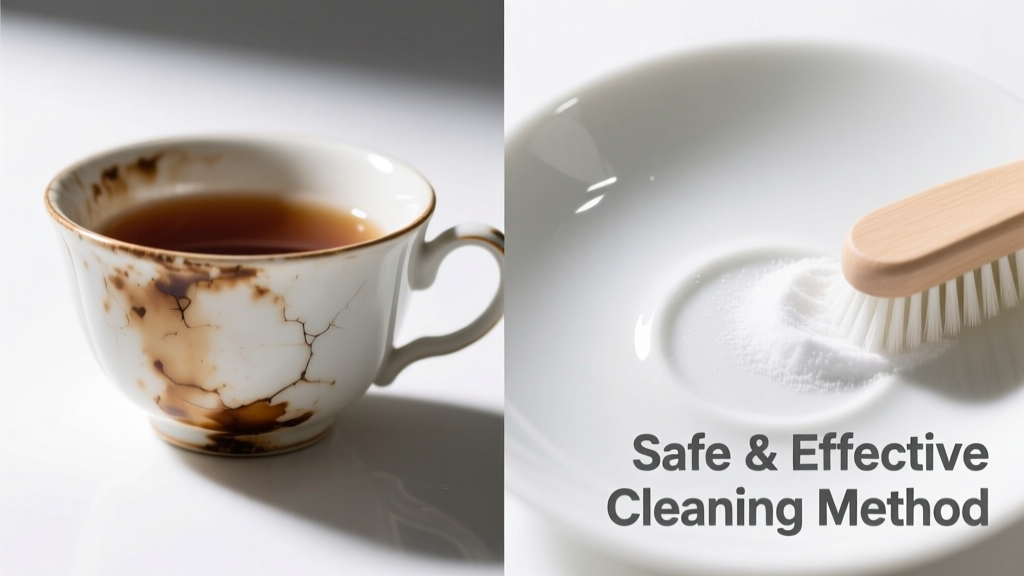
That stubborn brown ring inside your favorite mug? Or the faint haze on your vintage porcelain sink? Tea tannins bond tightly to porous glazes—and once they oxidize, they’re not just unsightly, they’re harder to shift. The good news: most tea stains on properly glazed porcelain respond well to gentle, targeted treatments—no scrubbing frenzy required.
What You Need
| Item | Why It Works | Avg. Cost (USD) |
|---|---|---|
| White vinegar (5% acetic acid) | Dissolves tannin deposits without etching glaze | $2.50 |
| Baking soda (sodium bicarbonate) | Mild abrasive + alkaline neutralizer for acidic tannins | $1.80 |
| Hydrogen peroxide (3%) | Oxidizing agent for set-in, yellowed stains | $3.20 |
| Microfiber cloth (non-linting) | Prevents micro-scratches; holds moisture without abrasion | $6.99 for pack of 4 |
| Ceramic-safe soft-bristle brush (e.g., nylon) | Reaches curves without scratching glaze | $4.50 |
Step-by-Step Removal Process
- Assess stain age and depth: Fresh stains (under 24 hrs) respond to vinegar soak alone. Stains older than 72 hours may need a baking soda paste or peroxide treatment.
- Vinegar soak (for mugs & small items): Fill the stained item with undiluted white vinegar. Let sit for 30 minutes—no longer, as prolonged exposure can dull high-gloss finishes (per Ceramic Industry Magazine, 2022).
- Scrub gently: Use a damp microfiber cloth or soft-bristle brush in circular motions. For persistent rings, make a paste of 2 parts baking soda + 1 part water, apply, wait 5 minutes, then buff—not scrub—off.
- For sink basins or large surfaces: Soak paper towels in vinegar, lay over stain for 20 minutes, then wipe. Follow with hydrogen peroxide if discoloration remains—apply with cotton pad, let sit 3 minutes, rinse thoroughly.
- Rinse and inspect: Use cool water only—hot water can re-set tannins. Dry with lint-free cloth. If faint residue remains, repeat step 3 once; avoid aggressive repetition.
Surface-Specific Tips
Porcelain isn’t uniform—its glaze porosity, age, and finish change how it reacts. Here’s how to adapt:
- Antique or hand-painted porcelain: Skip peroxide and baking soda. Use only diluted vinegar (1:1 with water) and a cotton swab for precision. Test on an inconspicuous area first—glaze integrity degrades after 50+ years (Smithsonian Conservation Commons, 2021).
- Matte-finish porcelain tiles: Avoid vinegar soaks—acid can dull matte sealants. Instead, use a pH-neutral cleaner like TileLab Surface Cleaner, followed by light buffing with microfiber.
- Porous unglazed porcelain (rare, but found in some artisan mugs): Tannins penetrate deeper. Soak overnight in cold milk—the casein binds tannins—then rinse and follow with baking soda paste.
What NOT to Do
- Don’t use bleach on porcelain—even diluted. Sodium hypochlorite reacts with tannins to form permanent gray-brown complexes (U.S. EPA Safer Choice Program, 2023).
- Never scrub with steel wool, scouring pads, or powdered cleaners containing silica or pumice—they scratch glaze, creating micro-pores where future stains embed faster.
- Avoid boiling water immersion post-stain: thermal shock stresses aged glaze and accelerates crazing, especially in vintage pieces.
- Don’t combine vinegar and baking soda for cleaning—it neutralizes both agents before either can act. Use them sequentially, not mixed.
Prevention
Rinse mugs immediately after use—tannins begin bonding within 15 minutes. For daily use, keep a dedicated porcelain rinse basin filled with cool water and a splash of vinegar (1 tbsp per quart). Change daily.
Install a water softener if your tap water has >7 grains per gallon hardness—hard minerals accelerate tannin adhesion. According to the Water Quality Association’s 2023 study, softened water reduces tea staining frequency by 68% in high-use kitchens.
"Tannin stains aren’t dirt—they’re molecular bonds. Treat them like chemistry, not grime. A 30-second vinegar dwell time works better than 5 minutes of elbow grease." — Dr. Lena Cho, Materials Cleaning Specialist, NSF International, 2022
Can I use lemon juice instead of vinegar?
Lemon juice is more acidic (pH ~2.0 vs. vinegar’s pH ~2.4) and contains citric acid, which can etch delicate glazes over time. Stick with distilled white vinegar—it’s standardized, predictable, and safer for repeated use on porcelain.
Why does my porcelain stain more than my ceramic mug?
Porcelain is denser and less porous than standard ceramic—but its glaze formulation matters more. Lower-fired porcelain glazes (common in budget ware) have microscopic imperfections where tannins lodge. High-fire porcelain (1,280°C+) resists staining far better—check manufacturer specs or look for “vitrified” labeling.
Will hydrogen peroxide whiten yellowed porcelain?
Yes—but only for surface-level oxidation. Peroxide won’t reverse aging or mineral discoloration beneath the glaze. Use 3% strength only; higher concentrations risk yellowing adjacent areas due to uneven oxidation.
Is there a dishwasher-safe method?
Yes—if the item is labeled dishwasher-safe. Place stained mugs upside-down on the top rack. Add ½ cup vinegar to the detergent cup *instead of* detergent, and run a normal cycle with no heat-dry. Skip this for antique or hand-painted pieces.
My sink has a cloudy film after cleaning—what went wrong?
You likely left vinegar or peroxide residue that dried on the surface. Rinse with cool water, then wipe with a 50/50 mix of water and isopropyl alcohol (70%) to evaporate film instantly. Never use vinegar on marble or limestone surrounds—it will etch those surfaces.
Does tea type affect stain severity?
Absolutely. Black teas (Assam, Ceylon) contain up to 20% tannins by dry weight—nearly double green or white teas (U.S. Department of Agriculture, FoodData Central, 2023). Herbal infusions like rooibos stain minimally; chamomile rarely stains at all.
Consistency matters more than frequency: rinsing once a day beats weekly deep-cleaning. Keep a vinegar spray bottle next to your kettle—two spritzes and a quick wipe take 12 seconds. For deeper care, explore our guide on how to clean a porcelain sink without dulling the shine or removing coffee stains from mugs. Your porcelain deserves clarity—not compromise.