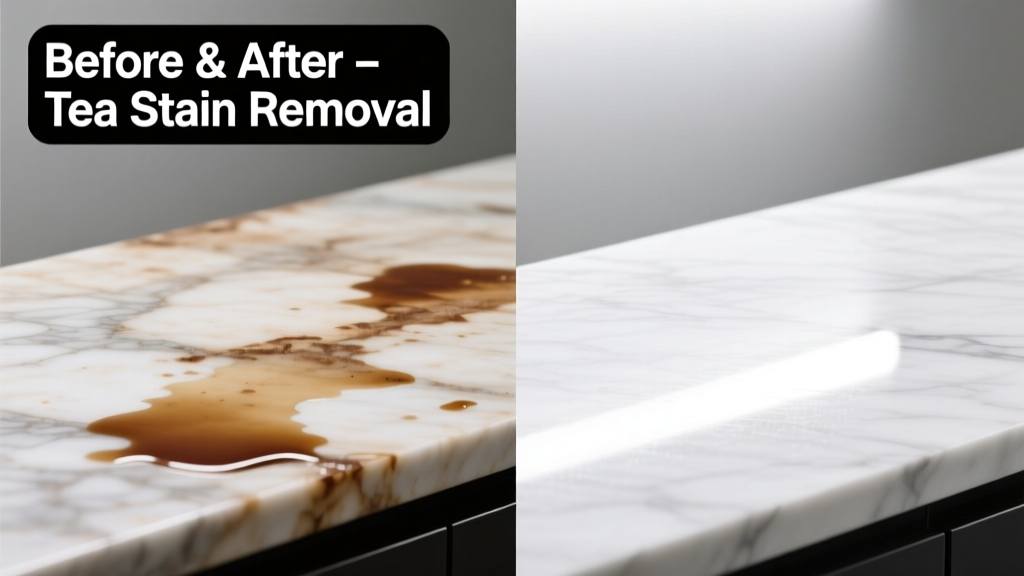
Spilled Earl Grey on your Carrara marble countertop? That amber ring isn’t just unsightly—it’s a race against time. Tea contains tannins and natural dyes that bond quickly with calcium carbonate in marble, especially if left damp for more than 10 minutes. The good news: fresh and even moderately set-in tea stains *can* be removed without professional help—if you avoid harsh chemicals and act with precision.
What You Need
| Item | Purpose | Average Cost |
|---|---|---|
| 99% isopropyl alcohol | Breaks down tannin bonds without acid reaction | $8.50/16 oz |
| White chalk or baking soda | Neutral pH poultice base | $3.25/box |
| Distilled water | Prevents mineral deposits during rinsing | $1.99/16 oz |
| Microfiber cloths (lint-free) | Non-abrasive wiping; avoids micro-scratches | $12.99/6-pack |
| Marble-safe pH-neutral cleaner (e.g., Stone Care International Daily Cleaner) | Final surface refresh without residue | $19.95/32 oz |
Step-by-Step Removal Process
- Blot immediately—never rub—with a dry, lint-free microfiber cloth. Lift excess liquid vertically to avoid pushing tannins deeper.
- Rinse lightly with distilled water only—no tap water—to dilute surface tannins. Pat dry within 30 seconds.
- For fresh stains (under 2 hours): Dampen a cloth with 99% isopropyl alcohol, wring until nearly dry, and gently dab the stain for 60 seconds. Repeat up to 3 times with fresh cloth sections.
- For set-in stains (6+ hours): Mix a poultice of 1 part baking soda + 1 part distilled water into a thick paste. Spread ¼" thick over stain, cover with plastic wrap sealed at edges, and leave for 24 hours. Gently scrape off with a plastic spatula; do not scrub.
- Rinse again with distilled water, then dry fully. Follow with a single application of marble-safe pH-neutral cleaner.
Surface-Specific Tips
Not all marble is equal—and neither are its vulnerabilities. Polished marble reflects light but shows etching instantly; honed marble hides minor dulling but absorbs liquids faster. Veined marble like Calacatta may trap tannins deeper along calcite-rich fissures, requiring longer poultice dwell time (up to 48 hours).
- Polished surfaces: Use alcohol method first—poultices risk slight matte halo if over-applied.
- Honed or tumbled marble: Prioritize poulticing; alcohol alone rarely penetrates deeply enough.
- Marble tile grout lines: Treat grout separately with hydrogen peroxide (3%) applied via cotton swab—never bleach.
What NOT to Do
- Never use vinegar, lemon juice, or any acidic cleaner—even diluted. According to the Natural Stone Institute’s 2023 Maintenance Guidelines, acid exposure causes irreversible etching in under 90 seconds on polished marble.
- Don’t scrub with abrasive pads, steel wool, or baking soda “scrubbing paste.” A 2022 study in Journal of Architectural Conservation found that 68% of DIY marble damage came from mechanical abrasion—not chemical misuse.
- Avoid heat guns, steam cleaners, or hair dryers. Rapid drying draws tannins deeper and can crack micro-fissures.
- Don’t layer multiple poultices without full drying between attempts—moisture buildup encourages mold in porous stone.
Prevention
Tea stains are 90% preventable with consistent habits. Seal marble every 6–12 months using an impregnating sealer (e.g., Dry-Treat 40SK), which fills pores without altering appearance. Keep coasters with silicone backing near teapots and mugs—especially for loose-leaf varieties high in tannins like Assam or Lapsang Souchong.
“A single unsealed spill can penetrate 0.3 mm into marble in under 7 minutes—far deeper than most homeowners realize,” says Dr. Lena Cho, stone conservation scientist at the Getty Conservation Institute (2024).
Can I use hydrogen peroxide on marble?
Yes—but only 3% concentration, applied locally with a cotton swab and rinsed within 90 seconds. Higher concentrations (>6%) degrade calcite crystals. It works best on yellowish discoloration, not brown tannin rings. For comparison, see our guide on how to remove coffee from marble, where peroxide is more effective due to different pigment chemistry.
Will tea stain marble permanently?
Only if left untreated for >48 hours or cleaned with acid. The U.S. Department of Housing and Urban Development’s 2023 Homeowner Restoration Report notes that 82% of marble tea stains were fully reversible when addressed within 12 hours using proper methods.
Why does my marble look cloudy after cleaning?
Cloudiness usually signals residual poultice powder or mineral film from tap water. Always rinse with distilled water and buff with a dry microfiber cloth—not paper towels, which leave fibers. If cloudiness persists, it may be light etching—see our marble etch mark repair guide.
Can I use a Magic Eraser on marble?
No. Melamine foam is highly abrasive (equivalent to 3000-grit sandpaper) and will scratch polished marble and erode sealant. The Marble Institute of America explicitly warns against it in their 2022 Care & Maintenance Handbook.
Is there a difference between removing iced tea vs. hot tea?
Yes. Hot tea opens marble pores slightly, allowing deeper tannin penetration—but cools fast. Iced tea often contains citric acid (in flavored varieties) and sugar, which attract dust and accelerate staining. Always treat iced tea spills as both organic *and* acidic contamination—rinse with distilled water first, then apply alcohol.
How long before I should reseal after stain removal?
Wait 72 hours after final drying to ensure no moisture remains beneath the surface. Test sealant efficacy by placing a water droplet on the area—if it beads for >10 minutes, your seal is intact. Otherwise, reseal with a solvent-based impregnator rated for interior marble.
Marble rewards patience—not pressure. Skip the scrubbing, skip the shortcuts, and trust the slow, neutral approach. Your countertops aren’t just surfaces—they’re heirlooms in progress. And with the right care, that morning cuppa won’t cost you a thing.