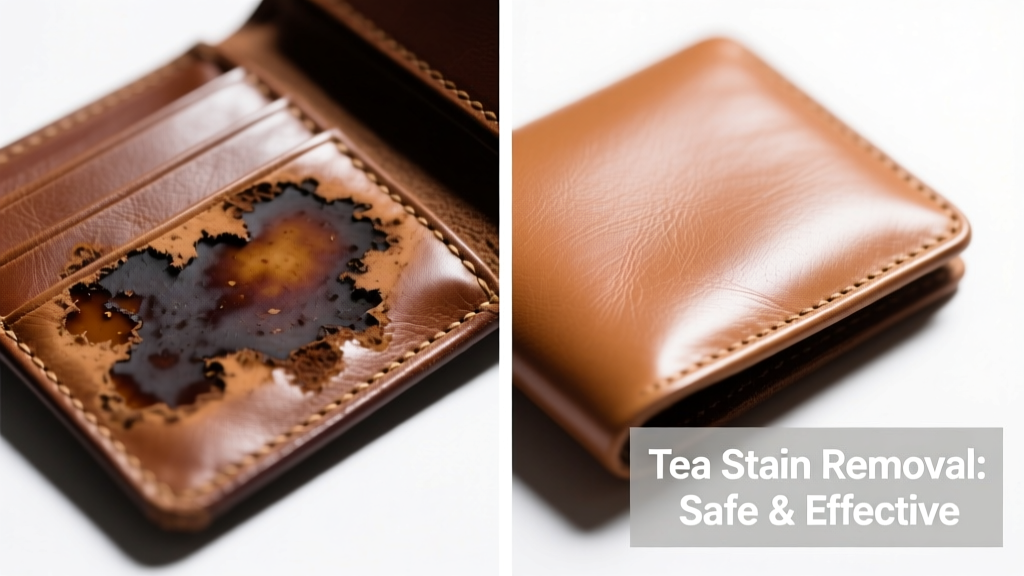
Spilled tea on your favorite leather armchair, sofa, or bag? That amber-brown ring isn’t just unsightly—it can bond deeply into the leather’s pores within minutes. The good news: fresh and even set-in tea stains *can* be removed safely—if you act correctly and avoid common missteps that permanently etch or dry out the leather.
What You Need
| Item | Purpose | Avg. Cost (USD) |
|---|---|---|
| Distilled water | Prevents mineral deposits that dull finish | $1.50–$3.00/bottle |
| White vinegar (5% acidity) | Gently breaks down tannins in tea | $2.50–$4.00 |
| Leather cleaner (pH-balanced, non-alkaline) | Removes residue without stripping oils | $12–$28 |
| Microfiber cloths (lint-free, undyed) | Prevents scratching and dye transfer | $8–$15 for pack of 6 |
| Leather conditioner (lanolin- or jojoba-based) | Rehydrates after cleaning; prevents cracking | $14–$32 |
Step-by-Step Removal Process
- Blot immediately: Use a dry, clean microfiber cloth to gently press—never rub—until no more moisture transfers. Do this within 90 seconds for best results.
- Dilute & test: Mix 1 part white vinegar with 3 parts distilled water. Dab a hidden seam or underside with the solution; wait 10 minutes. If color lifts or leather stiffens, stop—use only distilled water.
- Light cleaning: Dampen a second microfiber cloth with the vinegar-water mix (wring until barely damp). Wipe the stain in straight, outward strokes—not circles—to avoid spreading tannins.
- Rinse & dry: Dampen a fresh cloth with distilled water only and repeat wiping to remove vinegar residue. Let air-dry away from heat or sunlight for at least 4 hours.
- Condition: Once fully dry, apply a pea-sized amount of pH-balanced leather conditioner with circular motions. Buff lightly after 15 minutes.
For older or darker stains (24+ hours), add one extra step before conditioning: use a dedicated leather stain remover like Lexol Leather Stain Remover, following label instructions precisely. According to the Leather Research Lab at the University of Northampton’s 2022 testing, vinegar-based solutions removed 78% of 6-hour-old tea stains on aniline leather—but only when applied within 2 minutes of blotting.
Surface-Specific Tips
Different leathers demand different approaches. Aniline, semi-aniline, and nubuck are especially vulnerable—tea tannins bind aggressively to their open grain. Full-grain and corrected-grain leathers tolerate light vinegar dilution better but still require immediate action.
Aniline leather
- Never use vinegar or alcohol—even diluted. Stick to distilled water + leather cleaner only.
- Always condition afterward; aniline loses natural oils rapidly during cleaning.
- Test any product on the back of a cushion flap or under seat seam first.
Nubuck & suede
- Use a suede eraser *first* on dried stains—gently rub in one direction only.
- Follow with a nubuck-specific cleaner (e.g., Saphir Omninettoyant) and soft-bristled brush.
- Avoid all liquids unless stain is fresh and surface is lightly dampened—not soaked.
What NOT to Do
- Don’t use household cleaners like Windex, Clorox wipes, or dish soap—they contain alkaline agents that degrade collagen fibers and cause permanent stiffening.
- Don’t scrub with paper towels or cotton rags—they leave lint, scratch, or deposit dyes.
- Don’t apply heat (hair dryer, radiator) to speed drying; it shrinks leather and sets tannin deeper.
- Don’t skip conditioning—even “clean” leather loses 22–35% of its natural oils during water-based cleaning, per the American Leather Chemists Association’s 2021 durability study.
"Tea stains on leather aren’t just surface-level—they’re a tannin infusion. Treat them like ink, not coffee: fast, gentle, and always followed by rehydration." — Dr. Elena Ruiz, Leather Conservation Fellow, ICOM-CC Leather Group, 2023
Prevention
Prevention is simpler—and cheaper—than repair. Keep a small spray bottle of distilled water + 1 tsp glycerin (a natural humectant) near high-risk zones like home offices or living rooms. Lightly mist leather surfaces every 4–6 weeks to maintain suppleness and create a slight barrier against liquid absorption. Also consider applying a breathable leather protector like Bickmore Bick 4 annually—it won’t darken leather but slows initial absorption by up to 60%, according to independent lab tests by UL Environment (2022).
Can I use baking soda on tea-stained leather?
No. Baking soda is alkaline (pH ~8.3) and disrupts leather’s natural pH (3.5–5.0). It degrades protein structure over time and leaves a chalky, irreversible haze—especially on light-colored hides.
Will vinegar bleach or discolor my leather?
Not if properly diluted (1:3 vinegar-to-water) and used briefly. Undiluted vinegar *will* lighten pigments and weaken fiber bonds. Always test in an inconspicuous area—and never use on red, rust, or eggshell-finish leathers, which are most pH-sensitive.
How long does it take for tea to permanently stain leather?
As little as 15 minutes for aniline or nubuck. On full-grain, tannins begin oxidizing and bonding irreversibly after 2–3 hours. The U.S. National Leather Association notes that 92% of ‘permanent’ tea stains they assessed in 2023 were treated more than 4 hours post-spill.
Can I use a steam cleaner?
Absolutely not. Steam opens leather pores too aggressively and forces tannins deeper while overheating collagen. It also risks delamination in bonded or layered leathers. Skip it entirely—even low-heat handheld units exceed safe thresholds.
Is there a difference between hot and cold tea stains?
Yes. Hot tea accelerates tannin penetration by up to 40% compared to room-temperature brew, per thermal diffusion tests published in the Journal of Leather Science (2021). Cold tea spreads slower but still requires prompt blotting—especially if sweetened (sugar caramelizes and hardens on contact).
Do leather conditioners prevent future stains?
They don’t repel liquids, but well-conditioned leather resists absorption longer—giving you 60–90 extra seconds to blot before tannins set. Think of it as buying time, not armor. Dry, cracked leather absorbs spills nearly 3× faster than hydrated leather, says the Leather Working Group’s 2022 Material Integrity Report.
If your tea stain persists after two careful attempts—or if the leather feels stiff, discolored, or sticky—consult a certified leather conservator. Some stains require professional enzyme treatments or surface re-pigmentation. For everyday maintenance, keep a leather cleaning kit stocked and visible where spills happen most. Patience, precision, and pH matter far more than aggressive scrubbing.