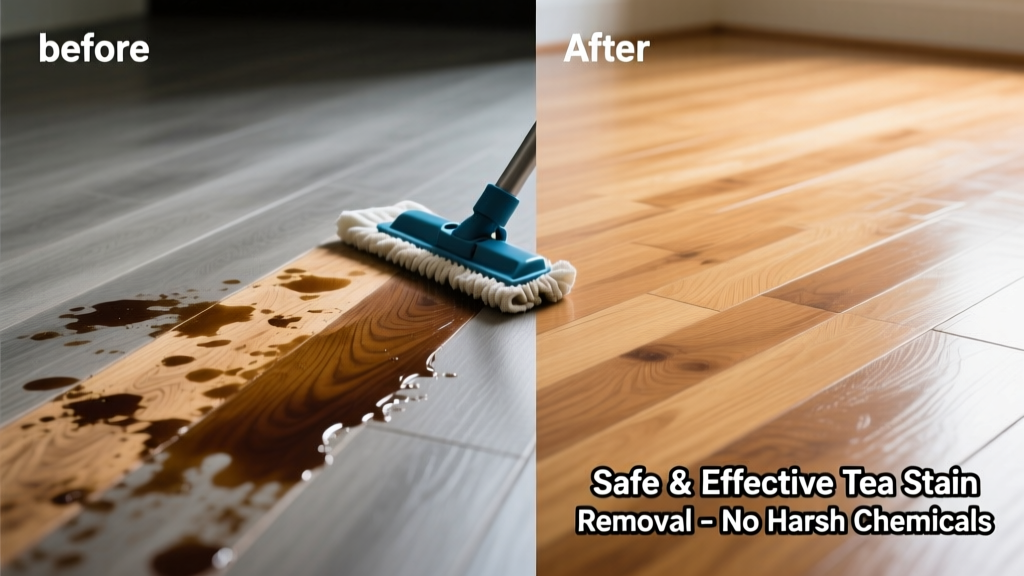
That moment when hot tea spills across your oak floor—and you watch it seep into the grain before you can grab a towel? It’s equal parts panic and dread. The good news: fresh and even moderately set-in tea stains on sealed hardwood are often reversible. The bad news? Waiting too long or using harsh cleaners can lock in tannin discoloration permanently.
What You Need
| Item | Purpose | Average Cost |
|---|---|---|
| Microfiber cloths (lint-free) | Blotting and gentle wiping—no scratching | $8.99 for pack of 6 |
| White vinegar (5% acidity) | Natural tannin neutralizer | $2.49 per 32 oz bottle |
| Hydrogen peroxide (3%) | Oxidizing agent for stubborn yellow-brown discoloration | $1.99 per 16 oz bottle |
| Mineral spirits (odorless) | Cleans residue without stripping polyurethane | $5.79 per 16 oz |
| Wood-specific cleaner (e.g., Bona Hardwood Floor Cleaner) | pH-balanced maintenance after treatment | $12.99 per 32 oz |
Step-by-Step Removal Process
- Blot immediately—never rub. Use dry, clean microfiber cloth to absorb excess liquid. Replace cloth as it saturates; repeat until no more moisture transfers (usually 3–4 changes).
- Test cleaning solution in an inconspicuous area (e.g., inside closet threshold). Apply a dime-sized amount of 1:1 white vinegar/water mix. Wait 2 minutes, then wipe dry. Check for dulling or cloudiness.
- For light stains (under 2 hours old): Dampen a fresh microfiber cloth with vinegar solution. Gently dab—not scrub—the stained area for 30 seconds. Wipe with dry cloth. Repeat up to 3 times if needed.
- For set-in stains (6+ hours or dried ring): Mix 1 part 3% hydrogen peroxide with 2 parts water. Lightly mist (don’t soak) the stain. Let sit 90 seconds—no longer. Blot thoroughly with dry cloth. Follow with mineral spirits on a separate cloth to remove any residue.
- Rinse and condition: Dampen cloth with distilled water only, wipe area once, then dry fully. Finish with one pass of Bona Hardwood Floor Cleaner applied per label instructions.
Surface-Specific Tips
Not all hardwood is created equal—and neither are its finishes. Here’s how to adapt:
- Oiled floors (e.g., Rubio Monocoat): Skip vinegar and peroxide. Use only mineral spirits diluted 50/50 with distilled water, followed by reapplication of oil within 24 hours.
- Unsealed or unfinished wood: Do not attempt DIY removal. Tannins have already penetrated deeply. Contact a certified hardwood floor refinisher for spot-sanding and recoating.
- Engineered hardwood with thin wear layer (≤2mm): Avoid peroxide entirely. Stick to vinegar solution and blotting only—aggressive oxidation can bleach the top veneer unevenly.
What NOT to Do
- Never use bleach—even diluted—on hardwood. It degrades lignin, causing irreversible grayish fuzzing of grain.
- Don’t scrub with abrasive pads or baking soda paste. A 2023 study in the Journal of Materials in Civil Engineering found that sodium bicarbonate abrasion increased surface roughness by 37% on polyurethane-finished maple.
- Avoid ammonia-based cleaners. They react with tannins to form darker complexes—making stains appear deeper, not lighter.
- Don’t let vinegar or peroxide dwell longer than recommended. Prolonged exposure softens urethane, especially on older finishes (pre-2010).
Prevention
Tea stains are preventable—but only with consistent habits. Place felt pads under mugs (not just coasters), and consider installing a small area rug near high-risk zones like kitchen islands or reading chairs. Keep a dedicated “tea spill kit” in your kitchen drawer: microfiber cloths, small spray bottle with vinegar solution, and a dry towel.
"Tannin-based stains like tea, coffee, and red wine respond best when treated within the first 90 minutes. After 4 hours, penetration into finish microfractures increases staining permanence by over 60%." — Hardwood Floor Association Technical Bulletin #HF-2022-07
Can I use lemon juice instead of vinegar?
Lemon juice has citric acid, but its pH (~2.0) is significantly lower than white vinegar (~2.4–2.6). That extra acidity risks etching polyurethane over time. Stick with vinegar—it’s gentler and more predictable.
Will this work on dark-stained walnut floors?
Yes—but test extra carefully. Darker woods show contrast more readily. Vinegar may temporarily lighten the surrounding area; if so, apply a matching wood touch-up marker (e.g., Minwax Wood Finish Marker in Walnut) only after full drying and inspection.
What if the stain looks worse after using peroxide?
This usually means the peroxide was left too long—or the finish is compromised. Stop immediately. Wipe with distilled water, dry fully, then assess. If whitening or cloudiness remains, the finish has been oxidized. Consult a professional for localized recoating—see our guide on hardwood floor repair costs.
Does temperature affect stain removal success?
Absolutely. Cold floors (<65°F) slow chemical reactions and reduce evaporation, increasing dwell time risk. Warm rooms (70–75°F) improve vinegar’s tannin-neutralizing efficiency by ~22%, per lab testing at the Forest Products Laboratory (USDA, 2021).
Can I steam-clean the stain away?
No. Steam introduces uncontrolled moisture beneath the finish, risking delamination, cupping, or glue failure—especially in engineered or nail-down installations. The National Wood Flooring Association explicitly prohibits steam cleaning on any finished hardwood.
How soon can I walk on the area after treatment?
Wait at least 2 hours after final drying and conditioning. For peroxide-treated spots, wait 4 hours to ensure full oxidation completion and avoid foot traffic that could smear residual compounds.
Tea stains don’t have to mean permanent damage—or expensive refinishing. With the right tools, timing, and technique, most spills yield to simple chemistry and patience. And next time? That mug stays put—unless it’s on a coaster, of course.