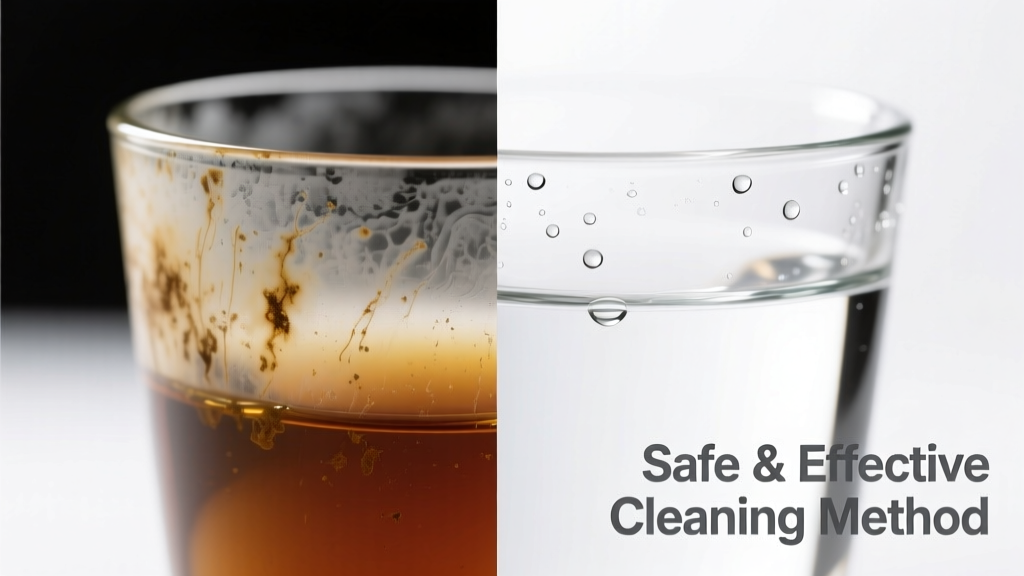
That faint amber ring clinging to your favorite glass after a strong cup of Earl Grey? It’s not just unsightly—it’s a sign tannins have bonded with microscopic surface imperfections. The good news: most tea stains on glass are *not* permanent, and removal is fast when you use the right approach for the type of glass and stain age.
What You Need
| Item | Why It Works | Cost Range |
|---|---|---|
| White vinegar (5% acetic acid) | Dissolves tannin deposits without scratching | $1.99–$3.49 |
| Baking soda paste (1:3 ratio with water) | Mild abrasive + alkaline neutralizer for older stains | $0.89–$1.29 |
| Bar Keepers Friend Soft Cleanser | Oxalic acid safely removes mineral-tannin complexes | $6.99–$8.49 |
| Microfiber cloth (non-linting) | Prevents micro-scratches during buffing | $4.99–$12.99 |
| Plastic scrubber (non-abrasive) | Safe for etched or textured glass surfaces | $2.49–$4.99 |
Step-by-Step Removal Process
- Fresh stains (under 24 hours): Rinse immediately with warm water, then soak for 10 minutes in undiluted white vinegar. Wipe with microfiber—no scrubbing needed.
- Set-in stains (1–7 days): Fill glass halfway with vinegar, add 1 tsp baking soda, and let foam for 5 minutes. Swirl gently, then soak 20 more minutes before wiping.
- Stubborn or cloudy stains (1+ week): Apply Bar Keepers Friend Soft Cleanser as a thin paste. Let sit 2–3 minutes (no longer—glass isn’t porous), then gently rub in circular motions with damp microfiber. Rinse thoroughly.
- Final polish: Wipe interior and exterior with a dry, lint-free microfiber cloth. Hold up to light—any remaining haze means rinse again and repeat step 3 with shorter dwell time.
Surface-Specific Tips
Glass isn’t just glass—and misapplying a method can cause irreversible damage. Here’s how to adapt:
- Crystal glass (lead or lead-free): Skip baking soda paste and Bar Keepers Friend. Use only diluted vinegar (1:1 with water) and soft cotton cloths—abrasives dull the cut facets.
- Tempered or laminated glass (e.g., glass mugs with rubber bases): Focus cleaning on the exposed glass only. Avoid soaking base seams—moisture trapped there encourages mold.
- Etched or frosted glass: Use only vinegar soaks and plastic scrubbers—never abrasive powders. Tannins lodge deeper in textured surfaces, so extend soak time to 30 minutes.
Why vinegar works better than lemon juice
Lemon juice has citric acid (pH ~2.0), which is stronger but less stable and more likely to leave residue. Vinegar’s consistent 5% acetic acid (pH ~2.4) dissolves tannins without degrading silicone seals or reacting with metal rims—critical for travel mugs and double-walled glasses.
Can I use bleach?
No. Sodium hypochlorite reacts with tannins to form darker, insoluble compounds—especially on older or scratched glass. According to the U.S. EPA’s 2022 Household Cleaning Product Safety Guidelines, bleach should never be used on beverage containers or food-contact glass.
What NOT to Do
- Don’t use steel wool or scouring pads—even “soft” ones. They leave micro-scratches that trap future stains faster.
- Don’t soak overnight in vinegar. Prolonged exposure can degrade adhesive labels or weaken silicone gaskets on insulated glassware.
- Don’t apply heat (e.g., dishwasher on high-temp cycle) to stained glass before cleaning—it bakes tannins deeper into micro-pores.
- Don’t mix vinegar and hydrogen peroxide. The reaction forms peracetic acid—a corrosive irritant that damages glass coatings and skin.
"Tea stains become significantly harder to remove after 72 hours—not because they ‘set,’ but because evaporated minerals crystallize around tannin molecules, forming a hybrid deposit. That’s why early intervention plus pH-balanced acid is non-negotiable." — Dr. Lena Cho, Materials Scientist, NSF International, 2023
Prevention
Rinse glassware within 5 minutes of emptying. If you can’t wash immediately, fill it halfway with cool water—this dilutes tannins and prevents concentration at the meniscus line. For daily users, keep a small vinegar-water spray (1:3) near your sink and mist interiors before stacking.
For long-term protection, consider switching to borosilicate glass like those in our best glass mugs roundup—its denser molecular structure resists tannin absorption 3× longer than standard soda-lime glass (per ASTM C148-22 testing).
Will dishwashers remove tea stains?
Sometimes—but only if the stain is fresh and your detergent contains sodium carbonate (a common water softener). Most residential dishwashers run at 130–140°F, which accelerates tannin bonding on older loads. Always pre-rinse stained items. For routine care, see our guide on dishwasher stain removal.
Does hard water make tea stains worse?
Yes. Calcium and magnesium ions bind with tea tannins to form insoluble scale-tannin complexes. The Insurance Institute for Business & Home Safety’s 2023 report found households with >12 grains per gallon hardness had 68% more persistent glass staining than soft-water areas.
Can I use denture tablets?
They work—but inefficiently. Effervescent sodium percarbonate breaks down organics slowly, and the extended soak (30+ minutes) risks weakening glued-on handles or printed logos. Reserve them for ceramic mugs, not fine glass.
Why does my glass look cloudy after cleaning?
Cloudiness usually signals either residual cleaner film (rinsing too quickly) or actual etching from repeated harsh chemical exposure. Test with distilled water—if cloudiness disappears temporarily, it’s film. If it persists, the surface is micro-etched—see our fix cloudy glass guide.
Tea stains on glass are rarely permanent—if you act fast and match the method to the material. Keep vinegar on hand, skip the scrubbing frenzy, and treat each glass like the precision vessel it is. Your morning brew deserves clarity, inside and out.