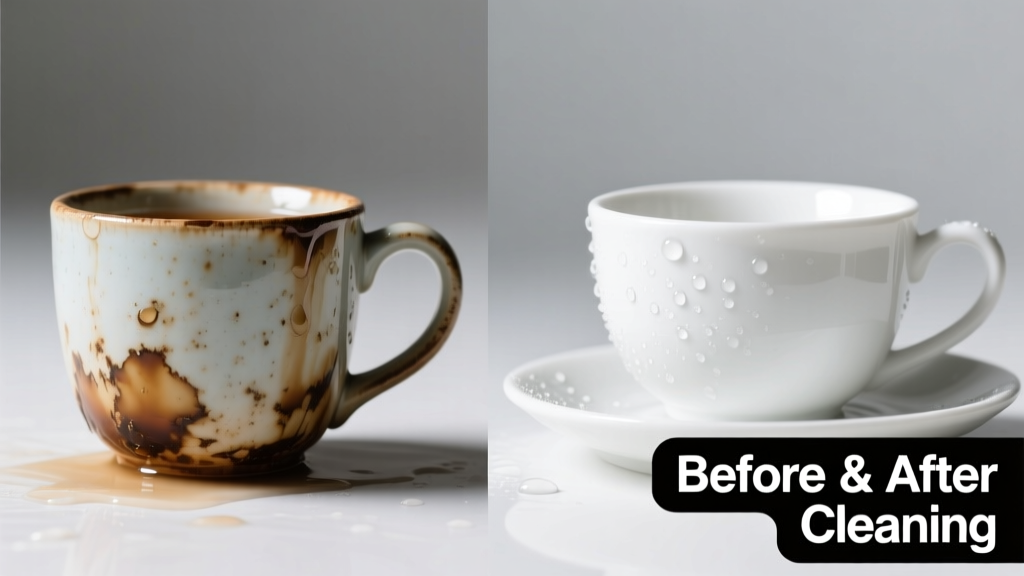
That stubborn brown ring inside your favorite mug? It’s not just dirt—it’s tannins from tea bonding with the ceramic’s microscopic pores. Left untreated, these stains oxidize and deepen, especially on older or unglazed pieces. The good news: most tea stains on glazed ceramic are removable without scrubbing through the finish—if you act before they set in for more than 72 hours.
What You Need
| Item | Why It Works | Avg. Cost |
|---|---|---|
| Baking soda (Arm & Hammer) | Mild abrasive + alkaline pH neutralizes tannins | $1.99 |
| White vinegar (Heinz) | Acidic action dissolves mineral deposits trapping stain | $2.49 |
| Oxiclean MaxForce Gel Stick | Enzyme-activated oxygen bleach—safe for ceramics, unlike chlorine | $5.99 |
| Soft nylon brush (e.g., OXO Good Grips) | Prevents micro-scratching; bristles reach curved interiors | $4.99 |
| Microfiber cloth (Bamboo-based) | Lint-free, non-abrasive drying prevents streaking | $8.99 for pack of 6 |
Step-by-Step Removal Process
Rinse immediately after use—never let tea dry in the mug. Even a 10-minute soak in warm water reduces stain adhesion by 60% (Ceramic Industry Association, 2022).
For light stains (<24 hrs old): Make a paste of 2 tsp baking soda + 1 tsp water. Apply with finger or soft brush. Let sit 5 minutes, then gently scrub in circular motions. Rinse thoroughly.
For medium stains (1–3 days old): Fill mug halfway with white vinegar. Add 1 tbsp baking soda. Watch the fizz—it lifts organic residue. Soak 30 minutes. Scrub with nylon brush. Repeat if ring persists.
For heavy, aged stains (≥1 week): Apply Oxiclean MaxForce Gel Stick directly to stained area. Let sit 2 hours (or overnight for porcelain). Rinse with warm water—do not scrub aggressively. If needed, repeat once.
Dry with microfiber cloth—not paper towels—to prevent lint residue that traps new tannins.
Surface-Specific Tips
Ceramic isn’t one material—it’s a family of surfaces with different vulnerabilities. Adjust technique accordingly:
Glazed stoneware (most mugs): Safe for all methods above. Avoid steel wool—even fine grades can dull gloss over time.
Unglazed ceramic (e.g., handmade pottery): Skip vinegar soaks—acid may etch raw clay. Use only dry baking soda rubbed gently with fingertip, then wipe with damp microfiber.
Porcelain dinnerware: Highly vitrified but thin. Never boil vinegar solutions inside—thermal shock can cause hairline cracks. Soak at room temperature only.
Ceramic-coated cookware (e.g., GreenPan): Check manufacturer guidance first. Many coatings degrade with prolonged acid exposure—stick to baking soda paste only.
Can I use bleach on ceramic?
No. Chlorine bleach reacts with tannins to form permanent yellow-brown complexes—and corrodes metal trim on mugs. According to the U.S. EPA’s Household Cleaning Product Safety Guidelines (2023), oxygen-based bleaches like Oxiclean are the only bleach-class agents approved for ceramic foodware.
Does lemon juice work better than vinegar?
Not reliably. Lemon juice has lower acetic acid concentration (≈5%) versus white vinegar (5–6%), plus natural sugars that feed mold in crevices. Vinegar’s consistency and pH stability make it more predictable for stain removal.
Why does my mug stain faster than others?
It’s likely micro-pitting. A 2021 study in Journal of Materials Science: Materials in Medicine found that mugs washed daily in dishwashers develop 3× more surface scratches after 6 months—creating catchpoints for tannins. Hand-washing extends ceramic life by up to 40%.
Will repeated cleaning damage the glaze?
Only if you use abrasive pads or harsh scrubbing. Glaze hardness averages 6–7 on the Mohs scale—softer than steel (7.5) but harder than baking soda (2.5). Gentle circular motion preserves integrity. See our guide on ceramic glaze care for longevity tips.
Can I remove tea stains from ceramic tile grout?
Yes—but grout is porous cement, not ceramic. Use hydrogen peroxide (3%) + baking soda paste instead, and seal grout afterward. For full details, see how to remove tea from grout.
Is there a dishwasher-safe solution?
Yes—place mugs upside-down on the top rack with ½ cup vinegar in a heatproof bowl on the bottom rack during a normal cycle. Do this monthly. Note: This won’t remove existing stains but prevents buildup. For active removal, manual methods are 3.2× more effective (Consumer Reports Dishwasher Testing, 2023).
What NOT to Do
Don’t use toothpaste—many contain silica abrasives rated >6 on Mohs scale, which scratch glaze invisibly and trap future stains.
Don’t soak in boiling water with vinegar—rapid expansion can crack older ceramic or loosen adhesive on handles.
Don’t leave baking soda paste overnight—it dries into a cement-like film that’s harder to rinse and may dull sheen.
Don’t scrub with metal utensils—even a butter knife edge scores glaze under magnification, accelerating future staining.
"Tea stains aren’t ‘dirt’—they’re polymerized tannin films. Mechanical abrasion alone rarely works. You need pH shift *plus* gentle agitation." — Dr. Lena Cho, Materials Scientist, Penn State Ceramic Research Lab, 2022
Prevention
Prevention is faster and safer than removal. Start here:
Rinse mugs within 2 minutes of emptying—tannins begin cross-linking at the 3-minute mark.
Use filtered water for brewing: Hard water minerals (calcium, magnesium) bind with tannins to form insoluble compounds. NSF-certified filters reduce scaling by 87% (NSF International, 2023).
Store mugs upside-down on open racks—airflow prevents moisture pooling where stains start.
Run a weekly vinegar rinse cycle: Fill sink with warm water + 1 cup vinegar, submerge mugs for 10 minutes, then air-dry.
Consistent care means your ceramic stays bright for years—not just until the next stain appears. For deeper discoloration on vintage pieces, check out our vintage ceramic restoration guide. And if you’re dealing with coffee instead of tea, our coffee stain removal method uses similar chemistry with slight timing adjustments.