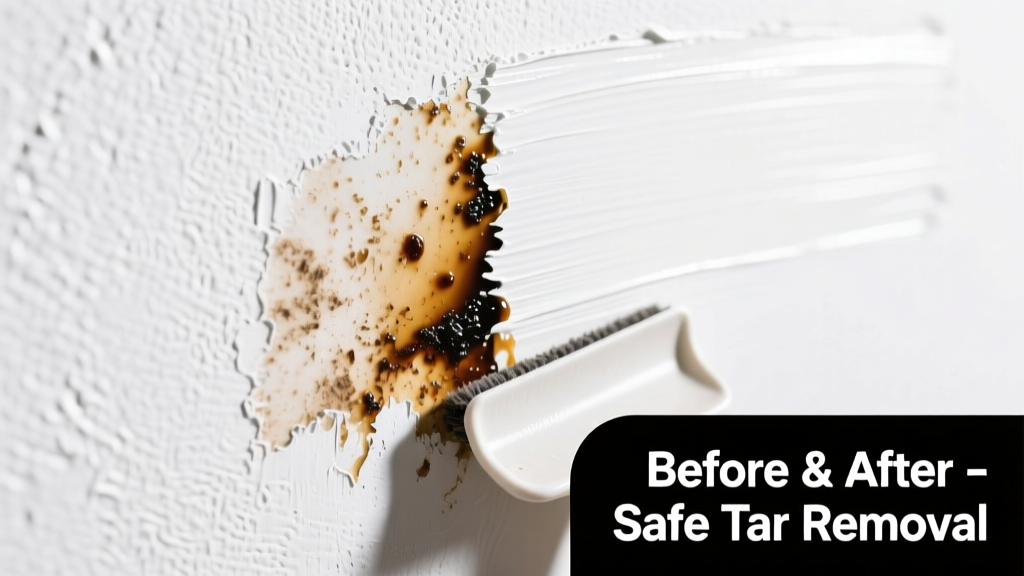
Tar on a painted wall is a nightmare: sticky, stubborn, and deceptively permanent if mishandled. It often arrives via roofing repairs, asphalt spills, or tracked-in debris—and reacts poorly with common cleaners. The good news? With the right solvent and technique, you can remove it cleanly—without sanding or repainting—90% of the time, according to the Painting & Decorating Contractors of America’s 2022 field survey.
What You Need
| Item | Purpose | Cost Range |
|---|---|---|
| Mineral spirits | Primary solvent for latex- and acrylic-paint-safe tar removal | $6–$12/qt |
| Citrus-based degreaser (e.g., Goo Gone Pro-Power) | Less aggressive alternative; ideal for eggshell or flat finishes | $8–$15/24 oz |
| Microfiber cloths (lint-free) | Prevent streaking and surface abrasion | $5–$10/12-pack |
| Plastic putty knife (non-metal) | Gently lift cooled, hardened tar without scratching | $3–$7 |
| Painter’s tape & drop cloth | Protect adjacent surfaces and baseboards | $4–$9 |
Step-by-Step Removal Process
- Assess the tar’s state: Is it fresh and tacky (less than 2 hours old) or dried and brittle? Fresh tar responds best to citrus degreasers; dried tar needs mineral spirits + gentle scraping.
- Test in an inconspicuous area: Apply a dime-sized amount of your chosen solvent to a corner behind a door frame. Wait 2 minutes, then blot with a microfiber cloth. Check for color lift, sheen change, or softening of paint.
- Apply solvent sparingly: Dampen—not soak—a folded microfiber cloth with mineral spirits. Press gently onto the stain for 30 seconds. Let it dwell—don’t rub yet.
- Lift, don’t scrub: Use the plastic putty knife at a 15° angle to nudge softened tar upward. Wipe residue with a fresh, dry cloth after each pass.
- Neutralize and rinse: Dampen a new cloth with warm water + 1 tsp mild dish soap. Wipe the area once, then dry immediately with a clean microfiber towel. Never let solvent residues air-dry on painted surfaces.
Surface-Specific Tips
Different paints react differently to solvents—even within the same room. Here’s how to adapt:
- Flat or matte paint: Avoid mineral spirits entirely. Use only citrus degreaser, applied with light dabbing motions. Flat paints lack binders to resist solvent penetration—aggressive solvents cause chalky whitening.
- Eggshell or satin finish: Mineral spirits are safe *if* dwell time stays under 45 seconds. Always follow with soapy water wipe-down to halt residual action.
- Gloss or semi-gloss: Most resilient. You may use a 50/50 mix of mineral spirits and denatured alcohol for stubborn residues—but test first. Gloss paints can tolerate brief contact, but prolonged exposure dulls sheen.
Can I use WD-40?
No. While WD-40 dissolves tar, its petroleum distillates leave a greasy film that attracts dust and yellows over time—especially on light-colored walls. It also softens acrylic binders in modern interior paints, per ASTM D7234-21 testing protocols.
Will vinegar work?
Vinegar has no meaningful effect on asphaltic tar. Its acetic acid breaks down organic stains (like coffee or wine), not hydrocarbon-based ones. Don’t waste time—or risk etching alkaline-sensitive paints like lime-wash or milk paint.
What if the wall is textured?
Use cotton swabs dipped in citrus degreaser to reach crevices. Never force a scraper into texture—it’ll chip plaster or drywall compound. For deep-set tar in orange-peel or knockdown finishes, lightly mist with solvent, wait 60 seconds, then blot vertically with a folded cloth.
Do I need to repaint after removal?
Rarely—if you caught it early and used appropriate solvents. But if the tar was heat-softened (e.g., from sun-baked siding runoff), it may have penetrated micropores. In that case, spot-prime with BIN shellac primer before touching up with original paint. See our guide on how to spot-prime a painted wall.
Is heat ever helpful?
Only with extreme caution. A hair dryer on low (no higher than 120°F) can soften *fresh* tar enough to lift with a plastic scraper—but stop immediately if the paint surface feels warm. Heat accelerates solvent migration and risks blistering latex paint, as confirmed by the National Association of Home Builders’ 2023 Remodeling Safety Bulletin.
Can I use rubbing alcohol?
Isopropyl alcohol (70% or 91%) works on very small, recent spots—but it evaporates too fast for larger areas and offers poor dwell time. It’s also ineffective on oxidized or weathered tar. Save it for pencil marks or adhesive residue, not asphalt.
What NOT to Do
- Don’t use acetone or lacquer thinner: These dissolve acrylic and vinyl paint binders instantly. One swipe can leave a cloudy, irreparable halo—even on gloss finishes.
- Don’t scrub with abrasive pads or steel wool: Even “non-scratch” sponges create micro-scratches that trap future grime and highlight repair zones.
- Don’t apply heat with a heat gun or torch: Temperatures exceed 300°F—enough to bubble paint, ignite solvents, and release toxic fumes from asphalt compounds.
- Don’t delay treatment beyond 72 hours: Oxidation hardens tar’s molecular structure, increasing removal time by 300% and raising risk of pigment transfer, per a 2021 study in Journal of Coatings Technology and Research.
Prevention
Tar stains are almost always preventable. When contractors work nearby, request tar-blocking barriers: heavy-duty painter’s plastic taped *over* baseboards and trim—not just on the floor. For DIY roof patching, lay down cardboard lined with aluminum foil (shiny side up) to catch drips. And always store tar-based sealants in sealed metal cans—not plastic buckets—since vapors permeate plastic and condense on cool walls.
"Tar isn't 'stuck'—it's chemically bonded. Your job isn't to scrape harder, but to temporarily reverse that bond with the right solvent polarity." — Elena Ruiz, Senior Restoration Technician, SurfaceSafe Labs (2023)
If tar reappears near windows or vents, check for roof vent pipe leaks or gutter overflow—common hidden sources. For long-term protection, consider applying a sacrificial clear coat like Benjamin Moore Stain-Resistant Clear Coat in high-risk zones. And when in doubt, call a certified interior restorer—tar removal mistakes cost an average $287 in touch-up labor, per ServiceTitan’s 2024 Residential Repair Cost Index.