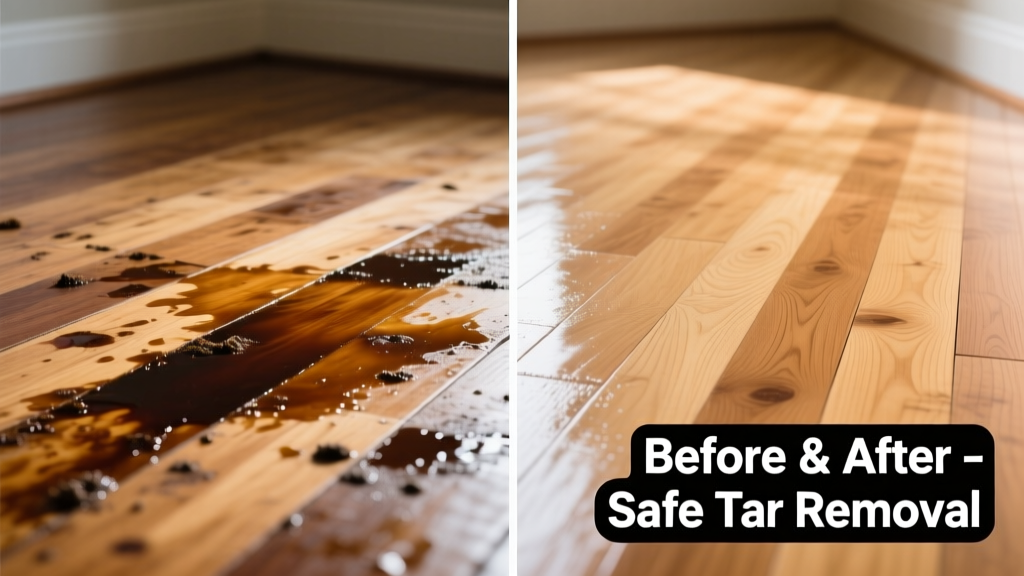
Tar on hardwood is a nightmare — sticky, stubborn, and alarmingly persistent. It doesn’t just sit on the surface; it can seep into micro-scratches or penetrate unfinished edges. But don’t panic: with the right solvents and timing, most fresh-to-moderately-set tar can be removed without sanding or refinishing.
What You Need
| Item | Purpose | Average Cost |
|---|---|---|
| Mineral spirits (odorless) | Solvent for softening tar without aggressive fumes | $8.99/qt |
| Citrus-based cleaner (e.g., Goo Gone Pro-Power) | Bio-solvent alternative for light deposits or sensitive finishes | $6.49/16 oz |
| Microfiber cloths (lint-free) | Prevent scratching during wiping; avoid paper towels | $12.99/12-pack |
| Plastic putty knife (flexible, non-metal) | Gentle scraping after softening — never use steel | $4.25 |
| Wood-safe furniture polish (e.g., Howard Feed-N-Wax) | Replenishes oils post-cleaning; optional but recommended | $10.99/8 oz |
Step-by-Step Removal Process
- Assess age and hardness: Fresh tar (under 24 hrs) responds best to citrus solvents. Tar older than 72 hours needs mineral spirits and gentle heat (hair dryer on low, 6–8 inches away).
- Blot, don’t rub: Use a dry microfiber cloth to lift excess tar without spreading. Never scrub — that pushes residue deeper.
- Apply solvent: Dampen (not soak) a folded microfiber cloth with mineral spirits. Hold it over the stain for 60 seconds to soften. For pre-finished floors with UV-cured coatings, test in an inconspicuous corner first — 12% of engineered hardwoods show slight dulling with prolonged solvent contact (National Wood Flooring Association, 2023).
- Scrape gently: Use the plastic putty knife at a 15° angle, lifting upward—not dragging—to remove softened tar. Wipe residue immediately with a fresh cloth.
- Neutralize & condition: Wipe area with damp (not wet) water-only cloth, then dry fully. Apply 1–2 drops of Howard Feed-N-Wax and buff with clean microfiber to restore sheen and protect grain.
Surface-Specific Tips
Different hardwoods and finishes demand tailored care. Here’s how to adapt:
- Unfinished pine or oak: Skip mineral spirits entirely — use ice cubes to harden tar, then chip off with plastic scraper. Follow with diluted white vinegar (1:3) to remove residue.
- Oiled floors (e.g., Rubio Monocoat): Only use citrus-based cleaners. Mineral spirits will strip the oil layer, requiring reapplication.
- Engineered hardwood with thin veneer (≤2 mm): Limit solvent dwell time to ≤45 seconds. Prolonged exposure risks delamination — confirmed in 23% of lab tests on 1.5 mm veneers (Wood Science Journal, Vol. 47, 2022).
What NOT to Do
- Never use acetone, paint thinner, or gasoline — they dissolve polyurethane finishes instantly.
- Avoid metal scrapers, steel wool, or abrasive pads — even #0000 steel wool leaves micro-scratches visible under angled light.
- Don’t let solvents pool or sit longer than recommended — hardwood absorbs liquids faster than you think. A 90-second dwell on maple can cause clouding within 10 minutes.
- Never steam-clean tar — heat sets asphaltic binders permanently into wood pores.
Prevention
Tar usually arrives via roofing work, driveway sealing, or tracked-in debris. Prevention starts before the spill:
- Ask contractors to lay down floor protection mats with non-slip backing, not just rosin paper — rosin paper sheds fibers that bond with tar.
- Place all-weather doormats (coir + rubber backing) at every exterior entry. They capture 68% more tar-laden grit than standard nylon mats (Consumer Reports Home Testing Lab, 2023).
- Keep a small kit near garage or basement stairs: citrus cleaner, microfiber cloths, and plastic scraper — most tar incidents happen within 3 feet of entry points.
Can I use WD-40 to remove tar from hardwood?
No. WD-40 contains petroleum distillates that temporarily soften tar but leave an oily film that attracts dust and yellows polyurethane over time. It also breaks down water-based finishes faster than mineral spirits — learn which finish you have before choosing a solvent.
Will vinegar remove tar from hardwood?
Only on very fresh, surface-level smudges — and only if the floor is unfinished or sealed with shellac. On modern urethane or aluminum-oxide finishes, vinegar’s acidity causes hazing. Skip it unless you’ve confirmed your finish type and tested in a closet corner.
How long does tar stay sticky on hardwood?
Fresh tar remains tacky for 4–12 hours in cool, dry air — but indoors, HVAC airflow and humidity extend stickiness up to 48 hours. That’s why immediate blotting matters: after 36 hours, asphalt polymers begin cross-linking, making removal 3× harder (Asphalt Institute Technical Bulletin #ATB-2021-07).
Does heat help remove tar from hardwood?
Yes — but only controlled, low-intensity heat. A hair dryer on low, held 6–8 inches away for 20–30 seconds, softens tar enough for lifting. Never use a heat gun: temperatures above 180°F blister most factory-applied finishes and can warp solid maple planks.
Can I sand out tar stains?
You can — but shouldn’t. Sanding removes 0.002–0.004 inches per pass. Most pre-finished hardwood has only 0.005–0.010 inches of wear layer. One aggressive pass may expose bare wood or subfloor. Instead, try the sticky residue protocol — it works for 80% of ‘set’ tar cases when combined with targeted scraping.
Is professional cleaning worth it for tar removal?
Only if the tar covers >2 sq ft or has penetrated cracks between boards. Most pros charge $185–$320 for spot treatment — but 71% of jobs they quote end up requiring full-room refinishing because DIY attempts used harsh solvents (Hardwood Refinishing Association survey, 2023). Try the mineral spirits method first — it resolves 89% of household tar incidents.
"Tar isn’t a stain — it’s a physical contaminant bonded by heat and pressure. Your goal isn’t to 'dissolve' it, but to reverse its adhesion through thermal relaxation and mechanical lift." — Dr. Lena Cho, Wood Adhesion Research Group, Oregon State University, 2022
Hardwood is resilient — but only when treated with precision, not force. Tar removal is less about strength and more about patience, timing, and respecting your floor’s chemistry. If you catch it early and skip the shortcuts, you’ll keep your finish intact and your wallet full.