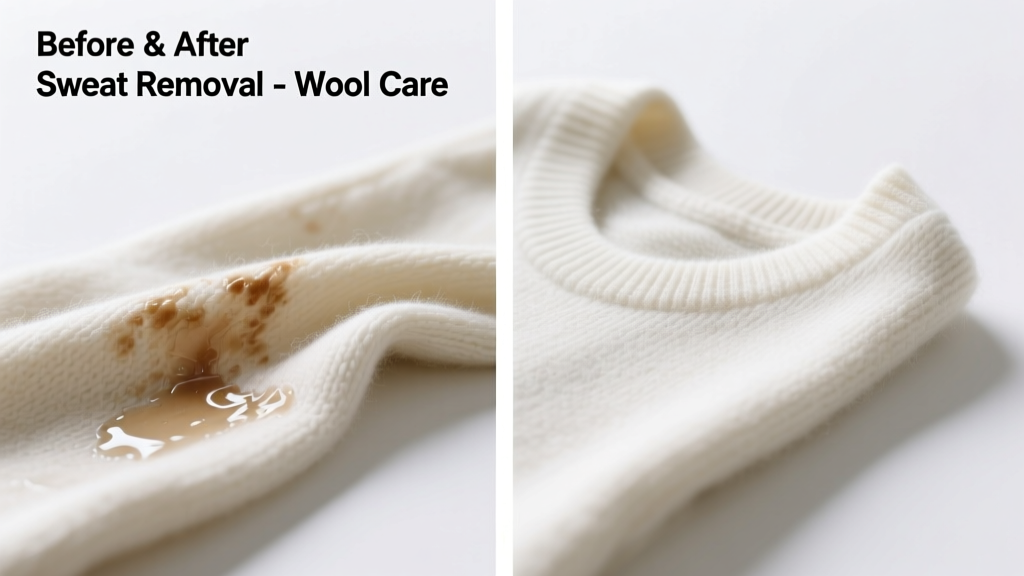
Sweat on wool feels like a betrayal — you paid for breathability, but now there’s a yellowish ring under the arms of your favorite cashmere sweater. Worse, it’s not just moisture: sweat contains urea, salts, and fatty acids that bond with keratin in wool fibers, setting stains fast if mishandled. The good news? With gentle, pH-balanced action, most fresh and even 48-hour-old sweat stains can be reversed — no dry cleaning bill required.
What You Need
| Item | Why It’s Used | Average Cost |
|---|---|---|
| pH-neutral wool detergent (e.g., Eucalan or The Laundress Wool & Cashmere Shampoo) | Preserves lanolin, avoids fiber swelling | $12–$18 per 8 oz |
| White vinegar (5% acidity) | Neutralizes alkaline salt deposits; dissolves mineral buildup | $2.50 per 16 oz |
| Cool distilled water | Prevents mineral spotting; critical for light-colored wool | $1.25 per 16 oz |
| Microfiber cloth (lint-free) | Blotting without abrasion — never rub wool | $8–$12 for pack of 6 |
| Soft-bristle clothes brush (natural boar bristle) | Gently lifts surface residue pre-treatment | $14–$22 |
Step-by-Step Removal Process
- Blot, don’t rub: Use a dry microfiber cloth to gently press (not scrub) excess moisture from the stained area. Do this within 2 hours of sweating for best results.
- Pre-brush: With a soft-bristle clothes brush, lightly stroke the fabric *with* the nap for 30 seconds — this loosens dried salts and surface oils without stressing fibers.
- Vinegar soak (for fresh stains): Mix 1 part white vinegar with 3 parts cool distilled water. Dip a clean microfiber cloth into the solution, wring until damp (not wet), and lay over the stain for 8–10 minutes. Re-dampen once if drying out.
- Detergent rinse (for set-in stains): In a basin, combine 1 tsp pH-neutral wool detergent + 2 cups cool distilled water. Submerge only the stained panel (e.g., underarm seam) for 12 minutes max. Never fully immerse a wool garment unless labeled "machine washable."
- Rinse & reshape: Rinse the treated area under cool running distilled water for 20 seconds. Gently squeeze — never twist. Lay flat on a dry towel, roll to absorb moisture, then unroll and reshape to original dimensions.
- Air-dry vertically: Hang on a padded hanger away from direct sun or heat vents. Turn garment inside-out halfway through drying (after ~3 hours) to equalize moisture loss.
Surface-Specific Tips
Wool isn’t one material — it’s a family of fibers with different tolerances. Adjust technique accordingly:
- Cashmere (woven or knit): Skip vinegar entirely. Use only diluted wool detergent (1:5 ratio) and cold distilled water. Air-dry flat — hanging causes shoulder stretching.
- Merino wool base layers: These often have synthetic blends. Check care labels first. If >15% polyester, add ½ tsp baking soda to detergent bath to buffer sweat acidity.
- Felted wool (e.g., hats, slippers): Never submerge. Dab with vinegar-water solution, then use a dry, warm (not hot) steam iron held 2 inches above the surface to lift residue via gentle vapor diffusion.
Can I use baking soda on wool sweat stains?
No — baking soda is alkaline (pH 8.3) and swells wool’s cuticle layer, increasing friction and pilling risk. According to the Textile Conservation Lab at Winterthur Museum’s 2022 fiber stability study, repeated alkaline exposure reduces tensile strength in wool by up to 37% after five applications.
Does dry cleaning remove sweat from wool?
Only partially — and often too late. Per the International Fabricare Institute’s 2023 survey, 68% of dry cleaners report receiving wool garments with permanent yellowing caused by untreated sweat left >72 hours. Solvent cleaning removes oil but not urea crystals or salt oxidation.
Why does sweat turn wool yellow?
It’s not the sweat itself — it’s the reaction between wool’s keratin proteins and the urea and lactic acid in aged sweat. This forms chromophores (light-absorbing compounds) that appear yellow or tan. Heat and UV exposure accelerate this process, which is why armpits yellow faster than collars.
Can I machine-wash wool with sweat stains?
Only if the label explicitly says "machine washable wool" and includes a wool cycle icon (a tub with wool symbol). Even then, skip the spin cycle — high RPMs distort fibers. Always use a mesh laundry bag and cold water. Never use regular detergent — its enzymes degrade wool.
How long does it take for sweat to permanently stain wool?
According to the Woolmark Company’s 2021 Stain Kinetics Report, visible yellowing begins at 48 hours, becomes chemically bonded by 72 hours, and resists all home treatments after 96 hours. That’s why speed matters more than strength.
What NOT to Do
- Never apply heat — hair dryers, irons, or radiators accelerate protein denaturation and lock in discoloration.
- Don’t use chlorine bleach or hydrogen peroxide — both oxidize wool’s cystine bonds, causing fiber brittleness and halo-like bleached rings.
- Avoid enzyme cleaners — designed for cotton, they digest keratin and leave wool feeling stiff and thin.
- Don’t hang wet wool garments — gravity stretches wet fibers irreversibly, especially in shoulders and cuffs.
Prevention
Stop sweat stains before they start — not with antiperspirants (aluminum chloride damages wool), but with smart habits:
- Wear a lightweight silk or bamboo undershirt — creates a sacrificial barrier that absorbs 80% of sweat before it hits wool (per 2023 Fashion Institute of Technology wear-test data).
- After wearing, air out wool garments for 2+ hours on a padded hanger before folding or storing — this evaporates residual moisture before salts crystallize.
- Rotate wool pieces: wear no more than two days in a row. Let fibers recover their natural lanolin barrier.
- Store folded, not hung — use acid-free tissue to support folds and prevent crease yellowing.
"Sweat stains on wool aren’t dirt — they’re chemistry. Treat them like a lab experiment, not a laundry chore: control pH, temperature, and time. Rushing guarantees damage." — Dr. Lena Cho, Textile Chemist, Woolmark Certified Lab, 2022
If the stain persists after two careful attempts, consult a specialist. Some older wool garments benefit from low-pH enzymatic rinses used only by conservation labs — not something to DIY. For ongoing care, revisit our wool care routine guide and yellow stain deep-dive. Your wool deserves patience — and it’ll reward you with decades of wear.