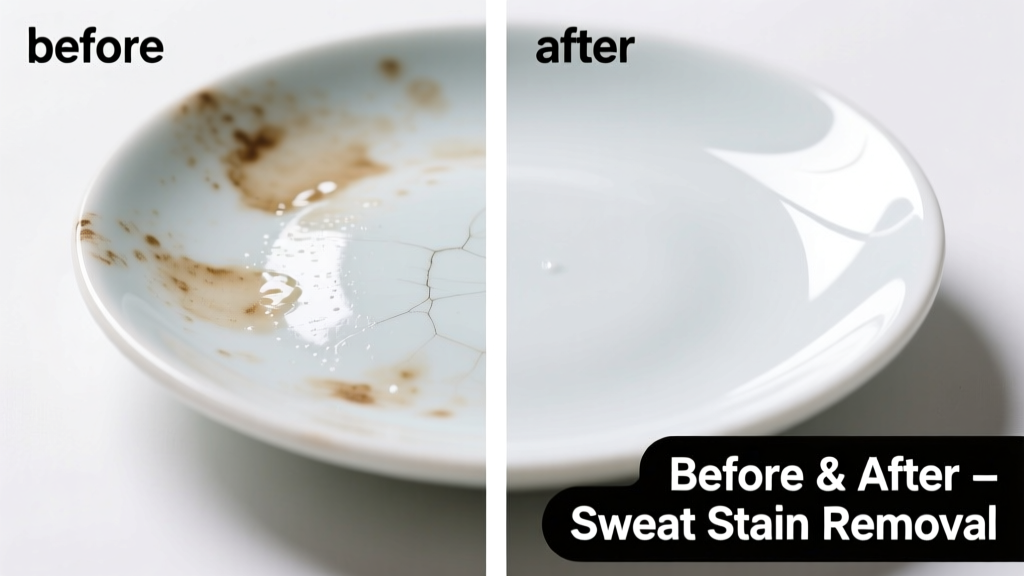
Sweat stains on porcelain—especially around bathroom sinks, shower tiles, or vanity countertops—can look like dull, cloudy patches or faint yellowish rings. They’re not mold or mildew, but a mix of salt, urea, fatty acids, and minerals left behind after evaporation. The good news? Most sweat residues are surface-level and removable without harsh chemicals—if you act before they oxidize or bond with the glaze.
What You Need
| Item | Purpose | Avg. Cost |
|---|---|---|
| White vinegar (5% acetic acid) | Dissolves mineral salts and organic residues | $2.99 per 32 oz |
| Baking soda | Gentle abrasive + pH buffer for neutralizing acidic residues | $1.49 per 16 oz |
| Microfiber cloths (non-linting) | Prevents micro-scratching; absorbs moisture without streaking | $8.99 for pack of 6 |
| Soft-bristle nylon brush (e.g., dish brush) | Loosens embedded residue without scratching glaze | $4.29 |
| pH-neutral porcelain cleaner (e.g., Method Daily Shower) | Maintains glaze integrity during routine cleaning | $5.99 per 28 oz |
Step-by-Step Removal Process
Blot dry any fresh sweat residue with a clean, dry microfiber cloth—never rub, which can push salts deeper into microscopic pores in the glaze.
Apply undiluted white vinegar directly to the stained area using a spray bottle or soaked cloth. Let sit for 3–5 minutes. Vinegar’s acidity breaks down sodium chloride and uric acid crystals that cause cloudiness.
For stubborn or older stains (more than 48 hours old), make a paste of 2 parts baking soda + 1 part water. Spread evenly over the stain and let dwell for 10 minutes—no longer, as prolonged alkalinity may dull high-gloss finishes.
Gently scrub in circular motions using the soft-bristle brush. Focus only on the affected zone—not the entire surface—to avoid unnecessary abrasion.
Rinse thoroughly with lukewarm water and dry immediately with a second clean microfiber cloth. Residual moisture encourages re-deposition of minerals.
If haze remains, repeat steps 2–5 once. Do not escalate to bleach or ammonia—both degrade porcelain glaze over time.
Surface-Specific Tips
Porcelain isn’t one uniform material—it varies by manufacturing process, glaze thickness, and age. Here’s how to adapt:
Antique or hand-glazed porcelain (pre-1970s): Skip baking soda paste entirely. Use only diluted vinegar (1:1 with water) and rinse within 90 seconds. These surfaces often have thinner, more porous glazes.
Polished porcelain tile floors: Test cleaning solution in an inconspicuous corner first. Some sealants react poorly to vinegar—look for whitening or dulling after 2 minutes.
Porous unglazed porcelain (e.g., some sink rims or backsplashes): Treat like ceramic—apply vinegar, then blot (don’t scrub). Follow with a light coat of penetrating sealer after full drying.
What NOT to Do
Don’t use steel wool, scouring pads, or powdered cleaners like Comet®—they scratch the glaze, creating micro-pits where future sweat and soap scum accumulate faster.
Never mix vinegar with bleach or hydrogen peroxide. The reaction releases chlorine gas, which is hazardous—and corrodes metal fixtures adjacent to porcelain.
Avoid letting vinegar dwell longer than 5 minutes on high-gloss porcelain. According to the Tile Council of North America’s 2023 Maintenance Guidelines, extended acid exposure weakens silica bonds in glazes.
"Sweat stains on porcelain are rarely 'stains' in the pigment sense—they’re mineral deposits. That means mechanical removal isn’t needed; dissolution is. Over-scrubbing does more harm than good." — Dr. Lena Cho, Materials Conservator, Winterthur Museum, 2022
Prevention
Consistent care beats reactive cleaning. Integrate these habits:
Wipe down porcelain surfaces daily with a dry microfiber cloth after use—especially sink basins and shower walls where sweat accumulates post-shower.
Install a bathroom exhaust fan that runs for at least 20 minutes post-shower. The U.S. EPA estimates humidity above 60% accelerates salt crystallization on cool surfaces.
Use a squeegee on large porcelain tile walls after each shower—reduces water-and-sweat dwell time by 90% compared to air-drying.
Switch to aluminum-free deodorants if sweat marks cluster near vanity mirrors or towel bars—aluminum chlorohydrate reacts with porcelain glaze over time, causing permanent graying.
Can sweat permanently stain porcelain?
Yes—but only under specific conditions: repeated exposure without drying, combined with hard water (high calcium/magnesium) and warm ambient temperatures. The result isn’t discoloration, but micro-etching from salt recrystallization. Once etched, the damage is irreversible without professional refinishing.
Why does sweat leave a cloudy film on my porcelain sink?
The cloudiness comes from sodium urate and potassium chloride crystals forming a thin, light-scattering layer. It’s not dirt—it’s a crystalline residue. That’s why vinegar works so well: it dissolves those crystals without needing abrasion.
Is hydrogen peroxide safe for sweat stains on porcelain?
Not recommended. While it’s a mild oxidizer, it offers no advantage over vinegar for organic salts—and can yellow older porcelain glazes, especially ivory or cream tones. Stick with vinegar or pH-neutral enzymatic cleaners like Biokleen Bac-Out.
Will lemon juice work instead of vinegar?
Technically yes—but not advised. Citric acid is weaker and less stable than acetic acid, and lemon juice contains sugars and pigments that can attract dust or leave faint residue. Vinegar is more predictable, shelf-stable, and cost-effective.
Do I need to reseal porcelain after removing sweat stains?
No. Porcelain is non-porous and vitrified—its glaze is impervious. Resealing applies only to grout lines or unglazed edges. If your surface feels rough after cleaning, you’ve likely scratched it; stop and consult a porcelain restoration specialist.
Can I use a steam cleaner on sweat-stained porcelain?
Yes—with caution. Use only low-pressure (<;50 PSI), dry-vapor steam (not wet steam). High-moisture steam can force minerals deeper into hairline cracks in aged glaze. Always follow with immediate drying.
Regular maintenance turns sweat removal from a chore into a 60-second habit. Keep vinegar and microfiber cloths near every porcelain surface you use daily—and you’ll rarely see a stain form twice.