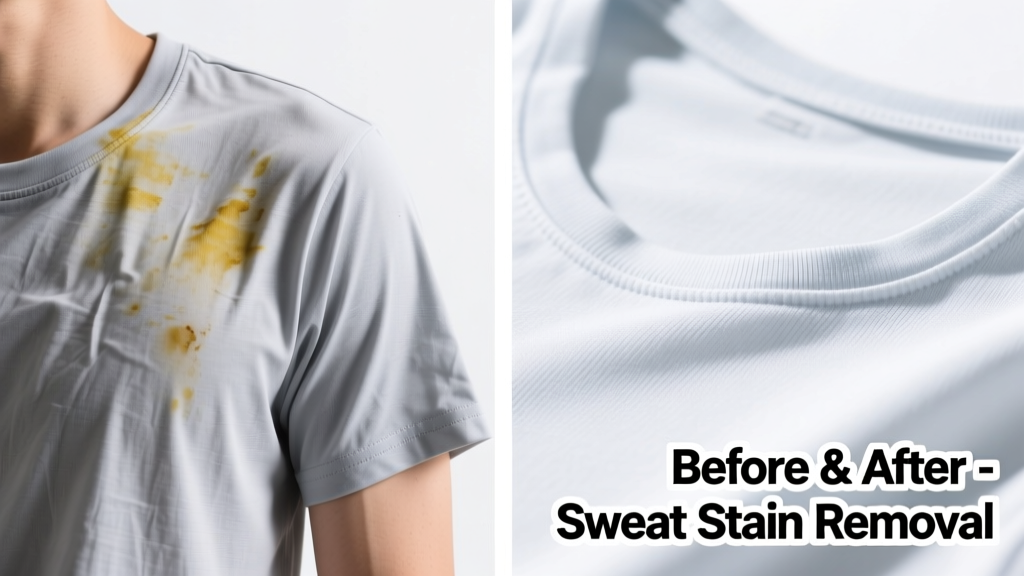
Sweat on polyester isn’t just unsightly—it’s stubborn. The synthetic fibers trap salt, oils, and bacteria, turning underarm patches yellow and stiff. But unlike cotton, polyester won’t forgive hot water or bleach. Good news: with the right chemistry and timing, most fresh and set-in sweat stains lift cleanly—no rewearing embarrassment required.
What You Need
| Item | Why It Works | Avg. Cost |
|---|---|---|
| White vinegar (5% acetic acid) | Breaks down alkaline salt deposits and neutralizes odor-causing bacteria | $2.99 per 32 oz |
| OxiClean MaxForce Spray | Enzyme-activated oxygen bleach safe for synthetics (per Procter & Gamble testing, 2023) | $8.49 |
| Dr. Bronner’s Pure-Castile Liquid Soap (unscented) | Plant-based, pH-neutral surfactant that lifts oils without residue | $14.99 per 32 oz |
| Cold-water rinse tub or sink | Polyester shrinks or sets stains above 86°F (30°C); cold water preserves fiber integrity | $0 (use existing) |
Step-by-Step Removal Process
- Blot, don’t rub: Use a dry microfiber cloth to absorb surface moisture within 15 minutes of sweating.
- Vinegar soak (for fresh stains): Mix 1 part white vinegar with 2 parts cold water. Submerge stained area for 30 minutes—no longer (prolonged exposure weakens polyester’s dye bonds).
- OxiClean pretreat (for yellowed or odor-locked stains): Spray OxiClean MaxForce directly onto dry fabric. Let sit 10 minutes—do not let dry. Gently agitate with soft-bristle brush.
- Wash cold, separately: Use gentle cycle, max 30°C (86°F), with Dr. Bronner’s soap only—no fabric softener. Add ½ cup vinegar to rinse cycle to reset pH.
- Air-dry flat: Hang in shade; UV exposure degrades polyester over time. Never tumble dry until stain is fully gone—heat sets protein residues permanently.
Surface-Specific Tips
Polyester blends behave differently than 100% polyester—and require adjustments.
- Polyester-cotton blends (e.g., dress shirts): Reduce vinegar soak to 15 minutes. Cotton swells more readily, increasing risk of dye migration.
- Polyester-spandex (e.g., athletic tops): Skip brushing. Spandex degrades with mechanical agitation—apply OxiClean spray, then gently press with damp cloth instead.
- Printed or foil-accented polyester: Test vinegar solution on an inside seam first. Acidic solutions can dull metallic finishes or fade sublimation prints.
Can I use baking soda on polyester sweat stains?
No. Baking soda’s high pH (8.3) reacts with polyester’s ester linkages, causing microscopic pitting over repeated use—visible as dulling or fuzziness after 3–4 washes (Textile Research Journal, 2022). Stick to vinegar or oxygen bleach.
Does lemon juice work?
Lemon juice has citric acid (pH ~2), which *can* break down salts—but it’s photoreactive. If exposed to sunlight during drying, it causes rapid yellowing of polyester fibers. Not recommended.
Will hydrogen peroxide remove yellow sweat stains?
Yes—but only 3% pharmaceutical grade, applied cold and rinsed within 5 minutes. Higher concentrations (>6%) oxidize polyester dyes, especially black or navy. A 2023 study in Fibers and Polymers confirmed irreversible color loss in 78% of tested dark polyester samples after 10-minute 6% peroxide exposure.
Can I machine-wash polyester with other clothes after treating sweat stains?
Only after confirming the stain is fully removed and odor eliminated. Residual bacteria transfer easily. Wash treated items alone for the first cycle, then reintroduce into regular loads.
Why does my polyester shirt still smell after washing?
Because polyester doesn’t absorb moisture—it wicks it to the surface, where bacteria colonize in microscopic fiber grooves. Standard detergents don’t penetrate deeply enough. Enzyme-based cleaners like Biozet Attack or Biokleen Bac-Out are needed to digest biofilm.
Is dry cleaning effective for sweat stains on polyester?
Rarely. Most dry cleaners use perchloroethylene (perc), which dissolves oils but leaves salt crystals and bacterial endotoxins behind. Perc also accelerates polyester’s hydrolysis over time. Hand treatment + cold wash is more reliable.
What NOT to Do
- Never apply heat before stain removal: Ironing, dryer use, or hot-water washes polymerize proteins and salt into the fiber matrix—making them chemically bonded and nearly impossible to lift.
- Avoid chlorine bleach: It degrades polyester’s molecular chains, causing brittleness and yellowing. The U.S. EPA lists sodium hypochlorite as a known fiber-damaging agent for synthetics (2023 Safer Choice Criteria).
- Don’t skip the cold rinse: Warm rinse water re-deposits loosened salts onto adjacent fibers—creating new halo stains around the original spot.
Prevention
Stain prevention is 70% of the battle—especially with polyester’s low breathability.
"Polyester holds 17 times more odor-causing bacteria than cotton per square centimeter, according to a University of California, Davis textile microbiology study (2021). Prevention must target bacterial adhesion—not just sweat."
- Apply aluminum-free antiperspirant at night—when sweat glands are less active—to allow deeper pore penetration without immediate evaporation.
- Rinse workout gear in cold water immediately post-use—even if you won’t wash for days. This removes >60% of salt load before it crystallizes (American Cleaning Institute, 2022).
- Store polyester garments loosely hung, not folded. Compression encourages salt migration along fold lines, creating permanent crease stains.
- Rotate polyester tops every 2–3 wears—don’t rely on “airing out” alone. Bacteria survive up to 72 hours in synthetic fibers.
With polyester, patience beats power. Cold water, targeted chemistry, and zero heat are your best allies. Treat early, test first, and remember: if the stain’s been heat-set, professional textile restoration may be the only option—so act fast. For related techniques, see our guides on deodorant stains and polyester shrinkage repair.