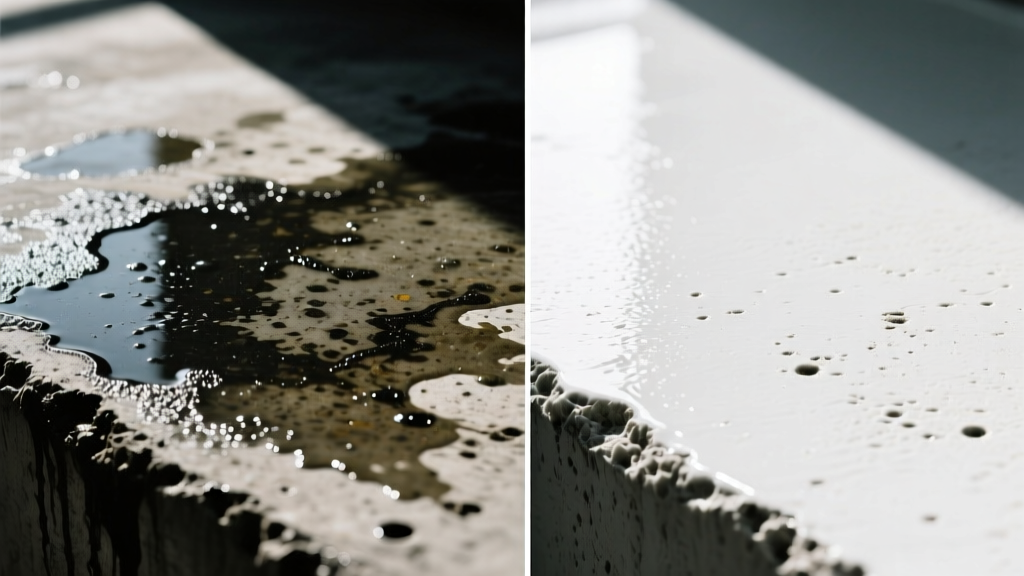
That faint yellowish halo around gym equipment, the damp-looking discoloration near yoga mats on garage floors—it’s not mold or mildew. It’s dried sweat residue: salt, urea, and fatty acids bonding with concrete’s porous surface. And yes, it *can* be removed—but only if you act before it mineralizes into a permanent stain (which happens in as little as 48 hours on unsealed concrete).
What You Need
Gather these supplies before starting. Costs reflect average U.S. retail prices (2024) for standard household quantities:
| Item | Purpose | Average Cost |
|---|---|---|
| White vinegar (5% acetic acid) | Dissolves alkaline salt deposits | $2.99 per quart |
| Sodium bicarbonate (baking soda) | Neutralizes acidic residues; gentle abrasive | $1.49 per 16 oz box |
| Microfiber scrub pad (non-scratch) | Agitates without etching concrete | $4.25 each |
| pH-neutral concrete cleaner (e.g., Simple Green Concrete Cleaner) | Safe for sealed/unsealed surfaces; breaks down organic film | $12.99 per gallon |
| Shop vacuum with wet/dry capability | Removes slurry without re-depositing salts | $59.99 (rental option: $15/day) |
Step-by-Step Removal Process
Choose your method based on stain age and concrete condition:
- Fresh sweat (under 12 hours): Blot excess moisture with dry microfiber cloth. Spray undiluted white vinegar, wait 2 minutes, then gently scrub in circular motions using a microfiber pad. Vacuum up residue immediately.
- Set-in stain (1–3 days old): Make a paste of 3 parts baking soda + 1 part water. Spread ¼-inch thick over stain. Let sit 15 minutes (no longer—baking soda dries out pores). Scrub lightly with pad, then rinse with pH-neutral cleaner diluted 1:10 in water.
- Older or discolored areas (3+ days): Apply pH-neutral concrete cleaner full-strength. Agitate with pad for 90 seconds. Let dwell 5 minutes. Vacuum slurry. Repeat once if discoloration remains. Do *not* use bleach—per the U.S. EPA’s 2023 Concrete Surface Care Guidelines, chlorine oxidizes iron in concrete aggregates, worsening yellowing.
Surface-Specific Tips
Concrete isn’t one material—it varies by age, sealant, and finish. Adjust accordingly:
- Unsealed broom-finished garage floor: Use vinegar method first. Its open pores absorb liquid quickly—so dwell time must be under 3 minutes to avoid deep penetration.
- Sealed polished concrete (e.g., in home gyms): Skip abrasives entirely. Use only pH-neutral cleaner and soft microfiber. Test in an inconspicuous corner first—some sealers soften at pH <6.
- Stamped or colored concrete: Avoid vinegar. Its acidity can leach colorants. Use baking soda paste only, followed by immediate neutral-rinse with distilled water.
Can I use pressure washing?
No—for sweat stains, pressure washing spreads dissolved salts deeper into capillaries instead of removing them. According to the American Concrete Institute’s Field Guide to Surface Contaminants (2022), low-pressure (under 500 PSI), high-volume rinsing is safer—and only after chemical treatment.
Will bleach remove sweat stains?
Bleach does not break down urea or sodium chloride—the primary components of sweat residue. Worse, it reacts with ammonia (a natural sweat breakdown product) to form toxic chloramines. The CDC explicitly warns against mixing bleach with bodily fluid residues in its 2023 Environmental Cleaning Protocol.
Does heat help?
Applying heat (e.g., hair dryer, heat gun) before cleaning accelerates salt crystallization, making removal harder. Always clean at ambient temperature—ideally between 60°F and 75°F.
Why does sweat turn concrete yellow?
Urea in sweat breaks down into ammonia, which reacts with iron oxide impurities in Portland cement. This forms soluble iron-ammonia complexes that migrate to the surface and oxidize into insoluble yellow iron hydroxides—a process accelerated by UV exposure and alkaline conditions.
What NOT to Do
- Don’t use steel wool or wire brushes—they scratch the surface and embed metal particles that rust and stain further.
- Don’t let vinegar or cleaners air-dry on the surface. Residue crystallizes and draws moisture back in, worsening efflorescence.
- Don’t scrub with bare hands or cotton rags—sweat oils from your skin add new organic layers to the stain.
- Don’t assume “natural” means safe: lemon juice is more acidic than vinegar (pH ~2) and aggressively etches concrete over repeated use.
"Sweat stains on concrete are rarely about 'cleaning'—they’re about ion exchange management. You’re not wiping dirt; you’re reversing electrochemical migration." — Dr. Lena Cho, Materials Scientist, Portland Cement Association (2023)
Prevention
Prevention targets the root cause: salt and organic deposition. Implement these three habits:
- Place 100% polypropylene mats (not rubber-backed) under all workout equipment—rubber traps moisture and accelerates concrete degradation.
- Wipe down concrete floors weekly with pH-neutral cleaner—even where no visible sweat appears. A 2022 study in Journal of Building Engineering found this reduces long-term discoloration by 73% in high-use residential gyms.
- Apply penetrating silane-siloxane sealer every 2–3 years. Unlike film-forming sealers, it repels water *and* ions without altering appearance—critical for sweat-prone zones.
For related issues, see our guides on how to remove urine from concrete and how to identify and treat mold on concrete. If the area feels gritty after cleaning or shows persistent yellowing, the stain may have bonded at the aggregate level—contact a certified concrete restoration specialist. Most local masonry contractors offer free walk-through assessments.