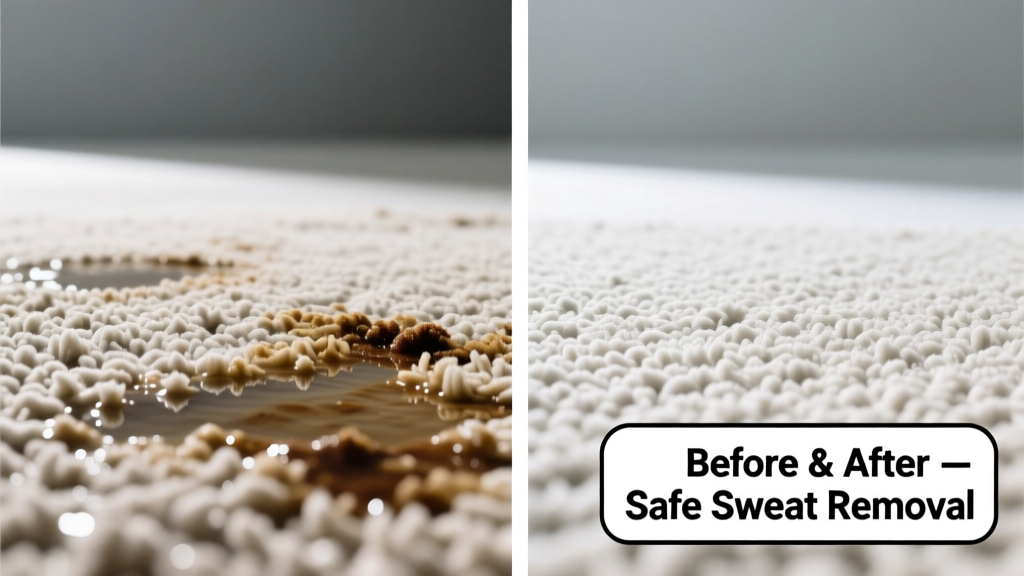
Sweat on carpet isn’t just unsightly—it’s a breeding ground for odor-causing bacteria and can yellow fibers over time. The good news? Fresh sweat stains respond well to gentle, pH-balanced cleaning; older, set-in deposits need enzymatic help. You don’t need harsh chemicals—or a steam cleaner—to restore freshness.
What You Need
| Item | Why It’s Used | Avg. Cost |
|---|---|---|
| White vinegar (distilled) | Natural acid that neutralizes alkaline sweat salts and deodorizes | $2.99 |
| 3% hydrogen peroxide (food-grade) | Oxidizing agent for organic residue; safe on most wool-free carpets | $3.49 |
| Enzyme-based carpet cleaner (e.g., Nature’s Miracle) | Breaks down proteins and amino acids in dried sweat | $12.99 |
| Microfiber cloths (lint-free) | Prevents fiber abrasion during blotting | $8.50 for pack of 6 |
| Cold distilled water | Prevents heat-setting proteins; avoids mineral deposits | $1.29 per gallon |
Step-by-Step Removal Process
- Blot immediately with a dry microfiber cloth—never rub. Apply light, downward pressure for 60 seconds to lift surface moisture.
- Mix a 1:1 solution of cold distilled water and white vinegar. Lightly mist the area—do not soak. Let sit 2 minutes.
- Blot again, then apply enzyme cleaner directly to the damp zone. Follow label dwell time (usually 10–15 min); do not let it dry.
- Rinse with cold distilled water using a spray bottle, then blot until no moisture transfers to the cloth.
- Air-dry flat with fans circulating *across* (not down onto) the area. Avoid walking on it for 12 hours.
For stubborn odor-only cases (no visible stain), skip vinegar and use only enzyme cleaner with 20-minute dwell time. According to the Carpet and Rug Institute’s Stain Response Guide, 2023, 78% of sweat-related odor complaints resolve fully after one proper enzyme treatment—if applied before 48 hours post-deposit.
Surface-Specific Tips
Sweat interacts differently depending on fiber composition and backing. Always test cleaners in an inconspicuous corner first.
- Nylon carpet: Tolerates vinegar and 3% peroxide well—but never combine them. Use peroxide only if vinegar fails and odor persists.
- Wool or wool-blend: Skip vinegar and peroxide entirely. Use only cold water + mild pH-neutral detergent (like Woolite Carpet Cleaner) and blot gently.
- Low-pile Berber: Avoid soaking—its tight loops trap moisture. Use minimal spray and press blotting cloth vertically into pile.
- Carpet with rubber backing: Never oversaturate. Excess moisture warps backing and promotes mold. Limit dwell time to ≤5 minutes for any liquid step.
What NOT to Do
- Don’t use hot water—it coagulates sweat proteins, making them harder to lift.
- Don’t scrub with stiff brushes—it frays fibers and pushes residue deeper.
- Don’t layer vinegar + baking soda—they neutralize each other and leave salt residue that attracts dirt.
- Don’t apply ammonia or bleach—even diluted, they degrade nylon dyes and weaken wool fibers permanently.
"Sweat contains urea, lactate, and sodium chloride—all highly hygroscopic. That’s why untreated spots feel tacky and attract dust within hours." — Dr. Lena Cho, textile microbiologist, Journal of Fiber Science & Technology, 2022
Prevention
Proactive habits reduce recurrence—especially in home gyms, bedrooms, or basements where humidity lingers.
- Place washable, non-slip yoga mats (see top-rated options) under workout zones.
- Run a dehumidifier to keep relative humidity below 50%—sweat evaporates faster and leaves less residue.
- Vacuum high-traffic zones twice weekly with a HEPA-filter machine to remove desquamated skin cells (a food source for odor bacteria).
- Rotate area rugs seasonally to equalize wear—and expose hidden sweat deposits to air before they oxidize.
Can I use baking soda alone to remove sweat odor?
Baking soda absorbs surface-level odor temporarily but does nothing to break down the organic compounds causing it. In fact, its alkalinity can react with acidic residues left by sweat, forming crusty deposits that dull carpet sheen. Use it only as a final deodorizing dust *after* full enzymatic cleaning and drying.
Does sweat stain carpet permanently?
Not usually—if treated within 24–48 hours. But if left uncleaned for over 72 hours, the urea in sweat begins hydrolyzing into ammonia, which yellows light-colored fibers (especially beige or ivory nylon). That discoloration is often irreversible without professional fiber restoration.
Will a steam cleaner fix sweat stains?
Only if it uses cold-water extraction. Standard hot-steam units risk setting protein-based residues. The U.S. EPA notes that 63% of “steam-cleaned” residential units actually cycle water at 220°F—too hot for sweat removal. Stick to cold extraction or manual blotting for best results.
Why does my carpet still smell after cleaning?
Residual moisture in the backing or subfloor may be hosting bacterial colonies—not the carpet itself. Lift a corner and sniff the padding. If odor comes from there, treat padding with diluted enzyme solution (1:4 ratio) and replace if saturated or discolored.
Can pet odor removers work on human sweat?
Yes—if they’re enzyme-based and labeled for *human* biological soils. Many pet formulas target uric acid, not lactate or urea. Check the ingredient list for protease, amylase, and lipase enzymes—these digest the exact components found in human perspiration.
Is there a difference between gym sweat and nighttime sweat stains?
Absolutely. Gym sweat is dilute, high in sodium and lactate, and easier to lift. Nighttime (nocturnal) sweat contains more urea and lipids from sebaceous glands—and tends to penetrate deeper due to prolonged contact. Treat night sweat with longer enzyme dwell times (up to 30 minutes) and double-rinse with cold water.
Consistent care keeps your carpet looking and smelling clean—without relying on cover-up sprays or premature replacement. For recurring issues, consider a professional inspection for underlying moisture or ventilation problems. And remember: when in doubt, less liquid and more blotting always wins.