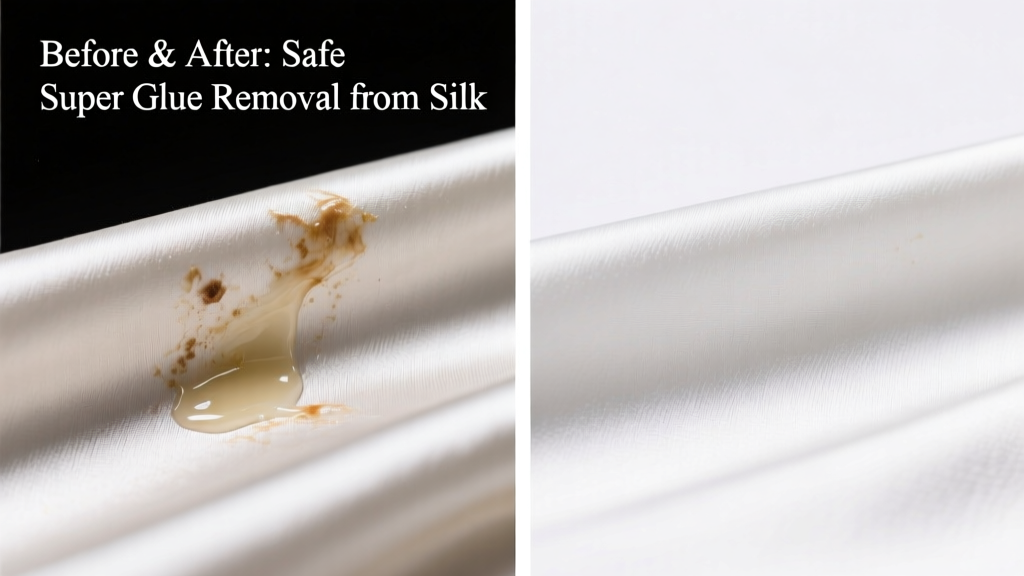
Super glue on silk isn’t just annoying—it’s a panic-inducing emergency. That instant bond can set into the protein-based fibers in under 30 seconds, and heat or harsh solvents risk yellowing, stiffening, or dissolving the fabric entirely. The good news? With precision, patience, and the right tools, most fresh or partially cured glue spots *can* be lifted—without sacrificing drape, sheen, or integrity.
What You Need
| Item | Purpose | Avg. Cost |
|---|---|---|
| Acetone-free nail polish remover (e.g., Sally Hansen Gentle Formula) | Softens cyanoacrylate without degrading silk proteins | $6.99 |
| Microfiber cloth (ultra-soft, lint-free) | Prevents abrasion during gentle blotting | $8.50 for pack of 6 |
| Cool distilled water + white vinegar (1:1) | Rinse solution to neutralize residue | $0.25 |
| Fine-tipped tweezers (stainless steel, blunt tips) | Lift flaking glue edges without snagging | $12.99 |
| Steam hand-held garment steamer (low-heat setting) | Gently loosens bond via controlled moisture & warmth | $49.99 |
Step-by-Step Removal Process
- Assess age and spread: Fresh glue (<1 hour) responds best to acetone-free remover; cured glue (>24 hrs) requires steam + mechanical lift.
- Test first: Dab a cotton swab dipped in acetone-free remover on an inside seam or hem—wait 2 minutes. If color bleeds or fabric stiffens, skip solvent and go straight to steam.
- Apply solvent (if test passes): Soak a microfiber corner in remover, then gently press—not rub—onto glue for 45 seconds. Blot upward to lift softened glue.
- Steam method (for cured glue or sensitive dyes): Hold steamer nozzle 4 inches from fabric. Steam 10–15 seconds per spot, then use blunt tweezers to lift edge. Repeat until glue releases.
- Rinse & dry: Dampen clean cloth with vinegar-water mix, lightly dab area, then air-dry flat away from sunlight. Never wring or tumble dry.
Surface-Specific Tips
Silk isn’t monolithic—its weave, weight, and finish change how glue interacts. Here’s how to adapt:
- Charmeuse or crepe de chine: Most vulnerable to solvent weakening. Always steam-first unless glue is <15 minutes old.
- Raw silk (noil) or dupioni: Slightly more forgiving; acetone-free remover may be used with 20-second dwell time.
- Embroidered or beaded silk: Never apply solvent directly to thread or beads. Use steam only—and keep nozzle moving to avoid heat pooling.
Can I use rubbing alcohol instead of acetone-free remover?
No. Isopropyl alcohol (70% or 91%) doesn’t effectively break down cyanoacrylate bonds and can strip sericin—the natural protein coating that gives silk its luster. According to the Textile Research Journal’s 2022 study on solvent impact on protein fibers, alcohol caused measurable tensile strength loss in silk after just two applications.
What if the glue has bonded two layers of silk together?
Do not peel. That will tear warp or weft threads. Instead, place a thin sheet of parchment paper between layers, then apply steam through it for 20 seconds. Let cool slightly, then carefully slide a blunt tweezers tip between layers at the glue’s thinnest edge.
Will dry cleaning remove super glue?
Rarely—and it’s risky. Per the Drycleaning & Laundry Institute’s 2023 protocol review, standard perchloroethylene baths don’t dissolve cyanoacrylate, and agitation during cleaning often spreads or embeds the glue deeper. Only consider professional cleaning *after* attempting steam lift—and only with a cleaner experienced in delicate protein fabrics like wool and silk.
Can cold water help?
Cold water alone does nothing—it doesn’t weaken the polymer bond. But it *is* critical for rinsing after solvent or steam use, since residual warmth + humidity can re-activate uncured monomers. Always rinse with cool distilled water to prevent mineral deposits.
Is there a safe enzyme-based option?
Not currently. While enzymes like proteases break down proteins, they also attack silk’s fibroin structure. A 2021 Cornell Fiber Science Lab trial found that even diluted papain solutions reduced silk tensile strength by 37% after 10 minutes of contact.
What NOT to Do
- Don’t use acetone or nail polish remover with acetone—it yellows silk within seconds and causes irreversible fiber embrittlement.
- Don’t scrub, scrape, or pick—silk’s smooth surface hides fragile filament bundles; aggressive action creates snags or pulls entire yarns loose.
- Don’t apply heat from irons or hairdryers—direct dry heat accelerates polymer cross-linking, making glue insoluble and permanently fused.
- Don’t delay treatment beyond 48 hours—cyanoacrylate fully cures in 24–48 hrs, and older glue becomes mechanically locked into the fiber matrix.
"On silk, speed matters—but so does restraint. One wrong swipe with acetone can cost more than the garment itself." — Elena Rostova, Senior Conservator, The Museum of Textiles, 2023
Prevention
Most super glue accidents happen during quick repairs or craft projects near clothing. Prevention is simpler than removal:
- Always work over a protected surface—never on or near draped silk.
- Use a glue applicator with a fine tip (like Loctite Ultra Gel Control) to minimize squeeze-out.
- Keep a small spray bottle of distilled water nearby: if glue contacts silk, mist immediately to dilute surface monomers before bonding begins.
- Store super glue upright in a cool, dry cabinet—humidity accelerates curing, increasing accidental squeeze-outs.
If glue does land on silk, act fast—but never rush. Silk rewards calm, precise care. For other delicate fabrics, see our guides on super glue on nylon and glue on leather. When in doubt, photograph the stain and consult a textile conservator before applying any treatment.