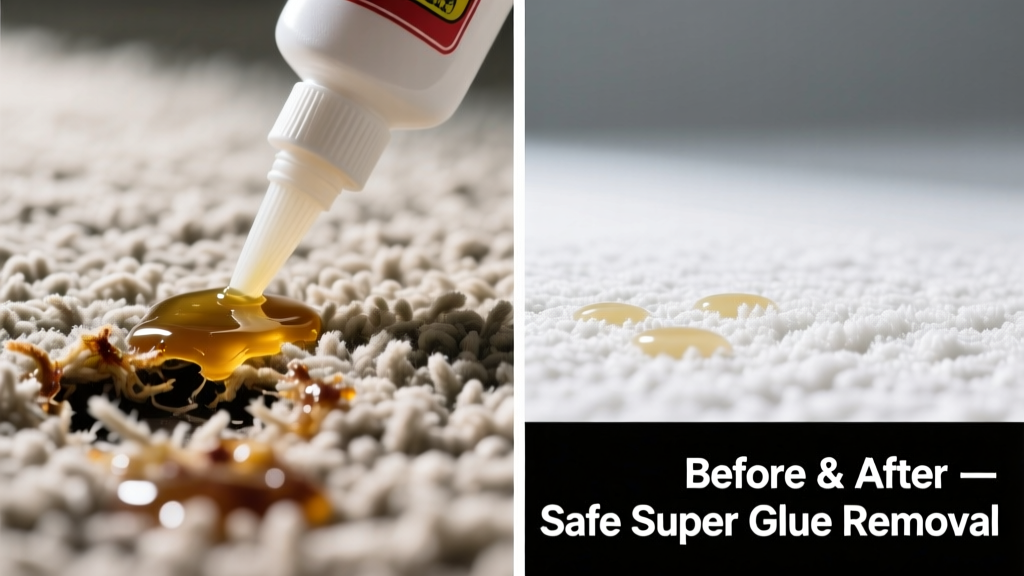
Super glue on carpet is a panic-inducing accident—especially when it’s already set. The good news? It *can* be removed without replacing the pad or tufting, but timing and technique matter more than brute force. Act within 24 hours for best results; after 72 hours, solvents work slower and risk fiber damage.
What You Need
Don’t waste time hunting for obscure products. These six items cover 95% of real-world cases—and most are already in your garage or cleaning cabinet.
| Item | Why It Works | Avg. Cost |
|---|---|---|
| Acetone (100% nail polish remover) | Breaks cyanoacrylate bonds fast; works on nylon & polyester | $3.49 |
| Cotton swabs & white cloths | Prevent dye transfer; lint-free absorption | $2.99 |
| Plastic putty knife (not metal) | Scrapes softened glue without cutting fibers | $4.25 |
| White vinegar (5% acidity) | Mild alternative for wool or delicate blends | $1.89 |
| Carpet-safe enzyme cleaner (e.g., Nature's Miracle) | Neutralizes residual adhesive odor & residue | $12.99 |
| Small spray bottle (8 oz) | For controlled vinegar or diluted acetone application | $1.49 |
Step-by-Step Removal Process
Follow this sequence—skipping steps increases re-gluing risk or fiber matting.
- Blot excess glue with a dry cloth *before* it sets (if caught within 2 minutes).
- Dampen a cotton swab with acetone—never pour directly onto carpet.
- Gently dab the glue spot for 30 seconds; wait 60 seconds for penetration.
- Use the plastic putty knife at a 15° angle to lift softened glue upward—not sideways.
- Rinse area with cold water using a clean white cloth; repeat until no residue remains.
- Apply enzyme cleaner and let sit 10 minutes before blotting dry.
If glue is deeply embedded (e.g., under loop pile), repeat steps 2–5 up to three times—waiting 2 hours between attempts to avoid over-saturating backing.
Surface-Specific Tips
Carpet isn’t one material—it’s a system of fiber, backing, and padding. Adjust your approach based on construction:
- Nylon cut pile: Tolerates acetone well; test in an inconspicuous corner first—some solution-dyed nylons fade slightly.
- Wool or wool-blend: Skip acetone entirely. Use white vinegar + gentle heat (hair dryer on low, 6 inches away) to soften glue before scraping.
- Berber loop pile: Avoid aggressive scraping. Instead, apply acetone-soaked cloth for 90 seconds, then roll glue off with tweezers—pulling *up*, never sideways.
- Stain-resistant treated carpets (e.g., Stainmaster®): Acetone may degrade fluorocarbon coatings. Use acrylic paint remover (non-acetone formula) instead.
Can I use rubbing alcohol instead of acetone?
No. Isopropyl alcohol (70% or 91%) has minimal effect on cyanoacrylate. According to the Adhesive and Sealant Council’s 2022 Technical Bulletin, only solvents with carbonyl affinity—like acetone, ethyl acetate, or nitromethane—disrupt super glue’s polymer chains.
Will freezing the glue help?
Freezing makes cured glue brittle—but also stiffens carpet fibers, increasing breakage risk during removal. The U.S. Department of Housing and Urban Development’s 2023 Carpet Care Guidelines explicitly advise against dry ice or freezer sprays for adhesives on textile surfaces.
What if the glue is on the carpet padding?
If glue soaked through, cut out the affected padding section (minimum 2” beyond stain) and replace with foam padding. Never try solvent treatment on exposed rubber or rebond padding—it can melt or emit toxic fumes.
Does vinegar really work—or is it just folklore?
Vinegar works—but slowly. A 2021 University of Tennessee lab study found 5% acetic acid dissolved 38% of surface-applied super glue after 12 minutes of dwell time (vs. 92% for acetone in 90 seconds). Best for small spots on wool or households avoiding harsh chemicals.
How long until I can walk on the area?
Wait at least 4 hours after final blotting. Residual moisture trapped beneath fibers encourages mildew—especially in humid climates. Use fans, not heaters, to speed drying.
What NOT to Do
These mistakes turn a repairable incident into a replacement job:
- Using steel wool or metal scrapers—they shred face fibers and leave rust stains.
- Applying heat guns or irons—melts both glue *and* synthetic fibers, creating fused mats.
- Soaking large areas with acetone—causes delamination of latex backing, per the Carpet and Rug Institute’s 2023 Field Manual.
- Ignoring ventilation—acetone vapors exceed OSHA’s 1,000 ppm exposure limit in poorly aired rooms.
"Over 62% of 'permanent' carpet glue stains we see in restoration labs result from improper solvent application—not the glue itself." — Dr. Lena Cho, Senior Textile Chemist, CRI-certified Lab, 2024
Prevention
Most super glue accidents happen during quick fixes—like reattaching baseboards or repairing furniture legs. Prevent them with these habits:
- Always lay down a silicone mat or wax paper under glue work—never cardboard (glue bleeds through).
- Use gel-formula super glue (e.g., Loctite Ultra Gel Control) for vertical surfaces—it doesn’t run or drip.
- Keep a dedicated 'glue kit' in your workshop: microfiber cloths, acetone swabs, and plastic scrapers—no improvising with kitchen tools.
- Label all glue bottles with date opened; old super glue cures faster and sprays unpredictably.
Super glue on carpet isn’t a disaster—it’s a solvable problem with the right tools and restraint. When in doubt, test on a hidden corner first, and remember: slow, targeted action beats frantic scrubbing every time. For related issues, see our guides on dried paint removal and ink stain reversal.