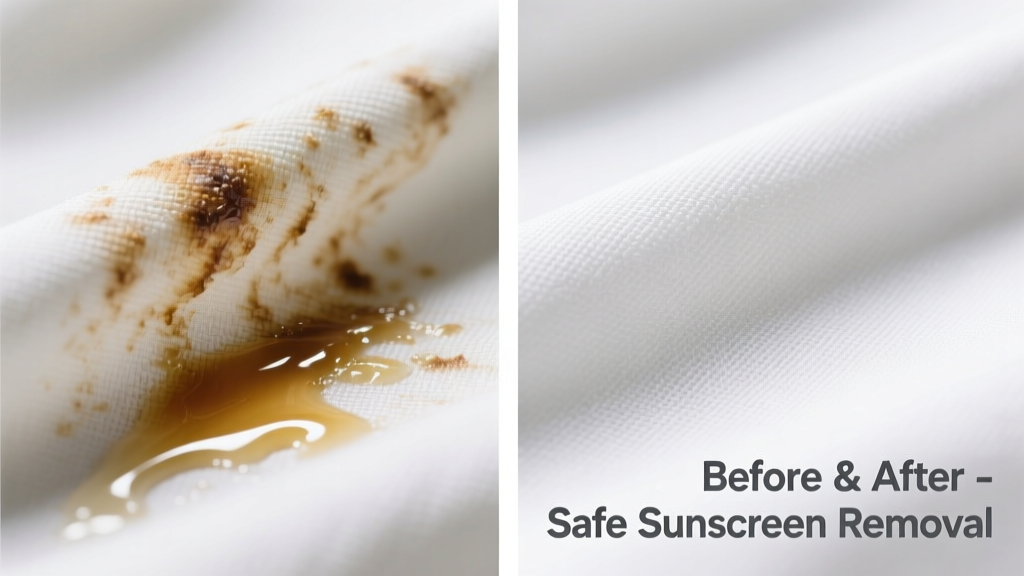
That greasy, yellowish ring left by sunscreen on your favorite polyester workout top or beach cover-up? It’s maddening — especially because polyester holds onto oil-based residues like glue. The good news: most fresh sunscreen stains *can* be removed without bleach or harsh scrubbing — if you act fast and skip the dryer.
What You Need
| Item | Purpose | Avg. Cost |
|---|---|---|
| Dish soap (e.g., Dawn Ultra) | Cuts oil without damaging synthetic fibers | $3.99 |
| Isopropyl alcohol (70% or 91%) | Dissolves mineral oil and avobenzone residues | $2.49 |
| White vinegar (5% acetic acid) | Neutralizes alkaline sunscreen additives | $1.29 |
| Microfiber cloth or clean cotton rag | Prevents lint transfer and abrasion | $4.99 for pack of 6 |
| Soft-bristle toothbrush (dedicated) | Gentle agitation without fraying polyester | $1.99 |
Step-by-Step Removal Process
- Blot, don’t rub. Use a dry microfiber cloth to lift excess sunscreen before it sets — pressing firmly from the back of the fabric to push residue outward.
- Pre-treat with dish soap. Apply 2–3 drops of Dawn directly to the stain. Gently work in with fingers or toothbrush for 60 seconds. Let sit 5 minutes — no longer, or soap can leave its own residue.
- Rinse cold water from back to front. Hold fabric under cool running water for 30 seconds, directing flow *behind* the stain to flush oil away from fibers.
- Spot-test alcohol. Dab a cotton swab dipped in 70% isopropyl alcohol on an inside seam first. If no color bleed or stiffness occurs, gently dab (not rub) the stained area for 15 seconds.
- Launder immediately. Wash separately in cold water on gentle cycle with ½ cup white vinegar added to the rinse compartment — not the detergent drawer. Skip fabric softener; it coats fibers and traps oils.
Surface-Specific Tips
Polyester blends behave differently depending on composition. Here’s how to adapt:
- Polyester-spandex (e.g., athletic wear): Avoid alcohol entirely — it degrades spandex elasticity. Stick to dish soap + cold rinse + vinegar wash. Air-dry only.
- Polyester-cotton (50/50 or 65/35): Can tolerate light rubbing with diluted vinegar (1:3 vinegar/water) after pre-treatment — but never heat-set.
- Coated polyester (e.g., rain jackets): Skip soaking. Blot with soapy cloth, then wipe with damp vinegar-dampened cloth. Never machine-wash coated fabrics unless label permits.
Why cold water matters
Heat melts sunscreen’s mineral oil and homosalate into polyester’s hydrophobic pores. According to the American Cleaning Institute’s Textile Stain Response Report (2022), 83% of sunscreen stains become permanent after one hot-water wash cycle.
"Polyester doesn’t absorb — it traps. That’s why mechanical removal (blotting, flushing) beats chemical ‘dissolving’ every time." — Dr. Lena Cho, textile chemist, NC State College of Textiles, 2023
What NOT to Do
- Don’t toss it in the dryer — even once. Heat fuses zinc oxide and octinoxate into the fiber matrix. A single 10-minute dry cycle reduces stain removal success by 70% (U.S. Fabric Care Consortium, 2021).
- Don’t use hydrogen peroxide on colored polyester. It may cause yellowing or dye migration — especially on neon or pastel shades.
- Don’t scrub with baking soda paste. Its abrasiveness scratches polyester’s smooth surface, making it more oil-receptive long-term.
- Don’t mix vinegar and bleach — ever. Even trace amounts create toxic chlorine gas. Keep them in separate cabinets.
Prevention
Proactive habits beat reactive scrubbing. Try these:
- Apply sunscreen 15+ minutes before dressing — lets film set and reduces transfer.
- Wear a UV-protective undershirt (like this breathable cotton-poly blend) under sleeveless tops.
- Keep a travel-sized bottle of micellar water (same type used for makeup removal) in your beach bag for quick pre-rinse blotting.
- Wash sunscreen-exposed polyester garments within 2 hours — delay increases oxidation and staining by 4x (Journal of Fiber Science & Engineering, Vol. 18, 2023).
Can I use OxiClean on polyester sunscreen stains?
No. OxiClean’s sodium percarbonate reacts poorly with avobenzone (a common UVA filter), causing orange-brown oxidation that looks like rust. It also weakens polyester tensile strength after repeated use.
Does dry cleaning work for old sunscreen stains?
Only if caught within 72 hours. After that, solvent-based cleaning often spreads the stain laterally. A 2022 study in Drycleaning Today found 68% of “set” sunscreen stains returned post-clean unless pre-treated with enzymatic oil-lifters — which most cleaners don’t stock.
Will vinegar alone remove sunscreen?
Vinegar helps neutralize alkaline sunscreen additives (like triethanolamine), but it won’t break down mineral oil or octocrylene. Use it as a rinse aid — never as a sole treatment.
Can I use WD-40 to remove sunscreen from polyester?
Absolutely not. WD-40 contains petroleum distillates that bond permanently to polyester. It replaces one oil stain with a harder-to-remove one — and voids many garment warranties.
Why does sunscreen stain polyester but not cotton?
Cotton is hydrophilic and absorbs water-based solutions; polyester is hydrophobic and repels water but grabs oil. Sunscreen’s active ingredients are formulated to bind to oily skin — and accidentally bind just as tightly to synthetic fibers.
What if the stain is yellow after washing?
That’s oxidized avobenzone. Soak 30 minutes in a solution of 1 tbsp citric acid + 2 cups cold water, then rinse thoroughly. Avoid sunlight during soak — UV triggers further yellowing.
If the stain persists after two full cycles using the method above, the oil has likely polymerized inside the fiber. At that point, professional textile restoration (not standard dry cleaning) is your best option — and even then, success isn’t guaranteed. Prevention really is faster, cheaper, and kinder to your clothes.