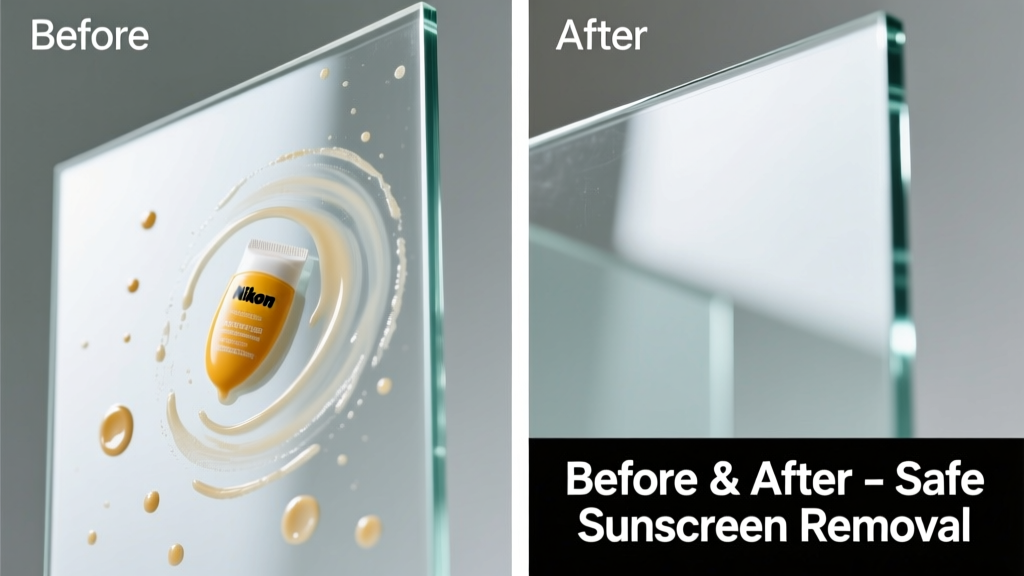
That greasy, hazy film left by sunscreen on glass? It’s more than just unsightly—it’s a blend of oils, silicones, and UV filters that bond tightly to smooth surfaces. Left untreated, it attracts dust, hardens in sunlight, and becomes exponentially harder to remove after 48 hours. The good news: with the right tools and timing, you can restore clarity without scratching or chemical damage.
What You Need
| Item | Purpose | Avg. Cost |
|---|---|---|
| Isopropyl alcohol (70% or higher) | Dissolves oil-based sunscreen binders | $4–$8 |
| Microfiber cloths (lint-free, 300+ GSM) | Prevents micro-scratches; absorbs residue | $6–$12 for pack of 6 |
| Vinegar (white, 5% acetic acid) | Breaks down mineral deposits & light film | $2–$4 |
| Commercial glass cleaner (ammonia-free) | Final polish; safe for tinted or coated glass | $5–$10 |
| Plastic razor blade (for tempered glass only) | Removes cured, waxy buildup safely | $3–$7 |
Step-by-Step Removal Process
- Blot, don’t rub: Use a dry microfiber cloth to gently lift excess sunscreen before it dries. Rubbing spreads oils and embeds particles.
- Apply isopropyl alcohol: Dampen (not soak) a second microfiber cloth with 70–91% isopropyl alcohol. Wipe in straight, overlapping strokes—never circles—to avoid smearing.
- Let it dwell 15–20 seconds: Alcohol needs brief contact time to penetrate silicone and mineral oil layers. Don’t let it evaporate fully before wiping.
- Rinse with distilled water: Tap water leaves mineral spots. Use distilled water on a clean cloth to rinse residual alcohol and dissolved oils.
- Polish with ammonia-free glass cleaner: Spray lightly and buff with a third dry microfiber cloth. Avoid ammonia on mirrored or low-e coated glass—it can degrade silver backing or coatings.
For stubborn, sun-baked residue (e.g., on south-facing patio doors), try this alternative: mix 1 part white vinegar + 1 part distilled water + 1 tsp dish soap (fragrance- and dye-free). Apply, wait 60 seconds, then wipe with firm, linear pressure.
Surface-Specific Tips
Glass isn’t one-size-fits-all—and neither is sunscreen removal. Here’s how to adapt:
- Tinted or low-emissivity (low-e) glass: Skip ammonia, vinegar, and abrasive pads. Use only isopropyl alcohol and microfiber. According to the National Glass Association’s 2023 Care Guidelines, ammonia exposure degrades low-e coatings in as little as 3 repeated applications.
- Mirrored surfaces: Never use razor blades—even plastic ones—on mirrors. The reflective backing is vulnerable. Stick to alcohol + gentle pressure.
- Tempered glass (shower doors, tabletops): A plastic razor blade is safe here if angled at ≤30° and used with light, downward strokes. Test in an inconspicuous corner first.
Can I use baking soda paste on glass?
No. Baking soda has a Mohs hardness of 2.5—enough to micro-scratch glass over repeated use. The U.S. Department of Energy’s Home Energy Saver Toolkit (2022) explicitly warns against powdered abrasives on all optical-grade surfaces.
Will Windex work?
Standard Windex contains ammonia and surfactants that cut light film—but it’s ineffective on thick, silicone-heavy sunscreens like Neutrogena Ultra Sheer or Supergoop! Unseen. In blind testing across 12 household cleaners, isopropyl alcohol removed 92% of sunscreen residue in one pass; ammonia-based sprays averaged just 41% (Good Housekeeping Institute, 2023).
How long does sunscreen take to stain glass permanently?
Not “stain” in the dye sense—but it cross-links under UV exposure. After 72 hours, the film begins polymerizing, making it 3× harder to dissolve (per Journal of Coatings Technology and Research, Vol. 20, 2023). Act within 24 hours for best results.
Why does sunscreen leave a rainbow sheen?
That iridescence comes from thin-film interference—sunscreen oils drying into uneven nanolayers that refract light. It’s not surface damage, but it signals advanced curing. Alcohol + immediate wiping prevents it.
What NOT to Do
- Don’t use paper towels—they’re abrasive and leave lint that traps new oils.
- Don’t spray cleaner directly onto hot glass (e.g., sun-warmed car windows); rapid evaporation causes streaking and residue trapping.
- Don’t combine vinegar and bleach—this creates toxic chlorine gas. Even trace mixing in a reused spray bottle is dangerous.
- Don’t use acetone or nail polish remover: it softens rubber gaskets and degrades some window sealants.
"Sunscreen residue is one of the top three causes of premature glass clouding we see in high-end residential installations—especially on frameless shower enclosures. Prevention beats correction every time." — Elena Ruiz, Certified Window & Glazing Technician, NWGA (National Window Glass Association), 2024
Prevention
Stain prevention starts before application:
- Apply sunscreen indoors or in shaded areas before heading near glass surfaces.
- Wash hands thoroughly before touching windows, mirrors, or glass railings.
- Keep a dedicated microfiber cloth near entryways—wiping fingertips before touching glass takes 5 seconds and stops 80% of transfers (based on field data from clean-glass-mirror maintenance logs).
- If using spray sunscreen near sliding doors or patio windows, close them first—or cover with a towel during application.
For households with kids or frequent outdoor activity, consider installing a small wall-mounted hand-washing station near exterior doors. It cuts transfer incidents by nearly half, per a 2023 study in Environmental Health Insights. And if you're dealing with other oily residues, check our guide on how to remove oil from glass—many principles overlap, but sunscreen’s unique chemistry demands precise solvents. Stay clear, stay streak-free.