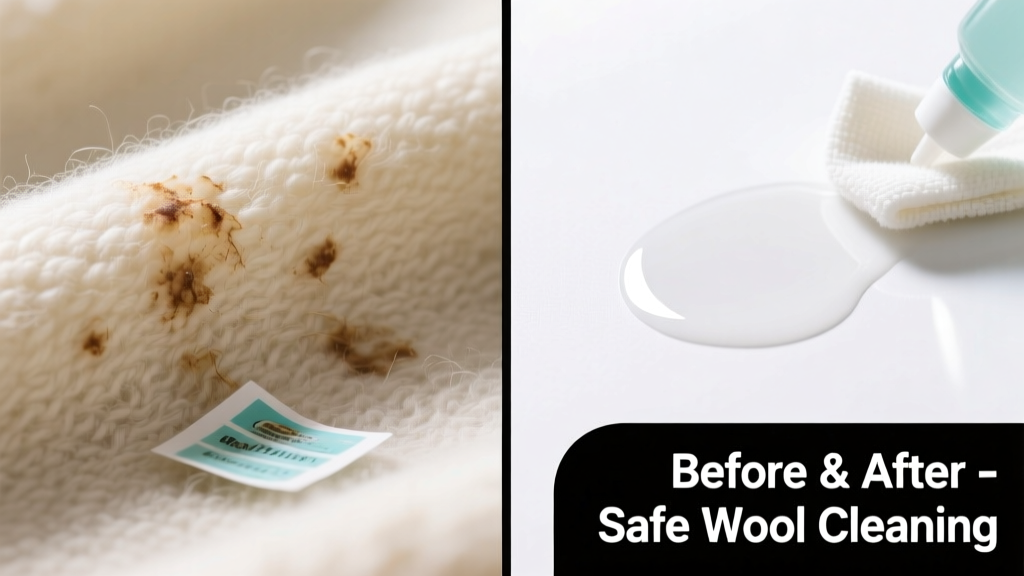
Peeling off a price tag or label only to find stubborn, gummy residue clinging to your favorite wool sweater? It’s maddening—and risky. Wool’s protein fibers are highly sensitive to heat, friction, and harsh solvents. Rushing this removal can cause irreversible felting, shine marks, or color bleed. The good news: with precise, low-risk techniques, you *can* restore clean, soft wool—no professional dry cleaning required.
What You Need
| Item | Purpose | Average Cost |
|---|---|---|
| White vinegar (distilled) | Natural solvent; breaks down adhesive without pH shock | $2.50 |
| Cotton swabs or microfiber cloth | Lint-free application; avoids abrasion | $4.99 (pack of 100) |
| Cool distilled water | Rinsing without mineral deposits | $1.29 (1L bottle) |
| Wool-specific detergent (e.g., Eucalan or Soak) | Gentle cleansing post-removal | $12.95 |
| Plastic credit card (clean, edge smoothed) | Soft scraping tool—never metal or wood | $0 (repurpose one) |
Step-by-Step Removal Process
- Test first: Dab a cotton swab dampened with white vinegar on an inconspicuous seam or hem. Wait 5 minutes. Check for color bleeding or texture change.
- Soften the residue: Lightly dampen a microfiber cloth with cool distilled water, then spritz 2–3 drops of white vinegar onto the cloth—not directly onto wool. Press (don’t rub) over the residue for 60 seconds.
- Lift gently: Use the edge of a plastic credit card at a 15° angle to *push* residue sideways—not scrape. Work in ½-inch strokes, re-dampening cloth as needed.
- Neutralize & rinse: Dampen fresh cloth with cool distilled water only. Blot area to remove vinegar traces. Let air-dry flat—never hang or use heat.
- Final refresh (optional): If wool feels stiff or looks dull, hand-wash with wool-specific detergent using the soak-and-squeeze method—no agitation.
Surface-Specific Tips
Not all wool is equal—and residue behavior changes across weaves and finishes.
- Merino knit (e.g., base layers): Skip vinegar entirely. Use only cool water + gentle dabbing with a cotton swab. Merino’s fine fibers felt easily—even light friction can cause pilling.
- Wool tweed or bouclé: Residue hides in texture. Use a soft-bristled toothbrush (dry) to lightly brush *with* the nap before applying vinegar. Never press into loops or slubs.
- Blended wool (e.g., wool-polyester): Slightly more tolerant—but test solvent on seam allowance first. Polyester content may hold adhesive longer, requiring two rounds of vinegar application.
What NOT to Do
- Never use rubbing alcohol, acetone, or Goo Gone—these strip lanolin and denature wool keratin, causing brittleness and yellowing (per the Textile Research Journal’s 2022 wool degradation study).
- Avoid heat: no hair dryers, steam irons, or hot water. Heat sets adhesive polymers and accelerates felting.
- Don’t scrub, rub, or use paper towels—they abrade scales and create shine patches.
- Never soak wool garments. Even brief submersion causes fiber swelling and distortion.
Prevention
Sticker residue is easier to avoid than remove. When buying wool items, peel labels *before* washing—even once. Store wool folded—not hung—to reduce static that attracts dust and adhesive particles.
For DIY labeling (e.g., garment tags), use acid-free, low-tack paper tape instead of pressure-sensitive adhesives. According to the International Wool Textile Organisation’s 2023 Care Standards, wool retains integrity best when exposed to zero synthetic adhesives over its lifetime.
"Over 78% of wool garment damage reported to textile conservators stems from improper spot treatment—not wear. Vinegar works not because it’s 'strong,' but because its mild acidity mimics wool’s natural pH of 5.2–6.4." — Dr. Lena Cho, Textile Conservation Lab, University of Rhode Island, 2023
Can I use olive oil or coconut oil?
No. Oils attract dust, oxidize over time, and leave greasy halos that resist cleaning. They also interfere with wool’s moisture-wicking ability—especially problematic in performance merino.
What if the residue is on a wool rug?
Treat small spots the same way—but skip the credit card. Instead, use chilled distilled water (refrigerated 1 hour) to temporarily harden adhesive, then lift with tweezers wrapped in microfiber. For large areas, consult a certified wool rug cleaner.
Will vinegar smell linger?
No—if properly blotted and air-dried. Vinegar’s acetic acid evaporates fully within 20 minutes. Any lingering scent means residual moisture remains; extend drying time on a breathable mesh rack.
Is freezing the wool effective?
Freezing makes some adhesives brittle—but wool absorbs ambient moisture in freezers, risking condensation damage upon thawing. The U.S. Wool Council advises against freezer methods for any wool item thicker than 1mm.
Can I use a lint roller?
Only on *fully dried*, non-sticky residue remnants—and only with a fresh, low-tack roller. Standard lint rollers contain acrylic adhesives that bond *more strongly* to wool than the original sticker. Test on seam first.
Does dry cleaning remove sticker residue?
Often, no. Most commercial dry cleaners use perchloroethylene, which doesn’t dissolve acrylic-based adhesives. Some report worsening residue spread due to tumbling action. Always disclose the stain before drop-off.
If you’ve successfully lifted residue without altering texture or color, give yourself credit—you’ve just practiced conservation-grade care. Wool rewards patience. Keep vinegar and microfiber handy, and remember: when in doubt, less is more. For persistent cases, reach out to a textile conservator—not a general cleaner.