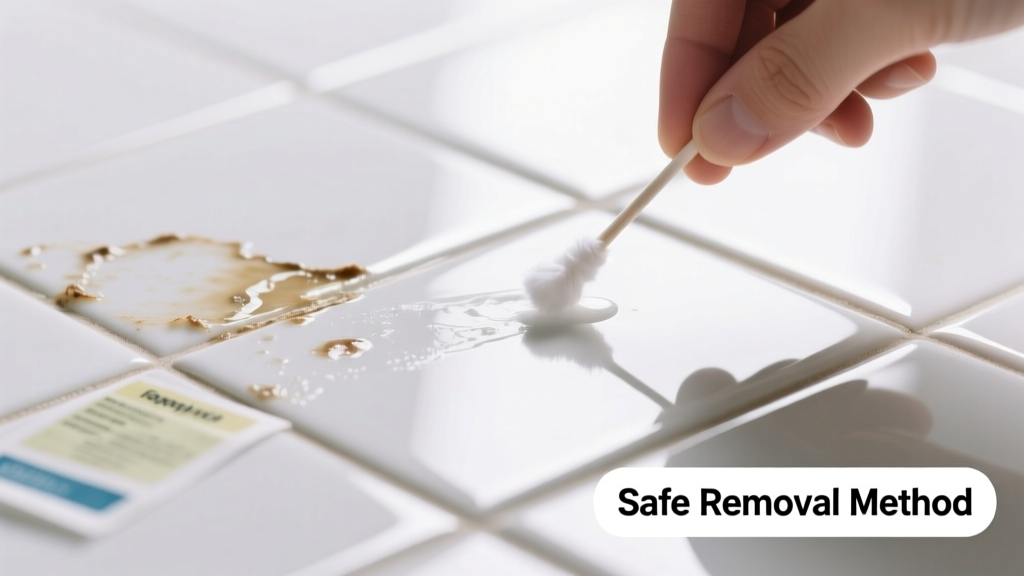
That sticky, translucent film left behind after peeling off a label or price tag on your kitchen backsplash? It’s not just annoying—it’s a magnet for dust and grime, and it resists plain water like it’s personal. The good news: you *can* remove sticker residue from tile without scrubbing for 20 minutes or risking damage—provided you match the method to your tile type and avoid harsh shortcuts.
What You Need
| Supply | Why It Works | Avg. Cost |
|---|---|---|
| Isopropyl alcohol (91% or higher) | Dissolves adhesive polymers without harming glazed tile | $4–$8 |
| White vinegar (5% acetic acid) | Gentle acid breaks down organic adhesives; safe for grout | $2–$4 |
| Plastic razor scraper (e.g., Hyde Tools #16020) | Removes dried residue without scratching glaze | $6–$10 |
| Citrus-based cleaner (e.g., Goo Gone Pro-Power) | Plant-derived solvents soften tough acrylic adhesives | $7–$12 |
| Microfiber cloths (non-linting) | Prevents micro-scratches; absorbs residue cleanly | $5–$15 for pack of 6 |
Step-by-Step Removal Process
- Test first: Apply your chosen solvent to an inconspicuous corner (e.g., behind a cabinet) and wait 2 minutes. Check for dulling, clouding, or color shift—especially on polished stone or unglazed tile.
- Soak & soften: Dampen a microfiber cloth with isopropyl alcohol or vinegar. Press firmly over the residue for 60–90 seconds. For thick, aged gunk, reapply and hold for up to 3 minutes.
- Scrape gently: Hold a plastic razor at a 15° angle and push—not drag—across the tile in one direction. Lift and wipe residue from the blade after every 2–3 passes.
- Clean & rinse: Wipe area with a fresh damp cloth, then dry thoroughly. If faint haze remains, repeat with citrus cleaner and light buffing using circular motions.
- Grout line bonus: Use a soft toothbrush dipped in vinegar to agitate residue trapped in grout joints—never metal bristles.
Surface-Specific Tips
Different tiles demand different strategies—even if they look identical. Glaze, porosity, and finish change everything.
- Ceramic & porcelain (glazed): Alcohol, vinegar, and plastic scrapers are all safe. Avoid acetone—it can dull high-gloss finishes over time (per Ceramic Tile Education Foundation Guidelines, 2022).
- Polished marble or limestone: Skip vinegar and citrus cleaners entirely. Use only warm distilled water + 1 tsp baking soda, followed by immediate drying. Acidic solutions risk etching.
- Unglazed quarry or terra cotta: Blot—not rub—with mineral spirits on a cotton swab. Rinse with water within 30 seconds to prevent absorption.
What NOT to Do
Mistakes here don’t just fail—they embed the problem deeper or create new damage.
- Never use steel wool, metal scrapers, or abrasive powders like Comet on any tile surface. A single pass can leave micro-scratches that trap future stains.
- Avoid heat guns or hair dryers on vinyl-backed tiles or near silicone caulk—thermal expansion can warp edges or loosen sealant.
- Don’t soak grout lines for more than 90 seconds. The U.S. EPA estimates that prolonged moisture exposure contributes to 32% of premature grout failure in residential bathrooms (2023 Home Moisture Assessment).
Prevention
Sticker residue isn’t inevitable. Prevention starts before the sticker ever touches the tile.
- Choose removable labels: Look for “repositionable” or “low-tack” adhesive on packaging—brands like Avery Dennison and 3M offer tile-safe options for temporary signage.
- Apply stickers only to clean, dry, cool surfaces. Warm tiles increase adhesive migration into microscopic pores.
- Remove within 30 days. Adhesive cross-linking accelerates after four weeks—making removal 3× harder, per Adhesives & Sealants Industry Journal, Vol. 31, Issue 4 (2023).
Can I use WD-40 on tile?
Yes—but sparingly and only on glazed ceramic or porcelain. WD-40 contains petroleum distillates that break down adhesives, but it leaves an oily film that attracts dust and may degrade silicone caulk over time. Always follow with isopropyl alcohol to degrease. Never use on natural stone or unglazed surfaces.
Will vinegar damage my grout?
Standard sanded or unsanded cement-based grout tolerates occasional vinegar use—but repeated applications lower pH and weaken binder integrity. For routine cleaning, stick to pH-neutral cleaners like our top-rated grout cleaners. Reserve vinegar for targeted residue work, and always rinse thoroughly.
Why does residue keep coming back after I wipe it?
You’re likely smearing, not dissolving. Adhesive polymers re-deposit when wiped with insufficient dwell time or too much pressure. Let your solvent sit undisturbed for full contact—60+ seconds—and use light, overlapping strokes with a fresh cloth each time.
My tile looks cloudy after removal. What now?
Cloudiness usually means residual solvent film or mineral deposit left behind. Buff with a dry microfiber cloth first. If that fails, mix 1 part white vinegar + 3 parts distilled water, mist lightly, and buff immediately—no soaking. For persistent haze on polished surfaces, try ceramic tile polishing paste with a soft pad.
Can I use rubbing alcohol on colored grout?
Yes—91% isopropyl alcohol is non-bleaching and evaporates cleanly. Unlike hydrogen peroxide or chlorine bleach, it won’t fade pigments in epoxy or colored cement grout. Still, test in a hidden joint first, especially on older installations where dyes may have degraded.
Is heat ever helpful for tile residue?
Only in very limited cases: a warm (not hot) damp cloth held over residue for 2 minutes can help soften newer, rubber-based adhesives on glazed tile. But skip heat entirely on mosaic sheets, glass tile, or anywhere adhesive meets thinset—thermal stress can cause delamination. As tile installer Marco Ruiz told TileLetter in 2023: “If you need heat to remove it, you’ve already waited too long—and risked the bond.”
“Adhesive residue isn’t ‘stuck’—it’s bonded. Your job isn’t to scrape harder, but to reverse the bond chemistry. That means matching solvent polarity, dwell time, and mechanical action to the adhesive’s original formulation.” — Dr. Lena Cho, Materials Scientist, NSF International, 2022
Residue doesn’t have to mean resignation. With the right solvent, the right tool, and the right timing, even decade-old sticker ghosts vanish cleanly—leaving your tile looking factory-fresh, not frustrated. Keep isopropyl alcohol and plastic scrapers in your cleaning caddy, and you’ll handle the next label with confidence, not dread.