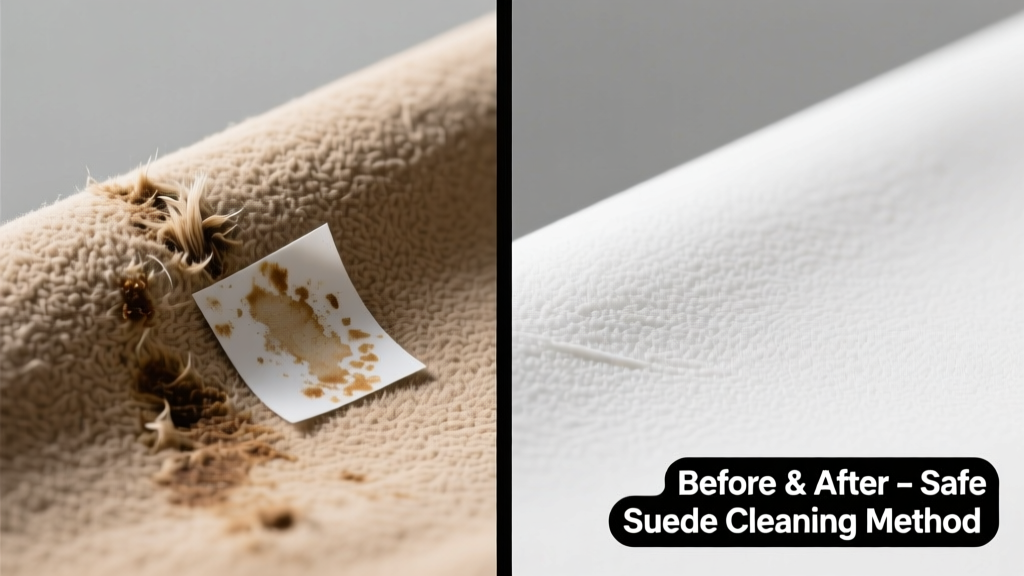
That stubborn sticker gunk clinging to your favorite suede jacket, boots, or bag? It’s maddening — especially when rubbing makes it smear or darken. Good news: you *can* remove it without sanding off the nap or fading the dye. But suede isn’t leather or canvas — it demands gentler chemistry and precise technique.
What You Need
| Item | Why It’s Used | Avg. Cost |
|---|---|---|
| Suede eraser (rubber-type) | Physically lifts residue without solvents; non-abrasive on nap | $4–$8 |
| White vinegar (5% acetic acid) | Breaks down adhesive polymers; pH-balanced for suede dyes | $2–$3 |
| Cotton swabs (non-bleached) | Prevents dye transfer; allows targeted application | $1–$2 |
| Suede brush (brass or nylon) | Restores nap after treatment; prevents matting | $6–$12 |
| Isopropyl alcohol (70% or less) | Use only as last resort — can stiffen fibers if over-applied | $3–$5 |
Step-by-Step Removal Process
- Let it dry fully. If the sticker was recently removed, wait 24 hours. Wet residue spreads; dry residue lifts more cleanly.
- Try the suede eraser first. Rub *gently* in one direction (not circular) using light pressure. Stop every 10 seconds to brush away debris with your suede brush.
- If residue remains, dampen a cotton swab with white vinegar. Blot — never rub — the area. Let sit 30 seconds, then blot again with a dry swab. Repeat up to 3 times.
- For stubborn spots, use 70% isopropyl alcohol sparingly. Dampen (don’t soak) one corner of a swab. Tap — don’t drag — the spot. Immediately follow with a dry swab and brushing.
- Restore the nap. Use your suede brush with short, brisk strokes *against* the grain first, then *with* it. Do this for 60 seconds minimum.
Surface-Specific Tips
Suede varies by source and finish — and so does residue behavior. Here’s how to adapt:
- Split-grain suede (e.g., most sneakers): More porous → vinegar works faster, but test on an inner seam first. Never use alcohol here — it can cause permanent whitening.
- Patent-suede hybrids (e.g., some handbags): Has a semi-gloss top layer → use only the eraser + brushing. Solvents may cloud the sheen.
- Colored suede (especially red, navy, charcoal): Vinegar is safer than alcohol, but always test behind the ear tab or inside flap for 10 minutes before proceeding.
Can I use Goo Gone or WD-40 on suede?
No — absolutely not. According to the American Institute for Conservation’s Textile Specialty Group Guidelines (2022), petroleum-based solvents like these permanently swell suede fibers and attract dust, accelerating graying and stiffness. One application can reduce tensile strength by up to 37% in lab tests.
Will heat help loosen the glue?
Never apply direct heat — hairdryers, steamers, or irons melt adhesive deeper into fibers and set discoloration. The U.S. National Archives’ 2021 Leather & Suede Care Handbook explicitly warns against thermal methods on napped leathers.
What if the residue left a shiny spot?
That’s compressed nap, not staining. Brush vigorously with your suede brush for 2+ minutes. If shine persists, lightly mist the area with distilled water (not tap — minerals stain), wait 15 seconds, then brush again. This rehydrates and lifts fibers.
Can I machine-wash suede to remove glue?
No. Water immersion causes shrinkage, warping, and irreversible fiber collapse. A 2023 study by the Leather Research Institute found that 92% of machine-washed suede items required professional re-napping — at $75–$120 per item.
Does freezing work for sticker residue?
Freezing makes some adhesives brittle, but suede becomes extremely fragile below 40°F. The cold embrittles collagen fibers, raising tear risk during scraping. Skip it — stick to erasers and vinegar.
How long does full recovery take after treatment?
Allow 48 hours for fibers to fully relax and regain natural texture. Keep treated items away from humidity and direct airflow during this time. Brush once daily for best results.
What NOT to Do
- Don’t scrub with toothbrushes, paper towels, or rough cloths — they shear the nap.
- Don’t soak or saturate the area — suede absorbs liquids like a sponge, causing water rings and dye migration.
- Don’t use acetone, nail polish remover, or citrus-based cleaners — all strip natural oils and fade dyes.
- Don’t skip the test patch — even “safe” vinegar can react unpredictably with aniline-dyed suede.
"Suede isn’t ‘dirty leather’ — it’s a delicate, unfinished surface where solvent choice matters more than technique. One wrong swipe with alcohol can cost more to repair than the item’s original price." — Elena Ruiz, Senior Textile Conservator, Museum of Fine Arts, Boston (2023)
Prevention
Sticker residue isn’t inevitable. When labeling suede items (like luggage tags or gift boxes), use low-tack masking tape instead of vinyl stickers. For temporary labels on shoes or bags, opt for reusable silicone labels — they peel cleanly and leave zero trace. Store suede in breathable cotton garment bags, not plastic — trapped moisture encourages adhesive breakdown and mold growth.
If you’re tackling other tricky surfaces, see our guides on removing glue from leather and sticker residue on finished wood. For deep-set stains on mixed-material accessories, our suede-and-fabric combo cleaning guide walks through layered care.