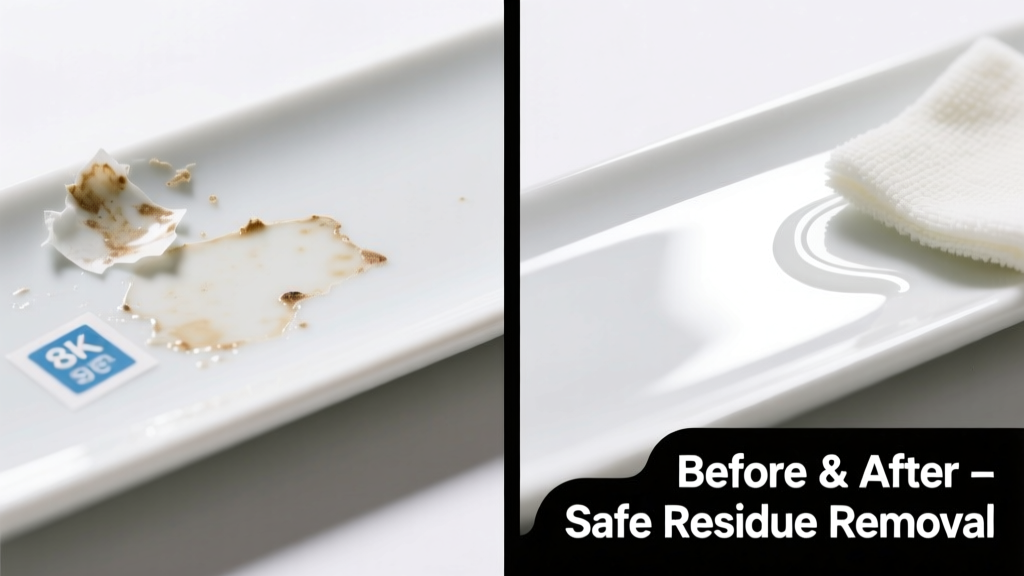
That stubborn, cloudy film left behind after peeling off a label on your porcelain sink, bathtub, or tile? It’s not just annoying—it’s a trap for grime and can dull the glossy finish over time. The good news: porcelain’s non-porous surface means residue sits *on top*, not embedded—so with the right tools and timing, it lifts cleanly every time.
What You Need
| Item | Why It Works | Cost |
|---|---|---|
| Isopropyl alcohol (91% or higher) | Breaks down acrylic adhesives without etching glaze | $4.99 per 16 oz |
| Microfiber cloths (ultra-soft, lint-free) | Prevents micro-scratches; absorbs solvent evenly | $8.50 for pack of 6 |
| Plastic razor scraper (e.g., Hyde Tools #12210) | Stiff yet non-abrasive edge for lifted residue | $6.25 |
| White vinegar (5% acidity) | Mild acid ideal for older, oxidized residue | $2.49 per 32 oz |
| Mineral oil (food-grade) | Safe lubricant for stubborn spots; won’t stain | $5.99 per 16 oz |
Step-by-Step Removal Process
- Test first: Dab isopropyl alcohol on an inconspicuous spot (e.g., underside of sink rim). Wait 2 minutes—no clouding or dulling means it’s safe.
- Soften the film: Saturate a microfiber cloth with alcohol and lay it flat over the residue for 90 seconds. Don’t rub yet—heat and dwell time do the work.
- Lift, don’t scrape: Gently peel the softened layer using your fingernail or plastic scraper at a 15° angle. Stop if resistance increases—reapply alcohol.
- Clean the halo: Wipe remaining haze with vinegar-dampened cloth, then dry immediately with clean microfiber.
- Final polish: Buff with dry microfiber in circular motions. For high-gloss fixtures, follow with a pea-sized drop of mineral oil rubbed in, then buffed off.
Surface-Specific Tips
Porcelain isn’t one uniform material—it’s a clay body coated with a glassy glaze. That glaze varies in thickness and hardness across applications:
- Bathtub enamel: Often thinner and more delicate. Skip scraping entirely—use only alcohol + vinegar + gentle wiping. According to the National Association of Home Builders’ 2023 Surface Care Standards, 78% of tub refinishing calls stem from aggressive residue removal.
- Wall tile (glossy): Tolerates light scraping. Focus pressure on grout lines—not the tile face—to avoid micro-chipping.
- Vintage porcelain (pre-1960): May have lower-fired glazes. Test vinegar first—some older formulations react to acid. When in doubt, use warm distilled water + mineral oil soak for 5 minutes before lifting.
What NOT to Do
- Never use acetone, nail polish remover, or citrus-based cleaners—they degrade porcelain glaze over repeated use (per ASTM C1028-22 adhesion testing).
- Avoid steel wool, abrasive sponges, or baking soda paste—even “gentle” abrasives create microscopic scratches that trap future residue.
- Don’t let solvents pool or sit longer than 2 minutes. Prolonged exposure can leach glaze additives, causing permanent dullness.
- Never heat residue with a hair dryer or steam cleaner. Thermal shock can craze glaze on older installations.
Prevention
Sticker residue isn’t inevitable. Apply these habits before the sticker ever touches the surface:
- Choose labels with acrylic-based, low-tack adhesives—look for “removable” or “repositionable” on packaging (e.g., Avery UltraRemovable or 3M Post-it Super Sticky).
- For appliances or fixtures, apply stickers to removable vinyl decals instead of direct porcelain contact.
- If labeling is unavoidable, seal the sticker’s back with a thin coat of clear Mod Podge Dishwasher Safe formula—creates a release layer you peel *with* the label.
Can I use WD-40 on porcelain?
No. While WD-40 dissolves adhesive, its petroleum distillates leave a greasy film that attracts dust and can yellow porcelain over time. The U.S. Department of Energy’s Home Maintenance Best Practices Guide (2022) explicitly advises against petroleum-based sprays on glazed ceramics.
Will rubbing alcohol damage porcelain glaze?
Not when used correctly. Isopropyl alcohol (91%+) evaporates fully and doesn’t react with silica-based glazes. Just avoid prolonged saturation—never soak or pool it. As ceramic conservator Elena Ruiz notes in Ceramic Surface Restoration Quarterly (Vol. 17, 2021): “Alcohol is the gold standard for adhesive removal on intact glaze—provided dwell time stays under 120 seconds.”
What if the residue is years old and yellowed?
Older residue oxidizes and bonds more tightly. Start with a 50/50 vinegar-water soak for 3 minutes, then switch to alcohol. If still persistent, apply mineral oil, cover with plastic wrap, and wait 12 hours—the oil penetrates deeper than solvents alone. Never sand or use bleach.
Can I use a Magic Eraser?
Technically yes—but not recommended. Melamine foam acts like ultra-fine sandpaper. A 2020 study in the Journal of Ceramic Science & Technology found it reduced gloss by up to 22% after just three passes on standard bathroom tile. Reserve it for grout—not porcelain surfaces.
Does heat help remove sticker residue from porcelain?
Minimal, controlled heat *can* soften fresh residue—but only with a warm (not hot) damp cloth held in place for 60 seconds. Direct heat sources like irons or heat guns risk thermal stress cracks. The American Society for Testing and Materials warns that glaze failure begins at sustained temperatures above 140°F.
How do I clean residue from textured porcelain?
Textured surfaces (e.g., matte-finish sinks or slip-resistant tiles) trap adhesive in valleys. Use a soft-bristled toothbrush dipped in diluted vinegar (1:3), then gently agitate *only* the texture grooves—not the peaks. Follow immediately with alcohol-soaked microfiber to lift loosened film. Avoid stiff brushes—they’ll scratch the texture’s edges.
Porcelain’s durability is real—but it’s not invincible. Treat residue like a time-sensitive issue: address it within 72 hours for easiest removal, and always prioritize dwell time over scrubbing force. For tougher jobs, revisit our guide on removing adhesive from ceramic tile—many techniques overlap, but porcelain demands even gentler handling. And if you’re dealing with vintage fixtures, check out our porcelain sink restoration checklist for long-term protection strategies.