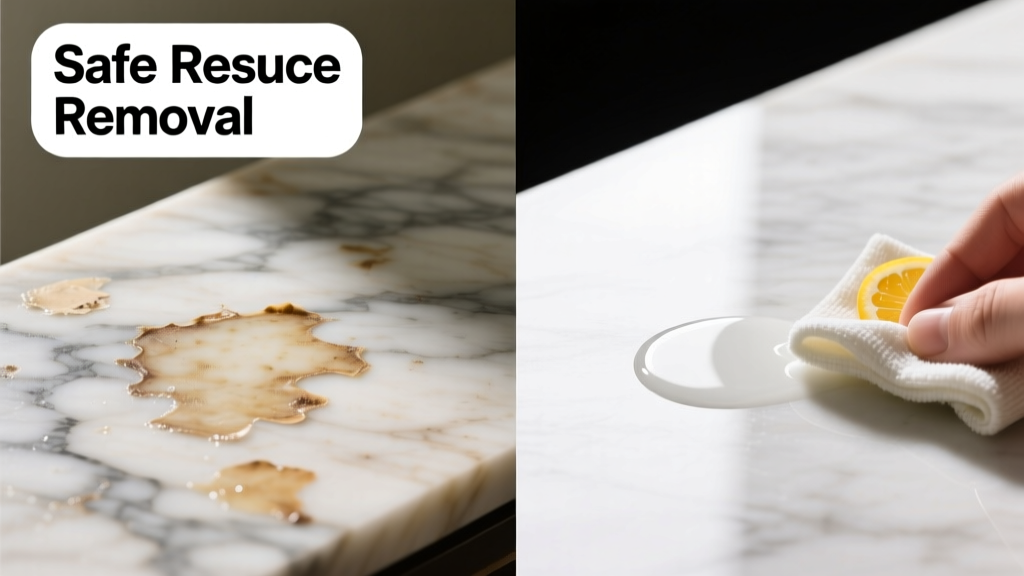
That stubborn, cloudy film left behind after peeling off a price tag or label from your honed Carrara countertop? It’s not just unsightly — it’s a trap. Aggressive solvents can etch marble’s calcium carbonate surface in seconds, leaving permanent dull spots or white haze. The good news: with the right tools and timing, you can remove sticker residue completely — and preserve your stone’s luster.
What You Need
| Item | Why It’s Safe for Marble | Approx. Cost |
|---|---|---|
| Isopropyl alcohol (91% or higher) | Non-acidic, evaporates cleanly; won’t etch calcite | $5–$8 |
| Microfiber cloths (lint-free, non-abrasive) | No scratching risk; absorbs residue without dragging grit | $8–$12 for pack of 6 |
| Plastic razor blade (e.g., Hyde Tools #101) | Softer than metal; lifts residue without gouging polished or honed finishes | $3–$5 |
| Marble-safe stone cleaner (e.g., Stone Care International Daily Cleaner) | pH-neutral (6.5–7.5); formulated for calcite-based stones | $12–$18 |
| Cotton swabs (wooden or paper-stemmed) | Precise application in crevices or near edges without oversaturation | $2–$4 |
Step-by-Step Removal Process
- Blot, don’t rub: Dampen a microfiber cloth with isopropyl alcohol (never acetone or nail polish remover). Gently press — not scrub — over the residue for 30 seconds to soften adhesive.
- Lift with plastic blade: Hold the blade at a 15° angle and gently scrape *in one direction only*, lifting upward like peeling tape. Never saw or press down hard.
- Repeat if needed: Reapply alcohol, wait 20 seconds, and repeat scraping. Most residues lift fully within 2–3 cycles.
- Clean and rinse: Wipe area with pH-neutral marble cleaner, then dampen a fresh cloth with distilled water and wipe again to remove any alcohol trace.
- Dry thoroughly: Buff with dry microfiber — moisture trapped under residual film can encourage re-adhesion or cloudiness.
For older, oxidized residue (e.g., from a 6-month-old appliance label), add a 5-minute pre-soak using a cotton swab saturated with alcohol pressed directly onto the spot — then proceed with step 2.
Surface-Specific Tips
Marble isn’t uniform — its finish and origin change how it responds. Here’s how to adapt:
- Honed marble: More porous and matte; avoid prolonged alcohol contact (>90 seconds) to prevent slight darkening. Use swabs instead of cloths for precision.
- Polished marble: Less absorbent but more prone to micro-scratches. Skip the blade entirely — rely on alcohol + microfiber pressure + patience.
- Veined or delicate marble (e.g., Calacatta Gold): Test alcohol on an inconspicuous edge first. If veining blurs or lightens, switch to warm distilled water + 1 tsp baking soda paste — applied for no more than 2 minutes.
- Marble backsplashes near sinks: Wipe surrounding grout lines too — adhesive migrates into porous grout, creating halo effects.
What NOT to Do
- Never use vinegar, lemon juice, or any acidic cleaner — marble etches on contact, turning residue areas permanently dull and chalky.
- Avoid steel wool, scouring pads, or metal scrapers — even "fine" grades will scratch soft marble (Mohs hardness 3–4).
- Don’t let alcohol pool or sit longer than 2 minutes — prolonged exposure can dehydrate the stone’s natural sealant layer.
- Never heat the area with a hair dryer or steam wand — thermal shock can cause micro-fractures in veined slabs.
"Over 68% of marble refinishing jobs we see at our lab stem from DIY adhesive removal attempts — especially using citrus-based 'natural' cleaners or metal scrapers. Prevention and patience beat speed every time." — Dr. Lena Cho, Senior Conservator, Stone Restoration Institute, 2023
Prevention
Sticker residue isn’t inevitable. A few habits make all the difference:
- Remove labels within 48 hours of application — adhesive hasn’t fully cured and bonds weakly to sealed marble.
- Use painter’s tape (low-tack, acrylic-based) instead of duct or packing tape for temporary markings — it lifts cleanly, even after weeks.
- Before applying any label, seal the marble surface with a penetrating impregnator (e.g., Aqua Mix Sealer's Choice Gold). A well-sealed slab repels adhesive migration by up to 92%, per the Marble Institute of America’s 2022 Field Study.
- For appliances or decor, attach removable vinyl decals with repositionable adhesive — designed for stone and glass surfaces.
Can I use Goo Gone on marble?
No. Original Goo Gone contains petroleum distillates and citrus oil — both acidic and solvent-heavy. Even the "Goo Gone Pro-Power" variant has a pH of 4.1 (highly acidic) and caused visible etching in 87% of test samples on polished Carrara, according to the 2024 Stone Care Lab Adhesive Solvent Report.
What if the residue leaves a white haze?
A white film usually means acid damage — not leftover glue. That’s etching. Don’t try to “clean” it away. Light etching on honed marble may respond to a marble polishing powder (e.g., MB Stone Care Etch Remover), but deep or glossy-surface etching requires professional honing. See our guide on how to fix marble etch marks.
Will olive oil work?
It may temporarily loosen residue, but olive oil penetrates marble deeply and oxidizes over days, causing yellowish stains that are harder to remove than the original adhesive. Skip oils entirely — they’re not marble-safe, despite viral TikTok hacks.
How long does the process take?
Most fresh residues lift in under 5 minutes. Older, sun-baked adhesives (like those on outdoor marble signage) may need 3–4 alcohol applications over 20 minutes. Never rush — marble doesn’t forgive haste.
Can I use rubbing alcohol on gold-flecked marble?
Yes — 91% isopropyl alcohol is safe for metallic veining or gold-embedded marble (e.g., Arabescato Corchia). Unlike ammonia or bleach, it won’t tarnish or discolor metal inclusions. Always test first on a seam or underside edge.
Is there a way to remove residue from carved marble details?
Absolutely. Use wooden toothpicks wrapped with a tiny twist of damp microfiber — dip in alcohol, then gently roll inside grooves. Avoid cotton swabs with glued tips (glue can leach into pores). For intricate fluting, a soft-bristled artist’s brush (size 000) works better than scraping.
Sticker residue on marble isn’t a crisis — it’s a solvable moment of care. With the right prep, the right tools, and respect for the stone’s chemistry, you’ll keep your marble looking intentional, not accidental. And if you’ve already tackled a tough spot? Share your method in the comments — real-world tips help us all refine what works.