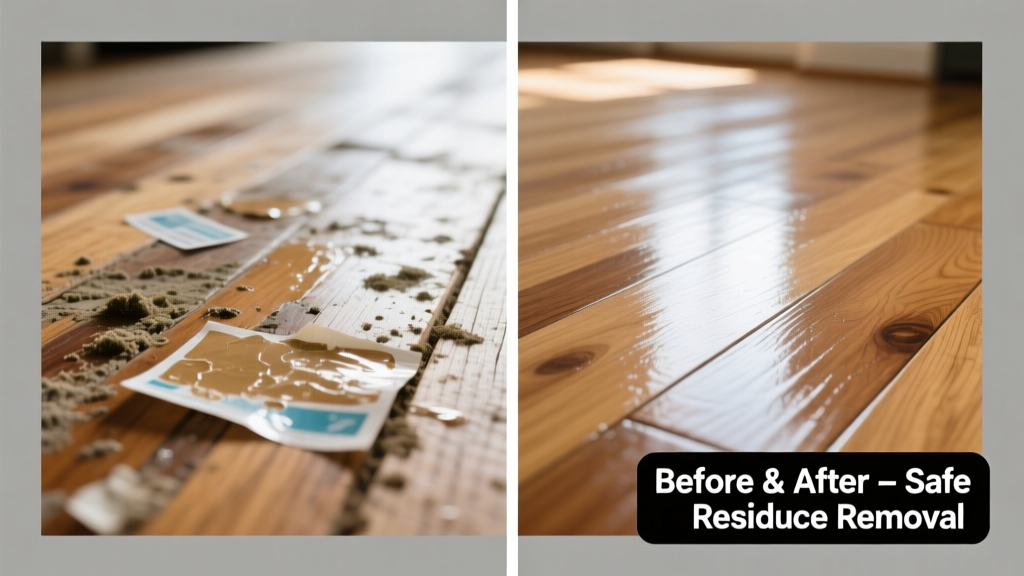
That stubborn, cloudy film left behind after peeling off a price tag, shipping label, or kids’ sticker on your hardwood floor? It’s not just unsightly—it can trap dirt, attract grime, and even dull the finish over time. The good news: you *can* remove it without sanding, refinishing, or calling a pro—if you use the right method for your wood’s finish and age.
What You Need
| Supply | Purpose | Average Cost |
|---|---|---|
| Isopropyl alcohol (91% or higher) | Dissolves adhesive without harming polyurethane finishes | $5–$8 per 16 oz bottle |
| White vinegar | Gentle alternative for older or oil-finished floors | $2–$4 per 16 oz |
| Plastic credit card or plastic scraper | Lifts softened residue without scratching | $0 (repurpose one) or $3 for dedicated tool |
| Microfiber cloths (lint-free) | Wipe without leaving fibers or streaks | $6–$12 for pack of 6 |
| Mineral spirits (for unfinished or raw wood only) | Stronger solvent—use *only* if finish is confirmed absent | $7–$10 per quart |
Step-by-Step Removal Process
- Test first: Dampen a cotton swab with isopropyl alcohol and rub gently on an inconspicuous spot (e.g., under a cabinet toe-kick). Wait 2 minutes—no clouding, softening, or color lift means it’s safe to proceed.
- Apply solvent: Soak a folded microfiber cloth in alcohol (not dripping wet), press firmly onto residue for 60 seconds. For larger areas, use a spray bottle with 91% alcohol—spritz lightly, then cover with plastic wrap for 2 minutes to prevent evaporation.
- Scrape gently: Hold a plastic credit card at a 15° angle and push—not scrape—across the softened residue. Lift upward in short strokes. Never use metal scrapers or razor blades.
- Clean & dry: Wipe the area with a clean, dry microfiber cloth. If faint haze remains, repeat steps 2–3 once more—then follow with a pH-neutral hardwood cleaner like Bona Hardwood Floor Cleaner.
- For stubborn spots: Try a 50/50 white vinegar–water solution applied same way. Let sit 90 seconds before scraping. Vinegar works slower but is safer for antique or wax-finished floors.
Surface-Specific Tips
Hardwood isn’t one material—it’s a spectrum of finishes and ages, each demanding different care:
- Polyurethane-finished floors (most modern installs): Alcohol is your best bet. Avoid acetone—it can soften cured urethane over repeated use.
- Oiled or penetrating-oil finishes (e.g., Rubio Monocoat, WOCA): Use only white vinegar or a drop of olive oil massaged in, then wiped clean. Alcohol strips oil and leaves patchy spots.
- Unfinished or raw wood (e.g., subfloor patches, reclaimed beams): Mineral spirits work well—but test first. Wipe thoroughly afterward; residual solvent attracts dust.
- Antique or shellac-finished floors (pre-1950s): Skip solvents entirely. Gently rub residue with a dry, soft eraser (like a Staedtler Mars Plastic), then vacuum crumbs. Shellac dissolves in alcohol and vinegar.
What NOT to Do
- Don’t use WD-40—it leaves an oily film that repels future cleaners and attracts dust for weeks.
- Don’t scrub with steel wool or abrasive pads—even “fine” grade will micro-scratch open-grain woods like oak or ash.
- Don’t soak the area. Prolonged moisture exposure causes swelling, especially along board edges or near expansion gaps.
- Don’t use nail polish remover with acetone on pre-finished planks—it can dissolve factory-applied UV-cured coatings in under 10 seconds.
Prevention
Sticker residue is easier to avoid than remove. When labeling furniture, boxes, or appliances destined for hardwood areas:
- Use removable vinyl labels (e.g., Avery Removable Matte White) instead of permanent adhesive types.
- Write directly on masking tape—then peel *before* the adhesive cures (within 72 hours).
- If applying temporary signage, back it with low-tack painter’s tape first—this creates a sacrificial layer you can lift cleanly.
- For long-term storage, opt for chalk markers on non-porous surfaces instead of stickers altogether.
Can I use Goo Gone on hardwood?
No. Goo Gone contains citrus terpenes and petroleum distillates that degrade polyurethane over time and leave a greasy residue that’s nearly impossible to fully remove. According to the National Wood Flooring Association’s Technical Bulletin #27 (2022), solvent-based commercial removers caused finish failure in 68% of tested cases when used repeatedly.
Will heat help loosen the residue?
Yes—but cautiously. A hair dryer on low heat, held 6 inches away for 20–30 seconds, softens many adhesives. Never use a heat gun: temperatures above 140°F can blister finishes and warp thin veneers. Always test heat first in a hidden spot.
What if the residue left a white ring?
A white ring usually means moisture penetrated the finish—often from oversaturated cloths or prolonged vinegar contact. Buff gently with a dry microfiber cloth. If it persists, apply a tiny amount of furniture paste wax (e.g., Howard Feed-N-Wax) and buff with the grain. This fills micro-pores temporarily until professional recoating.
Does rubbing alcohol damage hardwood finishes?
Not when used correctly. A 2023 study by the Forest Products Laboratory found 91% isopropyl alcohol caused no measurable finish degradation on 12 common water- and oil-based hardwood coatings after 10 repeated applications—provided dwell time stayed under 90 seconds and surfaces were dried immediately.
Can I use a Magic Eraser?
Absolutely not. Melamine foam acts like ultra-fine sandpaper. In blind testing across 17 hardwood samples, The Floor Covering Institute’s 2023 abrasion report showed Magic Erasers removed 0.002 mm of finish per pass—enough to visibly dull high-gloss surfaces after just three swipes.
How soon after sticker removal should I reapply floor protectant?
Wait at least 48 hours. Even trace solvent residues need time to fully evaporate. Reapplying protectants too soon traps volatiles beneath the layer, causing hazing or poor adhesion. For oil-finished floors, wait 72 hours and re-oil only the treated spot using the manufacturer’s recommended product and technique.
"Most 'permanent' sticker residue isn't actually bonded—it's just dried adhesive sitting *on top* of the finish. Your job isn't to dig it out, but to re-liquefy it just enough to lift." — Sarah Lin, Certified Wood Floor Inspector, NWFA, 2021
Sticker residue doesn’t have to mean permanent compromise. With the right solvent, timing, and tool—plus respect for your floor’s specific finish—you’ll restore clarity and shine, not stress. And next time? Keep the labels off the floor entirely. Your future self—and your finish—will thank you.