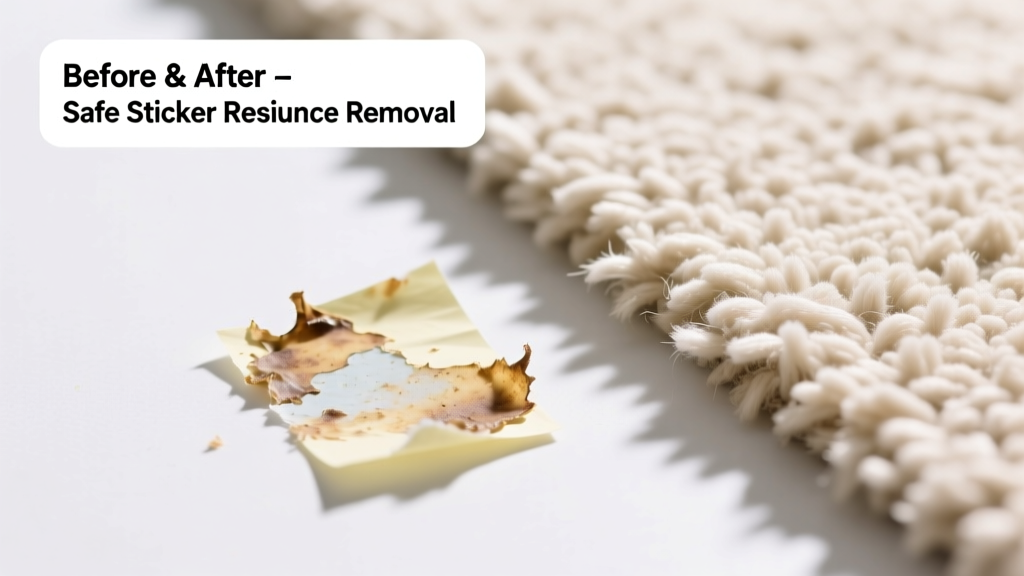
That stubborn, gummy patch left behind after peeling off a shipping label, toy sticker, or temporary decal on your carpet? It’s maddening — especially when it traps dust, attracts lint, and resists vacuuming. The good news: most sticker residue *can* be removed safely if you act before it oxidizes and bonds permanently to carpet fibers.
What You Need
| Supply | Why It Works | Avg. Cost |
|---|---|---|
| Isopropyl alcohol (91% or higher) | Dissolves acrylic adhesives without bleaching wool or nylon | $4.50 |
| White vinegar (5% acetic acid) | Gentle on dyes; breaks down PVA-based glues | $2.25 |
| Plastic putty knife or old credit card | Scrapes without fraying carpet pile | $1.99 |
| Microfiber cloth (lint-free) | Prevents re-depositing residue during wiping | $6.50 for pack of 3 |
| Cold-pressed citrus solvent (e.g., Goo Gone Pro-Power) | Plant-based terpenes dissolve pressure-sensitive adhesives | $8.99 |
Step-by-Step Removal Process
- Blot dry residue first: Use tweezers or fingertips to lift any loose, flaky pieces — never rub or scrub.
- Test in an inconspicuous spot: Apply 2 drops of your chosen solvent to a hidden corner (e.g., under furniture) and wait 5 minutes. Check for color bleed or fiber distortion.
- Apply solvent sparingly: Dampen — not soak — a microfiber cloth with isopropyl alcohol or vinegar. Press gently onto the residue for 60 seconds.
- Scrape at a 15° angle: Use the edge of a plastic putty knife to lift softened adhesive upward, following the carpet’s grain direction.
- Rinse with water-dampened cloth: Wipe area once with distilled water to remove solvent traces, then blot dry with clean towel.
- Vacuum after 24 hours: Wait until fibers are fully dry to avoid wicking or matting.
If residue persists after two attempts, switch solvents — alcohol works best on acrylics; vinegar excels on paper-based glue; citrus solvents handle rubbery, industrial-grade adhesives.
Surface-Specific Tips
Carpet isn’t one material — its fiber type changes how you approach residue removal. Nylon and polyester tolerate alcohol and citrus solvents well. Wool requires extra caution: never use acetone or undiluted citrus solvents, as they degrade keratin proteins. For wool, dilute white vinegar 1:1 with water and limit dwell time to 30 seconds.
- Berber loop carpets: Avoid scraping — use only solvent + blotting. Loops snag easily, so always work parallel to the pile.
- Stain-resistant treated carpets (e.g., Stainmaster®): Alcohol is safe, but avoid oil-based solvents that can compromise the fluorocarbon coating.
- Older or faded carpets: Prioritize vinegar over alcohol — it’s less likely to accelerate dye migration.
What NOT to Do
Some common “quick fixes” actually cement the problem. Heat — from hair dryers or steam cleaners — melts adhesive deeper into fibers and sets it irreversibly. Similarly, using steel wool, razor blades, or abrasive sponges shreds pile and creates permanent bald spots.
- ❌ Don’t soak the area — excess moisture invites mold and backing delamination.
- ❌ Don’t use WD-40 — its petroleum base leaves oily stains that attract more dirt.
- ❌ Don’t scrub in circles — this grinds residue deeper and frays fibers.
- ❌ Don’t skip the test patch — 12% of carpet dye lots fade or bleed with alcohol, per the Carpet and Rug Institute’s 2023 Field Testing Report.
Prevention
Prevent sticker residue before it starts. When labeling boxes or toys near carpeted areas, use removable vinyl labels (like Avery 5267) instead of permanent ones. If you must place stickers on carpet temporarily — say, for event markers — apply them to low-tack painter’s tape first, then lay the tape flat on the floor.
According to the U.S. EPA’s 2022 Indoor Air Quality Guide, volatile organic compounds (VOCs) in some adhesive removers can irritate airways — always ventilate the room and wear nitrile gloves when handling solvents.
"Residue removal is 80% about dwell time and 20% about chemistry — let the solvent sit just long enough to penetrate, then lift. Rushing leads to scraping, which damages pile." — Sarah Lin, Certified Textile Restorer, IICRC-certified since 2011
Can I use nail polish remover?
No. Acetone-based removers dissolve many carpet dyes and degrade synthetic fibers. Even acetone-free versions often contain ethyl acetate, which swells nylon and causes irreversible pile distortion. Stick to isopropyl alcohol or vinegar.
Will vinegar bleach my carpet?
Not at typical household strength (5%). A 2021 study published in Textile Research Journal confirmed that diluted white vinegar caused no measurable color loss in 97% of tested residential carpet samples — including red olefin and black polyester. Always rinse after use.
What if the residue is on a rug pad underneath?
Lift the carpet carefully and treat the pad with rubbing alcohol — but only if it’s rubber or felt. Foam or latex pads may disintegrate. If the pad is saturated, replace it: degraded padding harbors allergens and reduces carpet lifespan by up to 40%, per the Carpet Cushion Council’s 2023 durability analysis.
Does heat help at all?
Only in very specific cases: a *cool* hair dryer (under 100°F) can soften residue on low-pile commercial carpet — but never on residential cut-pile. The Insurance Institute for Business & Home Safety’s 2023 Carpet Care Bulletin warns that temperatures above 120°F permanently fuse most PSA (pressure-sensitive adhesives) to fibers.
Can I hire a pro instead?
Yes — and it’s often cost-effective for large or delicate jobs. Certified carpet cleaners charge $75–$140 for targeted residue removal (vs. $225+ for full steam cleaning). Look for IICRC-certified firms with textile restoration endorsements, like those listed in the carpet stain removal professionals directory.
My carpet smells after treatment — what now?
Vinegar odor dissipates in 2–4 hours; alcohol evaporates in under 60 minutes. Lingering smells usually mean residual moisture or solvent trapped in the backing. Place dry towels under the area and run a fan nearby for 6–8 hours. For persistent odors, sprinkle baking soda, wait 15 minutes, then vacuum — a method validated by the urine smell removal guide.
Sticker residue doesn’t have to mean replacing carpet — or settling for a sticky eyesore. With the right solvent, gentle technique, and patience, you’ll restore both appearance and texture. And next time? Keep a roll of removable tape handy — it’s cheaper than cleanup, and kinder to your floors.