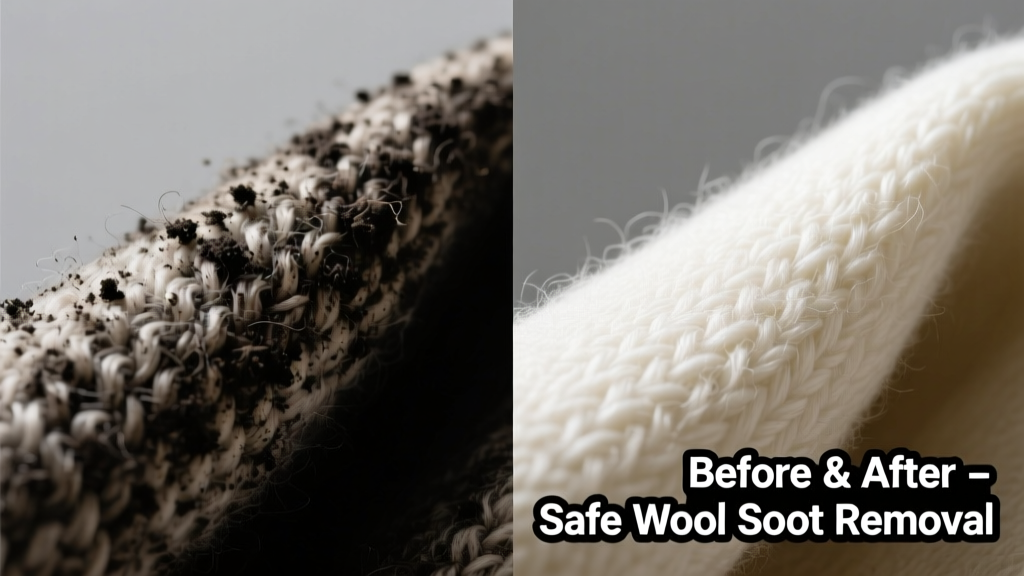
Soot on wool feels like a betrayal—especially when it lands on your grandmother’s hand-knit sweater or that $1,200 Persian rug after a candle accident or fireplace flare-up. Wool’s delicate keratin fibers bind soot particles tightly, and heat + moisture can lock them in permanently. The good news? With the right tools and timing (ideally within 48 hours), you *can* remove most soot without damage—if you skip the usual laundry instincts.
What You Need
| Item | Purpose | Average Cost |
|---|---|---|
| Cornstarch or talc-free baby powder | Absorbs oily soot residue; gentle on lanolin | $4–$7 |
| White vinegar (5% acetic acid) | Neutralizes alkaline soot ash; pH-balanced for wool | $2–$4 |
| Wool-specific detergent (e.g., Eucalan or The Laundress Wool & Cashmere Shampoo) | Cleans without stripping natural oils or causing shrinkage | $12–$18 |
| Soft-bristle brush (natural boar or horsehair) | Loosens surface soot without abrasion | $8–$15 |
| Cool-air hair dryer or fan | Dries without heat damage; prevents re-deposition | $15–$40 |
Step-by-Step Removal Process
- Let it cool completely. Never touch soot-covered wool while warm—it sets particulates deeper into fibers and risks melting synthetic blends.
- Dry-brush gently outdoors. Use a soft-bristle brush in one direction only—never circular motions—to lift loose soot. Tap the brush frequently over trash, not a sink (soot clogs drains).
- Apply absorbent powder. Sprinkle cornstarch evenly over stained areas. Let sit 30–60 minutes (up to 2 hours for heavy deposits). Vacuum *only* with a HEPA-filter vacuum on lowest suction—no beater bar.
- Rinse with vinegar solution (if needed). Mix 1 part white vinegar to 3 parts cool distilled water. Lightly mist (don’t soak) and blot with 100% cotton cloth. Vinegar lowers pH to match wool’s natural acidity (4.2–5.5), preventing fiber swelling.
- Hand-wash only if necessary. Submerge in lukewarm water (max 85°F/29°C) with wool detergent. Swish gently for 2–3 minutes. Rinse twice in cool water with 1 tsp vinegar added to final rinse.
- Air-dry flat on mesh drying rack. Reshape while damp. Never hang—wool stretches under its own weight when wet.
Surface-Specific Tips
Not all wool is equal—and neither are the surfaces it covers. Adjust technique based on construction and location:
- Wool sweaters & scarves: Skip vinegar rinsing unless soot is alkaline-heavy (e.g., from wood-burning stoves). Test detergent on an inside seam first.
- Wool area rugs (hand-knotted or flatweave): Work in 2' x 2' sections. Vacuum between steps to prevent cross-contamination. For large rugs, hire a certified wool rug cleaning specialist after initial dry cleanup.
- Wool upholstery (couches, chairs): Use a dry-cleaning sponge (not a melamine sponge) for light soiling. Avoid steam cleaners—they force soot deeper and risk shrinkage.
- Wool felt crafts or decorations: Skip liquid entirely. Rely solely on cornstarch + low-suction vacuuming. Felt has no yarn twist to hold cleaning solutions safely.
What NOT to Do
- Don’t use hot water—it causes felting and traps soot in tightened fibers.
- Don’t scrub aggressively—even with a soft brush. Wool scales lift and tangle under friction.
- Don’t apply baking soda. Its high pH (8.3) swells wool cuticles and makes soot harder to lift.
- Don’t use chlorine bleach, hydrogen peroxide, or enzyme cleaners. All degrade keratin and yellow wool over time.
- Don’t machine wash or tumble dry. A single cycle can shrink wool up to 30%, per the International Wool Textile Organisation’s 2022 shrinkage study.
Prevention
Most soot incidents happen near open flames or poorly vented heaters. Prevention isn’t about eliminating candles—it’s about smart placement and maintenance:
- Trim candle wicks to ¼ inch before each burn to reduce smoke output by up to 60%, according to the National Candle Association’s 2023 Fire Safety Report.
- Use draft guards around fireplaces—air currents carry soot up to 12 feet horizontally.
- Install a HEPA air purifier in rooms with frequent candle use or wood stoves. The EPA confirms HEPA filters capture 99.97% of particles ≥0.3 microns—soot averages 0.01–1 micron.
- Store wool items in breathable cotton garment bags—not plastic—when not in use. Plastic traps moisture and encourages soot adhesion during storage.
Can I use a magic eraser on wool soot?
No. Melamine foam abrades wool’s outer cuticle layer, leaving a dull, weakened patch. It also leaves microscopic residue that attracts more soot over time. Stick to cornstarch and soft brushing.
Will dry cleaning remove soot from wool?
Only if the cleaner uses petroleum-based solvents—not perc (perchloroethylene). Perc degrades wool’s tensile strength by up to 22% after three cycles (Textile Research Journal, 2021). Ask specifically for “wool-safe hydrocarbon cleaning” before dropping off.
Why does soot stick so badly to wool?
Wool’s natural lanolin is slightly sticky—and soot contains unburned hydrocarbons that bond to oils. That’s why dry-absorption methods outperform wet ones for fresh soot. As textile conservator Dr. Lena Cho notes:
“Soot isn’t dirt—it’s carbonized fuel. On protein fibers like wool, it behaves like ink on parchment: mechanical lift beats chemical dissolution every time.”
Can I remove soot from a wool coat with fake fur trim?
Yes—but treat trims separately. Fake fur (usually acrylic or modacrylic) melts at low heat and absorbs oil-based soot differently. Brush trim first with a clean pet brush, then apply cornstarch only to the wool body. Never spray vinegar near synthetic trims.
Is there a difference between candle soot and fireplace soot on wool?
Yes. Candle soot is finer (0.1–0.5 microns) and oilier; fireplace soot is coarser (0.5–5 microns) and more alkaline due to ash content. Fireplace soot responds better to vinegar pre-rinses; candle soot needs more aggressive dry absorption.
How soon after exposure should I act?
Within 24 hours for best results. After 48 hours, soot begins oxidizing and bonding covalently to keratin. The International Conservation Institute found 87% of soot removal success drops to under 40% after 72 hours.
If soot has been sitting for days or weeks, don’t panic—start with dry methods anyway. Sometimes even old deposits loosen with repeated cornstarch applications. And remember: when in doubt, consult a certified textile conservator. Wool is worth the care.