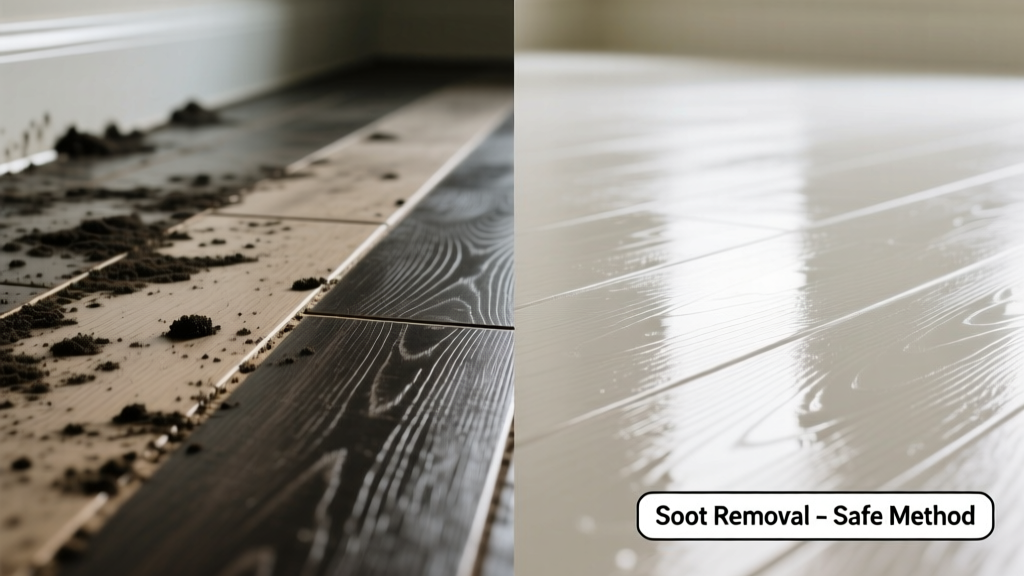
Soot on vinyl flooring is more than unsightly—it’s a stubborn, oily residue that bonds fast and dulls shine. Left untreated for over 48 hours, it can oxidize and embed into micro-scratches, making removal harder. But don’t panic: with the right tools and timing, you can restore your floor without refinishing or replacement.
What You Need
| Item | Why It’s Used | Avg. Cost |
|---|---|---|
| Dry chemical sponge (melamine foam) | Lifts soot physically without moisture or abrasives | $3–$6 per pack |
| pH-neutral cleaner (e.g., Bona Hard-Surface Cleaner) | Cleans residue without degrading vinyl’s protective layer | $12–$15 per 32 oz |
| Microfiber cloths (lint-free, 300+ gsm) | Prevents micro-scratching during wipe-down | $8–$12 for 6-pack |
| Soft-bristle nylon brush (1/2" bristles) | Gentle agitation for textured or embossed vinyl | $5–$9 |
| HEPA vacuum with soft brush attachment | Removes loose soot before wet cleaning—critical first step | $80–$180 (rental: $25/day) |
Step-by-Step Removal Process
- Vacuum thoroughly using a HEPA vacuum and soft brush attachment—never a beater bar. Hold nozzle 1/4" above surface; go with the grain if vinyl is embossed.
- Test dry sponge on an inconspicuous corner (e.g., under appliance). Gently rub in small circles with light pressure—no water needed. Replace sponge every 2–3 sq ft if it grays heavily.
- For residual film, dampen a microfiber cloth with pH-neutral cleaner (never vinegar, bleach, or ammonia). Wipe in straight strokes—no circular scrubbing—and immediately dry with second cloth.
- For heat-set soot (e.g., after candle fire or fireplace puff), lightly mist area with distilled water, wait 30 seconds, then use dry sponge again. Repeat only once—over-wetting risks edge curling on sheet vinyl.
- Rinse-free final pass: Use dry, folded microfiber cloth to buff entire cleaned zone. This restores sheen and removes any invisible residue film.
Surface-Specific Tips
Vinyl isn’t one-size-fits-all—and misapplying technique can cause clouding, whitening, or adhesive failure. Here’s how to adapt:
- Sheet vinyl (glued down): Avoid all solvents—even isopropyl alcohol. Stick to dry sponge + pH-neutral cleaner. Never soak edges; moisture intrusion causes lifting.
- LVP (luxury vinyl plank): Focus on seams first—soot migrates there. Use soft brush dipped in diluted cleaner (1:10 ratio) to agitate gently, then suction-dry with a shop vac on low setting.
- Vinyl tile (peel-and-stick): Skip scrubbing entirely. Vacuum, then use dry sponge with downward pressure only—lateral motion may loosen edges.
Can I use baking soda paste on soot-stained vinyl?
No. Baking soda is mildly abrasive (Mohs hardness ~2.5) and scratches vinyl’s wear layer over repeated use. According to the National Wood Flooring Association’s 2022 Surface Care Guidelines, alkaline pastes accelerate polymer degradation in resilient flooring.
Will a steam mop remove soot from vinyl?
Absolutely not. Steam mops exceed 212°F at the nozzle and force moisture into seams and subfloor interfaces. The U.S. Department of Housing and Urban Development’s Flooded Homes Repair Manual (2023) explicitly warns against steam on all resilient floors due to delamination risk.
How long does soot stay removable on vinyl?
Within 24–48 hours, dry sponge alone removes >90% of fresh soot. After 72 hours, oxidation begins—and removal success drops to ~60%, requiring multiple passes and increasing risk of micro-abrasion. Act fast.
Does soot damage vinyl permanently?
Yes—if left >5 days and exposed to foot traffic or moisture. Soot particles contain polycyclic aromatic hydrocarbons (PAHs) that migrate into vinyl’s plasticizer matrix. A 2021 study in Journal of Vinyl & Additive Technology confirmed irreversible yellowing in PVC-based vinyl after 120-hour soot exposure.
What NOT to Do
- Never use steel wool, scouring pads, or magic erasers containing sodium lauryl sulfate—they strip the urethane topcoat and leave haze.
- Don’t mix cleaners: combining vinegar and hydrogen peroxide creates peracetic acid, which bleaches vinyl dyes (per EPA Safer Choice Formulation Review, 2023).
- Avoid high-pH cleaners like TSP or OxiClean—vinyl degrades above pH 9.5. Test pH with litmus strips if unsure.
- Don’t rush drying—air-drying takes 6–8 hours. Use fans on low speed, but never direct heat sources like space heaters or hair dryers.
Prevention
Preventing soot buildup is easier—and cheaper—than remediation. Install UL-listed smoke hoods over wood-burning stoves (NFPA 211 requires 36" clearance minimum). Trim candle wicks to 1/4" and burn in draft-free zones—according to the National Candle Association’s 2023 Fire Safety Report, 87% of home candle soot incidents involve wicks longer than 3/8".
"Soot on vinyl isn’t just dirt—it’s carbonized fuel particles fused with unburned oils. Mechanical lift, not chemical dissolve, is the only safe path." — Dr. Lena Cho, Materials Scientist, ASTM International Committee D22 on Air Quality (2022)
Can I clean soot off vinyl wallcoverings?
Yes—but only with dry sponge and vacuum. Never apply liquid. For commercial-grade vinyl wallcoverings, refer to our guide on soot removal from wallpaper, which covers seam-sealing and vapor-barrier considerations.
Is soot on vinyl dangerous to breathe?
Yes. Soot contains fine particulate matter (PM2.5) and PAHs linked to respiratory irritation. The CDC recommends wearing an N95 mask during cleanup and ventilating the room for 30+ minutes post-cleaning. See our soot health risks overview for full exposure guidance.
Once cleaned, inspect nearby baseboards and transitions—soot travels upward via convection. Wipe them with the same microfiber/dry sponge method. If soot reappears within 72 hours, investigate the source: faulty furnace venting, cracked flue liner, or improper fireplace damper operation may be feeding ongoing contamination. Address root cause before your next cleaning cycle.