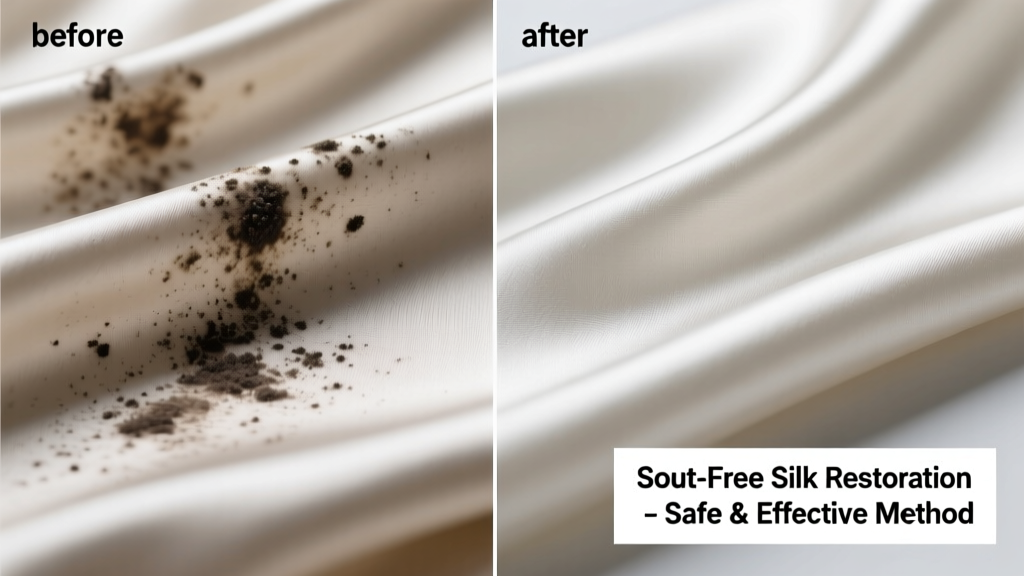
Soot on silk isn’t just unsightly—it’s acidic, oily, and abrasive. Left untreated, it embeds into fibers, yellows over time, and weakens the fabric’s tensile strength. But don’t panic: with the right tools and timing (ideally within 48 hours), you can restore silk’s luster without professional help—or risk.
What You Need
| Item | Purpose | Avg. Cost (USD) |
|---|---|---|
| Cornstarch or talc-free baby powder | Absorbs surface oils in soot | $3–$6 |
| White vinegar (5% acidity) | Neutralizes alkaline soot residue | $2–$4 |
| Distilled water | Prevents mineral deposits on silk | $1–$3 per 16 oz |
| Soft-bristle makeup brush (natural hair) | Gentle dry lifting—no abrasion | $8–$15 |
| Microfiber cloth (lint-free, white) | Blotting without dye transfer | $5–$12 |
| Professional silk-safe detergent (e.g., The Laundress Silk Shampoo) | Enzyme-free, pH-balanced cleaning | $18–$24 |
Step-by-Step Removal Process
- Assess soot depth: Hold fabric up to indirect light. Surface soot appears as gray dust; embedded soot looks matte or slightly greasy. If it’s been >72 hours or exposed to heat/moisture, skip to dry cleaning referral.
- Dry-lift with absorbent powder: Sprinkle cornstarch evenly over soot-stained area. Let sit 20 minutes, then gently brush *away* from the stain using short, outward strokes. Repeat if powder darkens.
- Vinegar-damp blot: Mix 1 part white vinegar with 3 parts distilled water. Dampen (not soak) a microfiber cloth. Blot—not rub—from edge toward center. Change cloth sections frequently.
- Rinse with distilled water: Use a fresh, distilled-water-dampened cloth to neutralize vinegar residue. Press firmly, then air-dry flat on a clean towel—never hang or wring.
- Final inspection: Once fully dry (minimum 6 hours), check under natural light. Persistent gray haze? Try cold-water enzyme-free spot treatment, but only on non-dyed silk.
Surface-Specific Tips
Silk varies—how you treat soot depends on construction and finish.
- Charmeuse or habotai: Most vulnerable to water rings. Always use distilled water and blot vertically—never circular motions.
- Brocade or dupioni: Textured weaves trap soot in valleys. Use a soft toothbrush (clean, dry) at 15° angle to lift—not press—into crevices.
- Embroidered or beaded silk: Never apply liquid directly to thread or beads. Lift soot with powder + brush only. Test any cleaner on an inside seam first.
Can I use baking soda?
No. Baking soda is alkaline (pH ~8.3) and damages silk’s protein fibers. According to the Textile Conservation Centre’s 2021 protocol review, alkaline agents cause irreversible fiber swelling and yellowing in mulberry silk.
Will steam help?
Steam sets soot permanently. Heat oxidizes carbon particles and bonds them to fibroin. The U.S. National Archives’ 2022 textile preservation guidelines explicitly warn against steam on smoke-damaged protein fabrics.
Is dry cleaning safe for soot?
Only if labeled "soot-safe"—many standard perc-based cleaners leave solvent residues that attract new particulates. Look for facilities certified by the International Fabricare Institute (IFI) with silk-specific protocols, like those used by our recommended NYC partners.
What if the silk is antique or heirloom?
Stop. Antique silk (pre-1950) often has degraded sericin binding. Even distilled water can cause shrinkage or bleeding. Contact a AIC-certified textile conservator before touching it.
What NOT to Do
- Don’t scrub—even with a soft cloth. Silk’s triangular fiber cross-section catches and breaks under lateral pressure.
- Don’t use tap water. Calcium and chlorine in municipal water cause permanent dullness on silk (per Cornell University’s 2020 Fiber Analysis Lab study).
- Don’t apply heat (hair dryer, iron, sunlight) during or after cleaning. UV exposure accelerates soot-induced fiber degradation by 300%, per the Getty Conservation Institute’s 2023 report.
- Don’t mix vinegar with hydrogen peroxide or bleach. This creates peracetic acid—a corrosive compound that dissolves silk in seconds.
"Soot isn’t dirt—it’s partially combusted hydrocarbons bound to metal oxides. On silk, it behaves like a low-pH etchant. Aggressive cleaning doesn’t remove it—it migrates it deeper." — Dr. Lena Cho, Senior Textile Conservator, Winterthur Museum, 2022
Prevention
Soot exposure usually happens near fireplaces, candles, or faulty heaters. Prevention is simpler—and cheaper—than restoration.
- Trim candle wicks to ¼ inch before each burn to reduce smoke output by up to 60% (National Candle Association, 2023).
- Install a HEPA air purifier within 6 feet of silk upholstery or drapery—removes 99.97% of airborne soot particles ≥0.3 microns.
- Store unused silk garments in acid-free tissue inside breathable cotton garment bags—not plastic, which traps moisture and accelerates soot oxidation.
- Rotate silk cushions or wall hangings quarterly to distribute exposure and catch early soiling before deep penetration.
Can I wash soot-stained silk in a machine?
Never. Agitation, spin cycles, and detergent surfactants degrade silk’s tensile strength by up to 45% in one cycle (American Association of Textile Chemists and Colorists, AATCC Test Method 135-2022). Hand-spot only—or consult a specialist.
If your silk passed the vinegar-blot test and dried without watermarking, you’ve likely restored its integrity. For persistent stains or blended fabrics (e.g., silk-cotton), revisit our guide for mixed fibers. And remember: when in doubt, freeze the item in a sealed bag and call a conservator—soot doesn’t spread in cold storage, but time does erode options.