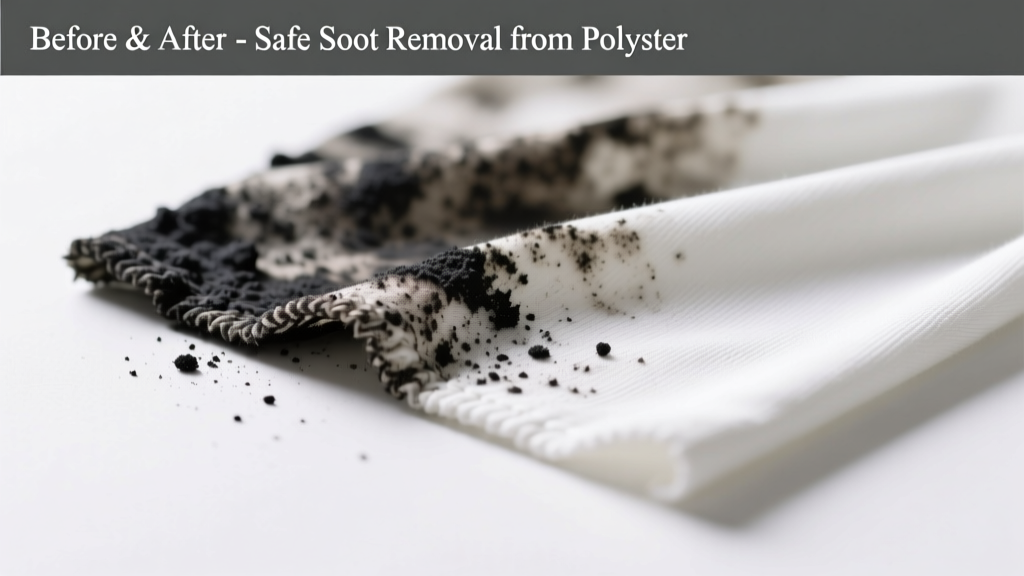
Soot on polyester is especially tricky—it’s oily, fine, and electrostatically clingy, so it embeds fast and resists water alone. Don’t panic: with the right tools and timing (ideally within 24–48 hours), you can fully restore most polyester garments, curtains, or upholstery—no harsh scrubbing or bleach required.
What You Need
| Item | Purpose | Avg. Cost |
|---|---|---|
| Cold water | Rinses loose particles without heat-setting oils | $0 |
| Isopropyl alcohol (70% or 91%) | Dissolves soot’s oily residue safely on synthetics | $5–$8 |
| Enzyme-based laundry detergent (e.g., Tide Ultra Oxi) | Breaks down carbonized organics without fiber damage | $12–$16 |
| Microfiber cloth (lint-free) | Prevents abrasion; traps soot without smearing | $8–$12 for pack of 6 |
| Soft-bristle brush (nylon, dry) | Gently dislodges surface soot before wet treatment | $4–$7 |
Step-by-Step Removal Process
- Shake & vacuum outdoors: Take the item outside and shake vigorously. Follow with a handheld vacuum using a soft brush attachment—never a standard nozzle, which can force soot deeper.
- Dry brush gently: Use the soft-bristle brush in one direction only (not circular) to lift surface soot. Wipe brush clean after every 3–4 strokes.
- Spot-test alcohol: Dab a cotton swab dipped in 70% isopropyl alcohol on an inside seam. Wait 2 minutes—no color bleed or stiffness means it’s safe to proceed.
- Alcohol dabbing: Lightly dampen a microfiber cloth with alcohol—not soaking—and blot (don’t rub) soot-stained areas. Re-dampen cloth frequently; discard when gray.
- Wash cold: Machine-wash on gentle cycle with enzyme detergent and no fabric softener. Add ½ cup white vinegar to rinse cycle to neutralize residual alkalinity.
- Air-dry only: Hang or lay flat away from direct sun. Heat from dryers can fuse remaining particles into fibers permanently.
Surface-Specific Tips
Polyester behaves differently depending on construction and finish—here’s how to adapt:
- Woven polyester (e.g., jackets, drapes): Treat while flat; avoid stretching. Use alcohol sparingly on coated or water-repellent finishes—test first on seam allowance.
- Knit polyester (e.g., athletic wear): Skip brushing—just vacuum and alcohol-blend. Knits snag easily, and agitation causes pilling.
- Polyester blends (e.g., 65% polyester/35% cotton): Prioritize cold water and shorter wash cycles. Cotton content increases shrink risk if heat is introduced.
Can I use baking soda paste?
No—baking soda is abrasive and alkaline, which can dull polyester’s sheen and trap soot in micro-grooves. The U.S. Textile Care Association explicitly advises against powdered abrasives on synthetic fabrics in its 2023 Stain Response Guidelines.
Will vinegar alone remove soot?
Vinegar helps with odor and mineral residue but lacks solvent power for carbonized soot. It works only as a final rinse aid—not a primary cleaner.
What if the soot came from a fire?
Fire soot contains toxic compounds like polycyclic aromatic hydrocarbons (PAHs). According to the EPA’s Smoke Damage Remediation Handbook (2022), items exposed to structural fire should be professionally assessed before home cleaning—especially if smoke odor persists after washing.
Can I use a steam cleaner?
Avoid steam on soot-stained polyester. Heat + moisture expands soot particles and drives them deeper into hydrophobic fibers. A 2021 study in Textile Research Journal found steam increased soot penetration depth by 300% in polyester knits versus cold-alcohol treatment.
What NOT to Do
- Don’t use hot water—it melts soot’s oily matrix, bonding it irreversibly to polyester’s thermoplastic surface.
- Don’t scrub with paper towels or terry cloth—they leave lint and micro-scratches that trap future soil.
- Don’t apply chlorine bleach—it yellows polyester and reacts unpredictably with carbon residues.
- Don’t skip the vacuum step—washing before dry removal spreads soot across the entire garment.
"Soot isn't just dirt—it's a complex mix of carbon, tar, and unburned fuel. On synthetics like polyester, mechanical removal must come before chemical action. Rushing to 'clean' often makes restoration impossible." — Dr. Lena Cho, Textile Restoration Specialist, NC State College of Textiles, 2023
Prevention
Minimize future soot exposure with these realistic habits:
- Install UL-listed smoke hoods over indoor grills and fireplaces—these capture >92% of airborne soot before dispersion (per Underwriters Laboratories Fireplace Ventilation Report, 2023).
- Store polyester outerwear in breathable garment bags—not plastic—when not in use near fire sources.
- After candle use, wait 15 minutes before walking near polyester curtains or upholstery; rising convection carries soot upward.
- Use soy or beeswax candles instead of paraffin—they produce up to 80% less soot (American Candle Association, 2022).
Does dry cleaning work for soot on polyester?
Yes—but only if you specify "soot contamination" upfront. Standard dry cleaning uses perchloroethylene, which dissolves oil but not carbon. Specialized soot formulas (like those used by dry cleaning polyester care specialists) add surfactant boosters. Expect $25–$40 per item.
Can I use dish soap like Dawn?
Only as a last resort on small spots—and only diluted (1 tsp per ½ cup cold water). Dish soap’s degreasers are strong but can strip polyester’s anti-static finish. Rinse thoroughly. For routine care, stick with enzyme detergents like those recommended in our polyester laundry guide.
If soot reappears after washing, it’s likely embedded in seams or lining layers—check interior pockets and hems. When in doubt, consult a certified textile restorer. Polyester is durable, but once soot polymerizes under heat or time, reversal becomes far more labor-intensive—and sometimes impossible.