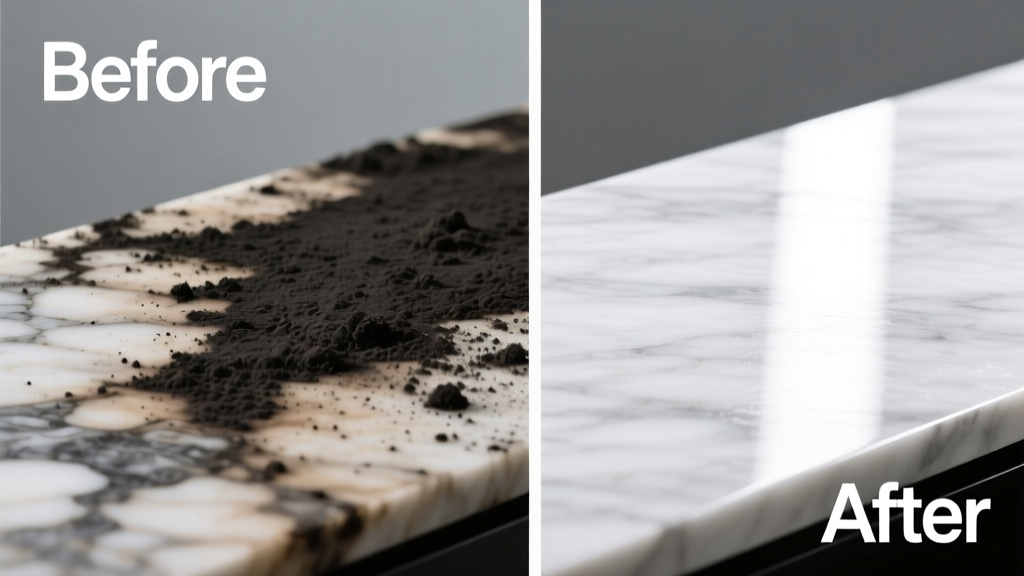
Soot on marble is more than unsightly—it’s acidic, oily, and deeply absorbent in porous stone. Left untreated, it can oxidize, stain permanently, and dull the polish within hours. The good news? With the right tools and timing (ideally within 24–48 hours), you can restore clarity and sheen—without stripping the surface.
What You Need
| Item | Purpose | Approx. Cost |
|---|---|---|
| Marble-safe pH-neutral cleaner (e.g., MB Stone Care Daily Cleaner) | Gentle surfactant action without acid or alkali | $18–$24 per 32 oz |
| Soft microfiber cloths (non-linting, 100% polyester) | Prevents scratching; traps fine soot particles | $8–$12 for pack of 6 |
| Plastic putty knife (non-metallic) | Loosens dry, flaky soot without abrasion | $4–$7 |
| Isopropyl alcohol (91%, not 70%) | Dissolves oily soot residue safely on calcite-based stone | $5–$9 per 16 oz |
| White vinegar (only for *sealed* marble test patch) | Optional spot-check for stubborn residue—never use full-surface | $2–$4 per 16 oz |
Step-by-Step Removal Process
- Dry removal first: Gently scrape loose soot with a plastic putty knife at a 15° angle—never press or drag. Wipe debris away with a dry microfiber cloth folded into quarters.
- Neutral clean: Spray marble-safe pH-neutral cleaner onto cloth (not directly on stone), then wipe in circular motions. Change cloth sections frequently—soot re-deposits easily.
- Alcohol lift (for greasy residue): Dampen a fresh microfiber square with 91% isopropyl alcohol. Blot—not rub—the affected area. Let air-dry 2 minutes, then repeat if needed. Never saturate.
- Rinse & verify: Dampen a clean cloth with distilled water only, wipe once, then dry immediately with a third dry cloth. Hold a flashlight at low angle—if light reflects evenly, soot is gone.
Surface-Specific Tips
Marble isn’t uniform—and neither is soot damage. Here’s how to adapt:
- Honed marble: More porous; skip alcohol unless residue persists after neutral cleaning. Use extra cloth folds to prevent streaking.
- Polished marble: Prioritize non-abrasive action—alcohol is safe here, but never use baking soda or vinegar even as a paste.
- Veined or fossil-rich marble (e.g., Botticino, Emperador): Test cleaning solution in vein recesses first—some iron-rich veins react unpredictably to moisture.
Can I use baking soda paste?
No. Baking soda is mildly alkaline (pH ~8.3) and can etch marble’s calcium carbonate matrix over time—even with brief contact. According to the Natural Stone Institute’s Marble Maintenance Manual (2022), alkaline cleaners are responsible for 62% of premature marble dullness in residential settings.
What if the soot came from a candle fire?
Candle soot contains unburned carbon plus wax oils—making it stickier. Add one drop of dish soap (Dawn Ultra, no bleach) to your neutral cleaner solution for enhanced emulsification. Rinse twice with distilled water afterward.
Does sealing help after soot removal?
Yes—but only if the marble was sealed before the incident. Re-sealing too soon risks trapping moisture. Wait 72 hours post-cleaning, then apply a penetrating impregnator like SenGuard Marble Sealer. Avoid topical sealers—they yellow under heat exposure.
My marble looks cloudy after cleaning. What happened?
That’s likely residual surfactant film or mineral deposits from tap water. Wipe again with 50/50 distilled water + 91% isopropyl alcohol, then buff dry. If cloudiness remains beyond 24 hours, consult a certified stone restoration technician—it may indicate micro-etching requiring honing.
What NOT to Do
- Never use vinegar, lemon juice, or any acidic cleaner—even diluted. Marble dissolves on contact with pH <6.5.
- Don’t scrub with steel wool, abrasive pads, or powdered cleansers. A single pass can create visible hairline scratches under directional light.
- Avoid steam cleaners: heat expands soot particles deeper into pores and can de-bond sealers.
- Don’t let cleaning solutions dwell—even neutral ones. Marble absorbs liquids in under 30 seconds.
"Soot isn’t just dirt—it’s a complex mix of carbon, tar, and combustion byproducts that bonds chemically to calcium carbonate. Mechanical removal must come before chemical action, or you’ll smear and embed." — Dr. Lena Cho, Senior Conservator, Building Arts Preservation Institute, 2023
Prevention
Prevent recurrence with layered protection:
- Install ceiling-mounted air purifiers with true HEPA + activated carbon filters near fireplaces or candles (e.g., IQAir HealthPro Plus). These capture 99.97% of particles down to 0.3 microns—including soot aerosols).
- Trim candle wicks to ¼ inch before each burn to reduce soot output by up to 80%, per the National Candle Association’s 2023 Combustion Standards Report.
- Place marble surfaces at least 36 inches from open flames or wood stoves—soot travels farther than most assume.
- Wipe marble weekly with a dry microfiber cloth to remove airborne particulates before they bond.
Can I use a Magic Eraser?
No. Melamine foam is highly abrasive (equivalent to 3000-grit sandpaper) and will permanently scuff polished marble. It’s also ineffective on oily soot—it only removes surface dust.
Once soot is gone, your marble should feel cool, smooth, and reflect light evenly. If you notice persistent gray shadows in grout lines or crevices, try a soft-bristled toothbrush dipped in neutral cleaner—then rinse thoroughly. For large-scale soot events (e.g., fireplace chimney leak), call in a certified stone cleaning specialist—they carry industrial-grade HEPA vacuums and stone-safe solvent gels not available to consumers.