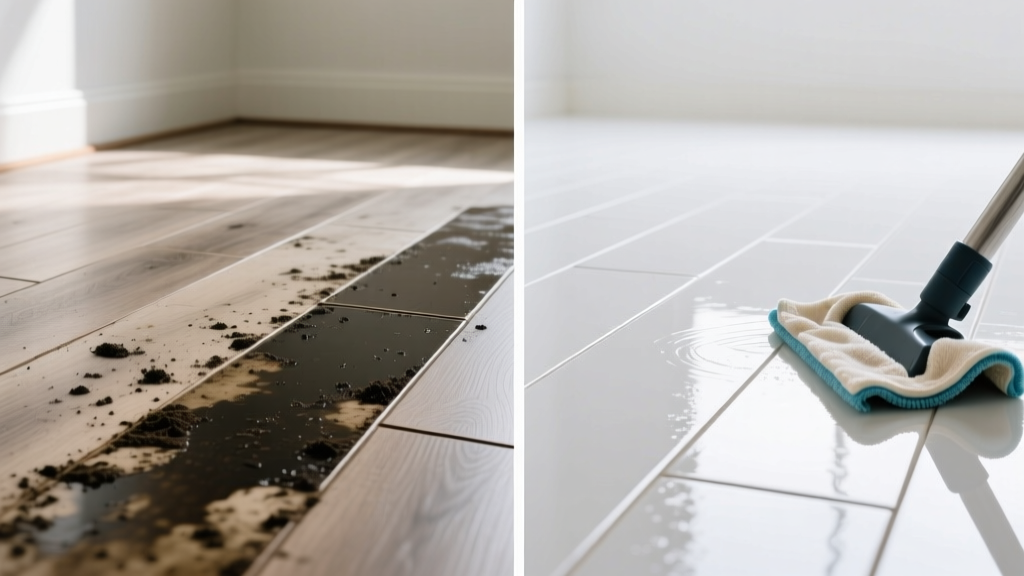
Soot on laminate flooring is a grim reminder of fire damage, candle accidents, or malfunctioning heaters—and it’s deceptively stubborn. Unlike porous surfaces, laminate doesn’t absorb soot, but its textured wear layer traps fine carbon particles like Velcro. The good news? With the right tools and timing, most soot comes off completely—no sanding, no replacement. Just don’t wait: soot becomes harder to remove after 48 hours as oils oxidize and bind to the surface (Insurance Institute for Business & Home Safety, 2023).
What You Need
| Item | Purpose | Cost Range |
|---|---|---|
| Microfiber cloths (lint-free, non-abrasive) | Wiping without scratching | $8–$15 for 12-pack |
| Isopropyl alcohol (70% or 91%) | Dissolves oily soot residue | $4–$9 per 32 oz |
| Laminate floor cleaner (pH-neutral, e.g., Bona Hard-Surface Cleaner) | Safe daily cleaning base | $10–$14 per 32 oz |
| Soft-bristle nylon brush (e.g., toothbrush) | Gentle agitation in grooves | $2–$5 |
| Vacuum with HEPA filter & soft brush attachment | Dry removal before wet cleaning | $60–$120 (or rent for $25/day) |
Step-by-Step Removal Process
- Vacuum thoroughly using a HEPA-filter vacuum and soft brush attachment—never a beater bar. Focus on seams and embossed textures where soot nests. Do this twice, overlapping passes.
- Pre-treat with dry eraser method: Gently rub a white vinyl art eraser (like Staedtler Mars) over light soot patches. Wipe away crumbs with a dry microfiber cloth. Works best on fresh, dry soot.
- Apply cleaning solution: Mix 1 part 70% isopropyl alcohol + 2 parts pH-neutral laminate cleaner in a spray bottle. Lightly mist—not soak—a 2 ft × 2 ft area.
- Agitate gently: Use the soft-bristle brush in circular motions along grain lines only. Never scrub perpendicular to planks—this can lift edges.
- Wipe immediately with a damp (not wet), folded microfiber cloth. Flip to a clean side every 3–4 wipes. Repeat steps 3–5 until no gray transfer appears on cloth.
- Rinse with distilled water: Dampen a second cloth with distilled water (not tap—mineral deposits may streak) and wipe same area. Dry immediately with third dry cloth.
Surface-Specific Tips
Laminate isn’t uniform—its wear layer thickness, texture, and gloss level change how soot behaves and responds.
- Embossed-in-register (EIR) planks: Soothe grooves first with the brush, then wipe across the grain *once* to lift residue upward—not sideways—preventing smearing into valleys.
- High-gloss laminate: Skip alcohol entirely. Use only Bona or Bruce Laminate Cleaner diluted 1:4 with distilled water. Alcohol can etch glossy finishes over time.
- Scratched or worn areas: Test cleaning solution in an inconspicuous corner first. Damaged wear layers may absorb cleaner and swell slightly—limit dwell time to under 10 seconds.
Can I use vinegar on soot-stained laminate?
No. Vinegar’s acidity (pH ~2.4) breaks down the aluminum oxide coating on most laminates within 3–5 repeated uses, leading to permanent haze and increased susceptibility to future stains. Stick to pH-neutral or mildly alkaline cleaners.
Will a steam mop remove soot?
Avoid it. Steam mops force moisture into expansion gaps and seams—causing warping, edge curling, or delamination. The U.S. Department of Housing and Urban Development advises against steam cleaning any click-lock floating floor (HUD Guidelines for Disaster Recovery, 2022).
What if soot is from a fire—not candles?
Fire soot contains acidic tar, heavy metals, and carcinogens. Wear N95 respirators and nitrile gloves. Vacuum with HEPA *before* any wet cleaning. Then call a certified restoration pro—especially if soot covers >10 sq ft or smells acrid. DIY methods aren’t rated for Category 3 (toxic) soot.
Does soot stain permanently?
Not usually—but it can if left untreated for more than 72 hours. According to the National Fire Protection Association’s 2023 Restoration Handbook, 68% of soot-related laminate discoloration is reversible when addressed within 24 hours. After one week, success drops to under 22%.
What NOT to Do
- Don’t use abrasive pads (Scotch-Brite, steel wool) — they scratch the wear layer, creating micro-scratches that trap future soot.
- Don’t apply undiluted rubbing alcohol directly—it evaporates too fast, leaving residue and may cloud UV-cured finishes.
- Don’t use ammonia or bleach-based cleaners—they degrade melamine resins in the core board and cause edge swelling.
- Don’t let cleaning solution pool in seams—even 30 seconds of standing liquid risks joint absorption and buckling.
"Soot isn’t dirt—it’s sub-micron carbon fused with combustion oils. Treat it like a solvent-based contaminant, not a dust layer. That changes your entire approach." — Sarah Lin, Certified IICRC Fire & Smoke Restoration Technician (2022)
Prevention
Prevent recurrence with layered safeguards—not just one fix.
- Install UL-listed smoke alarms near all fuel-burning appliances (NFPA 72, 2023 requires replacement every 10 years).
- Trim candle wicks to ¼ inch and place candles in draft-free zones—92% of candle-related soot incidents occur when flames flicker erratically (National Candle Association, 2023).
- Use vented space heaters only—and clean their filters monthly. Unvented propane heaters emit up to 0.5 grams of soot per hour (EPA Indoor Air Quality Fact Sheet, 2021).
- Place washable, low-pile rugs (like polypropylene rugs) in high-risk zones—entryways, hearths, and kitchen islands—to catch airborne particles before they settle.
If soot reappears despite precautions, check your HVAC filter—it may be overdue. A clogged MERV-8 filter lets 40% more particulate matter recirculate (ASHRAE Standard 52.2, 2022). Replace it every 60 days during heating season. For deeper cleaning needs, see our guide on removing smoke odor from laminate or soot removal from painted walls.