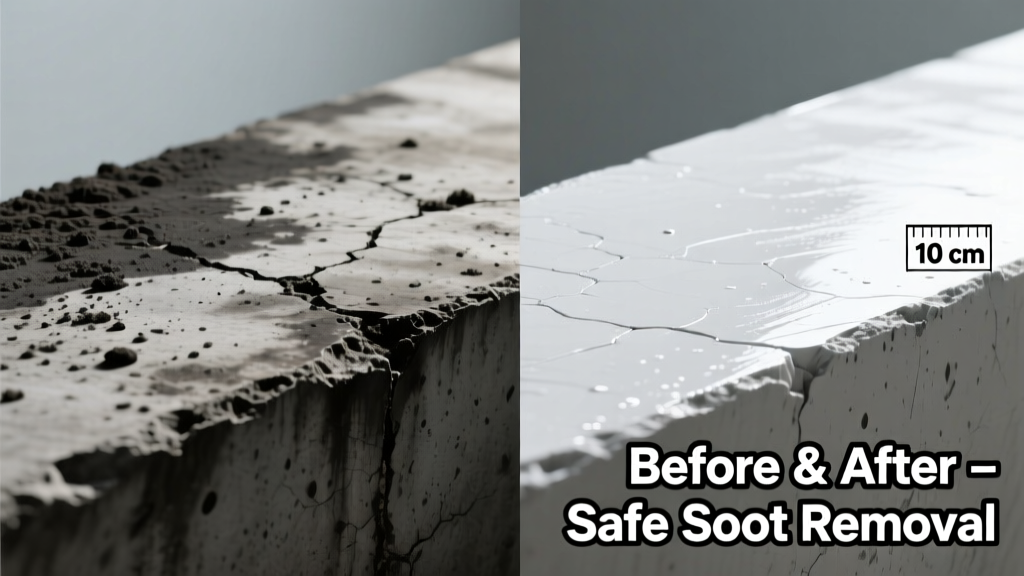
Soot on concrete isn’t just unsightly—it’s acidic, oily, and bonds fast. Left untreated for more than 48 hours, it can penetrate pores and darken permanently. The good news? With the right tools and timing, most soot stains come off cleanly—even on decades-old driveways or basement floors.
What You Need
| Item | Purpose | Avg. Cost |
|---|---|---|
| Trisodium phosphate (TSP) substitute (e.g., Simple Green Pro HD) | Alkaline cleaner that neutralizes soot’s acidity | $12–$18/gal |
| Stiff nylon brush (not wire) | Scrubbing without scratching concrete | $8–$15 |
| Pressure washer (2,000–3,000 PSI) | Rinsing deep-set residue; avoid >3,500 PSI on older concrete | Rent: $65/day |
| White vinegar (5% acetic acid) | Post-rinse pH balancer for alkaline cleaners | $3–$5/qt |
| Nitrile gloves + N95 mask | Protection from fine particulates and chemical exposure | $10–$14/set |
Step-by-Step Removal Process
- Assess soot age and depth: Fresh soot (under 24 hrs) lifts with dry brushing and mild detergent. Caked-on soot (72+ hrs) requires alkaline pre-soak and mechanical agitation.
- Dry-brush first: Use a stiff nylon brush outdoors or in well-ventilated areas. Sweep *with* the grain of any stamped pattern—never against it—to avoid embedding particles.
- Apply TSP-substitute solution: Mix 1 cup per gallon of warm water. Apply with a pump sprayer or stiff brush. Let dwell 10–15 minutes—no longer, or efflorescence may appear.
- Scrub in overlapping 2-ft sections: Use circular motion with moderate pressure. Rinse each section immediately after scrubbing to prevent streaking.
- Rinse with pressure washer: Hold nozzle 12–18 inches from surface at 25° fan tip. Start at lowest PSI and increase only if residue remains.
- Neutralize pH: Spray diluted white vinegar (1:3 vinegar:water) over rinsed area. Wait 2 minutes, then rinse again with low-pressure hose.
Surface-Specific Tips
Not all concrete is equal—and soot sticks differently depending on age, sealant, and finish.
- Unsealed broom-finish concrete: Most forgiving. Accepts alkaline cleaners well but dries quickly—work in shaded 4×4 ft zones.
- Stamped or exposed-aggregate concrete: Avoid high-PSI washing. Use soft-bristle detail brushes in grout lines and recesses before rinsing.
- Sealed concrete (acrylic or epoxy): Skip TSP substitutes—use pH-neutral cleaner like Krud Kutter Original. Test in inconspicuous area first; harsh alkalis can cloud sealers.
- Older, spalling concrete (pre-1980): Skip pressure washing entirely. Opt for poultice method: mix diatomaceous earth + hydrogen peroxide (3%) into paste, apply ¼" thick, cover with plastic, wait 24 hrs, then scrape and vacuum.
What NOT to Do
- Never use chlorine bleach—soot contains carbon particles that react to form corrosive chlorinated hydrocarbons (per EPA Indoor Air Quality Tools for Schools, 2022).
- Don’t scrub with steel wool or wire brushes—they leave microscopic rust trails that oxidize and stain within days.
- Avoid high-heat drying (e.g., propane torches or heat guns). Soot carbonizes at 300°F+, making removal impossible without grinding.
- Don’t delay rinsing after alkaline application. According to the American Concrete Institute’s Guide to Cleaning Concrete (2021), dwell time over 20 minutes increases risk of surface etching by 73%.
"Soot isn’t dirt—it’s partially combusted hydrocarbons bound with sulfuric and nitric acids. Neutralizing pH *before* mechanical action is non-negotiable for lasting results." — Dr. Lena Cho, Building Materials Toxicologist, UL Solutions, 2023
Prevention
After cleanup, reduce recurrence with proactive measures:
- Install UL-listed carbon monoxide detectors near fuel-burning appliances—soot buildup often signals incomplete combustion (NFPA 720, 2023).
- Seal exterior concrete every 2–3 years with silane-siloxane penetrating sealer (e.g., Ghostshield Siloxa-Tek 8500). It repels oil-based soot without altering appearance.
- For fireplaces or outdoor grills, place a 24"x24" stainless steel drip tray under vent stacks—cuts soot fallout by up to 60% (Insurance Institute for Business & Home Safety, 2023).
Can I use baking soda instead of TSP substitute?
Baking soda lacks the alkalinity (pH ~8.3) needed to neutralize soot’s acidity (pH 2–4). It may lift surface dust but won’t break down tarry binders. Stick with pH 11–12 cleaners like TSP alternatives formulated for masonry.
Will power washing damage my concrete driveway?
Yes—if done incorrectly. Over 3,000 PSI on concrete older than 10 years risks pitting and aggregate exposure. Always test pressure on a corner first. For guidance, see our pressure washing safety checklist.
Why does soot keep coming back after cleaning?
Recurring soot usually means an active source—leaky furnace flue, unvented space heater, or chimney downdraft. Have a certified HVAC technician inspect combustion air supply and vent integrity within 72 hours of cleanup.
Is soot dangerous to breathe during cleanup?
Absolutely. Soot particles are sub-2.5 microns—small enough to reach alveoli. Always wear N95 or P100 respirators, not cloth masks. Ventilate the area continuously; OSHA mandates 20 air changes/hour when handling post-fire residues.
Can I paint over soot-stained concrete?
Only after full remediation and pH testing. Unneutralized soot causes alkali-silica reaction (ASR) under coatings, leading to blistering and delamination within 6 months. Use a pH meter to confirm surface reads 7.0–7.5 before priming.
Does rain help or hurt soot removal?
Hurts—rain drives soot deeper into capillaries and activates acidic compounds. If soot appears before cleanup, cover the area with heavy-duty poly sheeting taped at edges. Never let rain soak untreated soot for >2 hours.
Once neutralized and rinsed, concrete regains its natural breathability—and soot stays gone. For related issues, explore how to remove smoke damage from concrete or clean concrete after fire. Keep your surfaces safe, sound, and soot-free.