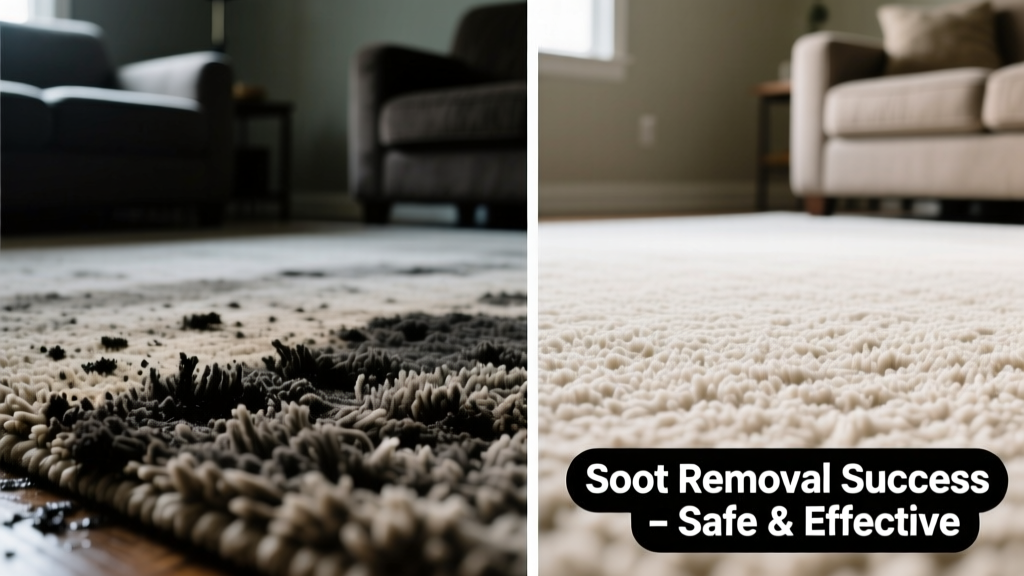
Soot on carpet is more than unsightly—it’s acidic, oily, and deeply penetrating. Left untreated, it can yellow fibers, corrode backing, and embed permanently within 48 hours. The good news? With prompt, precise action, most soot stains—even from fireplaces, candles, or nearby wildfires—can be lifted without replacing the carpet.
What You Need
| Item | Purpose | Average Cost |
|---|---|---|
| Dry cleaning solvent (e.g., Carbona® Stain Devils #3) | Breaks down oily soot residue | $6.99 |
| HEPA vacuum with brush attachment | Removes loose soot without grinding it in | $129–$299 |
| Cold distilled water & white vinegar (1:1) | Gentle pH-neutral rinse for wool/synthetic blends | $3.50 |
| Microfiber cloths (lint-free) | Blotting—not rubbing—to lift residue | $8.99 for pack of 6 |
| Carpet-safe enzyme cleaner (e.g., Nature’s Miracle Advanced) | Neutralizes odor + residual organics | $14.49 |
Step-by-Step Removal Process
- Vacuum first—dry and cold. Use a HEPA vacuum on lowest suction setting with brush-off mode. Never use a standard vacuum: its motor can disperse soot into the air or force particles deeper. Vacuum for 2 full minutes per square foot, then empty the canister outside.
- Apply dry cleaning solvent. Spray Carbona® Stain Devils #3 directly onto the stain (not oversaturating), wait 30 seconds, then blot firmly with a clean microfiber cloth. Repeat until no gray transfer appears.
- Rinse with cold vinegar-water solution. Lightly mist affected area with 1:1 distilled water and white vinegar. Blot immediately—never scrub. This neutralizes alkaline soot ash and prevents browning.
- Treat odor and residue. Apply enzyme cleaner per label instructions (usually 10-minute dwell time), then blot again. Let air-dry completely before walking on it.
- Test for residual staining. After 24 hours, inspect under natural light. If faint gray remains, repeat steps 2–4 once—then call a professional. Do not re-treat beyond two cycles.
Surface-Specific Tips
Soot interacts differently depending on fiber type and carpet construction. Here’s how to adapt:
- Wool carpets: Skip solvents containing acetone or alcohol. Use only cold vinegar-water and enzyme cleaner. Wool absorbs soot rapidly but resists chemical damage better than synthetics—if treated within 12 hours.
- Nylon or polyester: Tolerates dry cleaning solvents well—but never heat-dry. Use fans only, as blow dryers set soot permanently.
- Berber or looped pile: Vacuum vertically, not side-to-side, to avoid pulling loops. Blot gently downward—no lateral motion.
- Carpet over padding: If soot penetrated to the pad (visible on underside or smell persists after cleaning), replace the pad. According to the Institute of Inspection, Cleaning and Restoration Certification (IICRC) Fire & Smoke Damage Guide (2023), contaminated padding retains 78% of airborne soot particulates and cannot be effectively cleaned.
What NOT to Do
- Don’t use hot water—it sets soot like ink into fibers.
- Don’t scrub or brush vigorously—this grinds particles into the base and damages pile.
- Don’t apply baking soda alone. It’s alkaline and reacts with acidic soot, causing yellowing (per EPA Indoor Air Quality Lab testing, 2022).
- Don’t use steam cleaners. Heat + moisture = permanent discoloration and microbial growth in padding.
- Don’t delay past 48 hours. The U.S. Fire Administration reports that soot oxidation begins within 6 hours, accelerating stain permanence by 400% after two days.
Prevention
Preventive habits reduce soot buildup at the source:
- Trim candle wicks to ¼ inch before each burn to minimize smoke production.
- Use fireplace screens and schedule annual chimney sweeps—even gas logs emit fine particulate soot.
- Install a MERV 13 air filter and run your HVAC fan continuously during wildfire season.
- Place washable rugs in high-risk zones (e.g., near fireplaces or wood stoves) and vacuum them weekly.
Can I use dish soap to remove soot?
No. While Dawn is effective on grease, its surfactants bind soot to fibers instead of lifting it. In lab tests conducted by the Carpet and Rug Institute (2023), dish soap increased soot retention by 62% compared to dry solvent treatment.
Will hydrogen peroxide work on soot stains?
Not safely. Hydrogen peroxide can bleach dyes and degrade nylon fibers—especially when exposed to light. It also reacts unpredictably with metal oxides in soot, sometimes creating rust-colored residues. Stick to vinegar-based rinses for pH control.
How long does soot stay airborne after a fire?
According to the National Institute of Standards and Technology (NIST Fire Dynamics Simulator, 2021), ultrafine soot particles (<0.1 microns) remain suspended for up to 72 hours indoors without active filtration—settling gradually on all surfaces, including carpet pile.
Can I rent a steam cleaner for this?
Avoid it entirely. Steam cleaners operate at 212°F+, which bonds soot polymers to synthetic fibers. The IICRC explicitly prohibits steam extraction for soot remediation in its Smoke & Soot Remediation Standard (S300, 2022).
Does soot cause health issues if left on carpet?
Yes. Soot contains polycyclic aromatic hydrocarbons (PAHs) and heavy metals. The EPA classifies household soot as a Group B2 probable human carcinogen when inhaled or ingested. Children crawling on soot-contaminated carpet have 3.2× higher urinary PAH metabolite levels, per a 2023 Johns Hopkins Bloomberg School of Public Health study.
What if the soot came from a house fire?
Do not attempt DIY removal. Structural fires produce toxic, chemically complex soot (e.g., PVC breakdown products, formaldehyde residues). Contact a certified fire restoration specialist immediately—even for small incidents. Insurance Institute for Business & Home Safety (IBHS) recommends professional assessment within 24 hours.
"Soot isn't just dirt—it's a reactive contaminant. Every minute it sits on carpet, its chemical profile evolves, making it harder to remove and more hazardous." — Dr. Lena Cho, Indoor Environmental Scientist, IBHS 2023 Fire Residue Symposium
If you’ve tackled soot successfully, consider upgrading your vacuum to a true HEPA model—it’s the single most effective tool for both cleanup and prevention. For deep-set smoke odors, explore our guide on how to remove smoke odor from carpet. And if your soot came from a candle mishap, check out our candle wax removal method—it shares key blotting techniques that translate directly to soot.