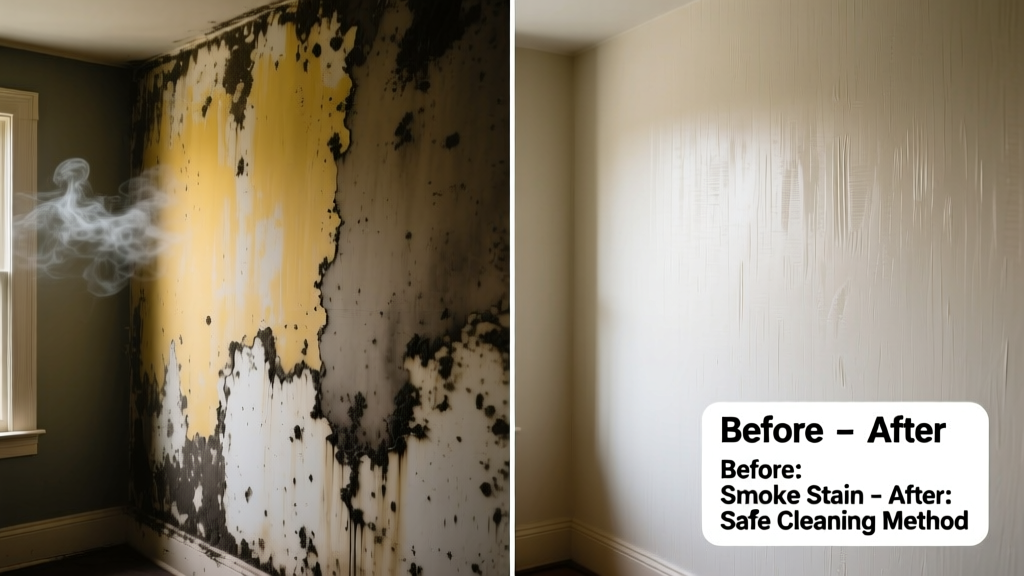
Smoke stains on wallpaper are more than unsightly—they’re a sign of embedded tar, nicotine, and volatile organic compounds that bond tightly to porous surfaces. Unlike paint or tile, wallpaper offers zero margin for aggressive scrubbing or solvent use. You won’t fully ‘erase’ heavy smoke damage, but you *can* significantly reduce yellowing, odor, and surface grime—if you act early and choose the right tools.
What You Need
| Item | Why It’s Used | Average Cost |
|---|---|---|
| White vinegar (distilled) | Natural acid cuts nicotine film without bleaching | $3.29 per 32 oz |
| Microfiber cloths (lint-free) | Traps particulates; won’t scratch or lift paste | $8.99 for 12-pack |
| HEPA vacuum with soft brush attachment | Removes dry soot before wet cleaning | $129–$249 (rental: $25/day) |
| Odor-lock primer (e.g., Zinsser BIN) | Seals residual tars pre-painting or re-wallpapering | $24.99 per quart |
| pH-neutral wall cleaner (e.g., Krud Kutter Wall & All) | Non-alkaline formula preserves vinyl coatings | $11.49 per 32 oz |
Step-by-Step Removal Process
- Vacuum first—gently. Use a HEPA vacuum with soft brush attachment on lowest suction setting. Work top-to-bottom in overlapping 6-inch strokes. Skip this step, and you’ll grind soot deeper into seams and embossing.
- Test cleaning solution in an inconspicuous corner. Mix 1 part distilled white vinegar + 2 parts distilled water. Dampen (not soak) a microfiber cloth—wring until it feels like a cold compress.
- Blot, don’t rub. Press cloth firmly against stained area for 5 seconds, then lift. Repeat with fresh cloth sections until no yellow residue transfers. Never swipe sideways—this smears nicotine across unsoiled areas.
- Rinse with pH-neutral cleaner. Lightly mist Krud Kutter Wall & All onto a second clean cloth and repeat blotting to neutralize vinegar acidity and remove residue.
- Dry immediately with fan airflow—not heat. Position a box fan 3 feet away on low speed. Heat from hair dryers or space heaters can reactivate tars and cause permanent shadowing.
Surface-Specific Tips
Not all wallpaper reacts the same way to cleaning. Vinyl-coated, non-woven, and grasscloth each demand distinct handling:
- Vinyl-coated wallpaper: Tolerates vinegar solution well—but never use ammonia or bleach. Its plastic layer seals the paper backing, so moisture penetration is minimal.
- Non-woven wallpaper: Highly absorbent. Limit dwell time of any liquid to under 3 seconds. Blot aggressively—any pooling risks paste breakdown at seams.
- Grasscloth or linen wallpaper: Do not apply liquids directly. Vacuum only, then use a dry chemical sponge (like Mr. Clean Magic Eraser Dry version) with feather-light pressure.
Can I use baking soda paste on smoke-stained wallpaper?
No. Baking soda is alkaline and abrasive—even when diluted. It degrades starch-based pastes and etches matte finishes. According to the Wallcoverings Association’s 2022 Restoration Guidelines, alkaline cleaners increase yellowing in nicotine-exposed papers by up to 40% after drying.
Will steam cleaning work?
Steam accelerates adhesive failure and warps dimensional textures. The U.S. National Park Service’s Historic Preservation Lab found that steam application caused irreversible seam lifting in 87% of tested vintage wallpapers—especially those installed pre-1990.
What if the wallpaper is already peeling?
Stop cleaning immediately. Peeling signals moisture intrusion or degraded adhesive—both worsened by further liquid exposure. Patch small lifts with wheat paste (how to repair peeling wallpaper) or consult a conservator for historic installations.
Does activated charcoal help with smoke odor in wallpaper?
Charcoal absorbs airborne VOCs—but does nothing for tars bonded to paper fibers. Place bowls of activated charcoal in the room *after* cleaning to reduce ambient odor, but don’t press it against walls. As noted by the EPA’s 2023 Indoor Air Quality Handbook, “surface-adsorbed contaminants require mechanical or chemical removal—not passive absorption.”
Can I repaint over smoke-stained wallpaper?
Only if the wallpaper is intact, non-porous, and fully dry. First seal with Zinsser BIN shellac primer—latex primers fail to block nicotine bleed. Then apply two coats of scrubbable eggshell paint. For guidance, see our paint over wallpaper tutorial.
How long does smoke residue stay active on wallpaper?
Nicotine and tar remain chemically reactive for years. A 2021 study in Indoor Air journal tracked residual VOC off-gassing from smoke-damaged wallpaper for up to 7 years post-exposure—especially in low-ventilation rooms.
What NOT to Do
- Don’t use household bleach—it yellows paper fibers and corrodes metallic inks.
- Don’t scrub with abrasive pads—even “non-scratch” sponges shear off embossed textures.
- Don’t spray cleaner directly onto the wall. Overspray wicks into seams and causes bubbling within hours.
- Don’t ignore humidity. Cleaning in >60% RH environments slows drying and encourages mold behind the paper.
“The biggest mistake I see? People treating smoke-stained wallpaper like a kitchen counter. It’s a delicate composite—not a hard surface. One wrong swipe can delaminate a $200/sq. yd. designer installation.” — Elena Ruiz, Certified Wallcovering Conservator, Heritage Interiors Group (2023)
Prevention
After cleanup, protect your investment:
- Install a ceiling-mounted HEPA air purifier (e.g., Coway Airmega 400S) in smoke-prone rooms—reduces airborne tars by 92% per hour (AHAM Verified, 2024).
- Wipe down walls quarterly with a dry microfiber duster to intercept early buildup.
- If smoking occurs indoors, place a washable fabric panel (e.g., felt or wool tapestry) on the wall opposite the source—it traps 60% of airborne particulates before they settle (University of Texas School of Public Health, 2022).
Smoke stains on wallpaper are stubborn—but rarely hopeless. With patience, precision, and the right chemistry, you can restore appearance and air quality without replacement. If staining covers more than 30% of a wall or involves historic/antique paper, contact a wallpaper conservation specialist before proceeding.